
Business & Economy
NCDMB webinar unlocks AfCFTA market access for energy sector….. provides roadmap to $3.4tn continental market

By David Owei,Bayelsa
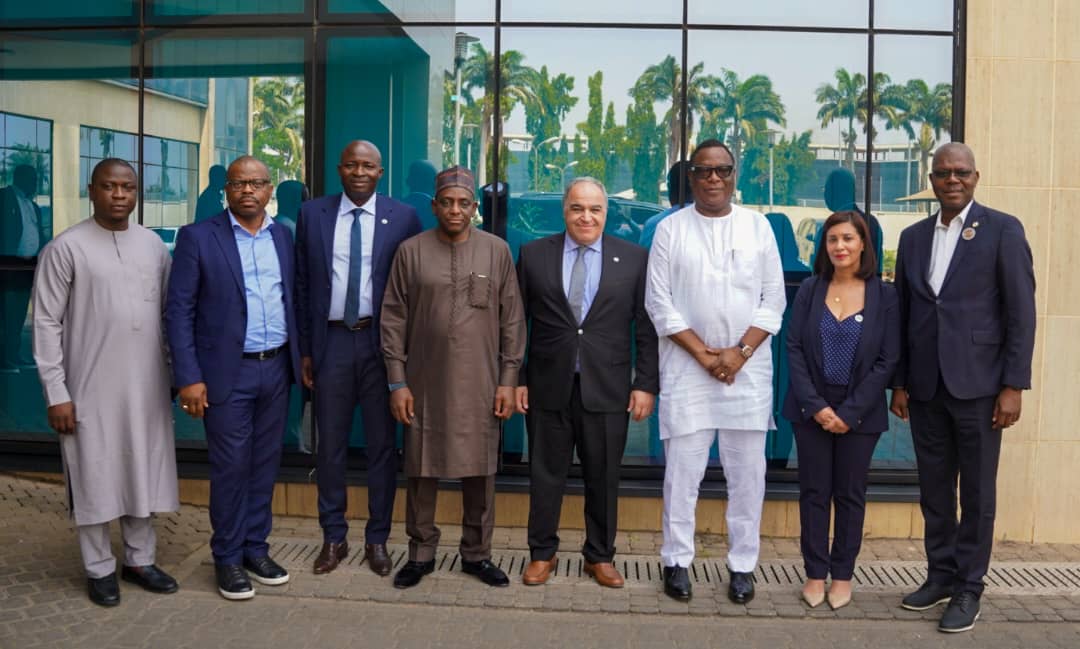
The Nigerian Content Development and Monitoring Board has outlined a practical framework for positioning Nigeria’s energy sector to access the African Continental Free Trade Area, following a strategic webinar focused on meeting rules-of-origin requirements for continental trade. The Board held a pre-conference webinar on Wednesday ahead of the Nigeria Local Content AfCFTA Energy Summit scheduled for Monday, February 9, 2026. The engagement was attended by stakeholders from the oil and gas, power and renewable energy sectors, and they addressed how Nigerian products and services can qualify for preferential market access across 54 African countries with a combined gross domestic product of $3.4tn and a population of about 1.4 billion people.Entitled ‘Meeting AfCFTA Origin Requirements in Energy Trade’, the webinar focussed on one of the major barriers facing Nigerian exporters under AfCFTA — structuring production and operations to meet origin requirements that determine eligibility for duty-free and preferential trade.The initiative was supported by the Executive Secretary of NCDMB, Engr. Felix Omatsola Ogbe, and the Acting Director of Planning, Research and Statistics, Mr. Ene Ette, as part of preparations for the forthcoming Nigeria Local Content AfCFTA Energy Summit, with the theme ‘Unlocking Africa’s Energy Future through AfCFTA: Trade, Innovation and Regional Integration’.Speaking during the session, a communications analyst, Joseph Nwokedi, representing the Acting National Coordinator of Nigeria’s AfCFTA Coordination Office, Mrs Patience Okala, stressed the central role of energy in Africa’s economic integration under AfCFTA. He urged Nigerian companies to shift their focus from Nigeria’s domestic market of about 200m people to the wider continental market of 1.4bn consumers. “Without energy, there’s no industrialisation. Without energy, regional value chains remain aspirational,” Nwokedi said. “With AfCFTA, energy transforms from a domestic infrastructure issue into a tradable, investable and exportable sector within an integrated African market.”He noted that even one per cent penetration of the African market translates to about 14m consumers, underscoring the scale of opportunity available to Nigerian energy firms. The webinar identified four key pathways through which Nigeria’s energy sector can participate in AfCFTA-enabled trade. First, Nigeria’s Electricity Act of 2023 allows independent power producers to supply electricity directly to industrial clusters and export processing zones, positioning power generation as a foundation for trade-ready manufacturing. Second, the country has submitted commitments under AfCFTA that enable professionals such as engineers, electricians, geophysicists and energy auditors to export services across Africa, subject to mutual recognition of qualifications. Third, refined petroleum products, gas derivatives, electricity and renewable energy components can be traded across borders under preferential tariffs, provided they meet AfCFTA rules of origin.Fourth, AfCFTA’s investment protocol, combined with recent domestic reforms, including the Presidential Directives on Investment Incentives for 2024–2025, strengthens Nigeria’s credibility for attracting cross-border investments in power generation, transmission, renewable energy and storage infrastructure. Delivering a technical presentation, Assistant Comptroller of Customs, Burhan Sulaiman, explained that AfCFTA would eliminate tariffs on 90 per cent of goods traded within the bloc over five to 10 years, with an additional seven per cent liberalised over 13 years. However, he stressed that these benefits were conditional on meeting origin requirements. “Companies lose benefits because origin was treated as an afterthought,” Sulaiman said. “You must build in origin compliance from the beginning, not while already running your project. Origin determines whether you export duty-free or pay full tariffs.” He clarified that origin is determined by where economic production takes place, not by company ownership or registration. Foreign-owned companies producing in Nigeria can export as Nigerian origin, while Nigerian companies importing finished goods cannot claim AfCFTA preferences. Sulaiman explained that products qualify for preferential access through two routes. “Wholly obtained” goods are entirely produced within AfCFTA member states, such as crude oil and natural gas extracted in Nigeria, as well as locally generated electricity regardless of fuel source. The second route, “substantial transformation”, applies where foreign inputs are used and requires compliance with one of three tests: a change in tariff classification; a value-addition threshold limiting foreign content to between 30 and 60 per cent of ex-works price; or completion of specific prescribed processes such as distillation, cracking or reforming for petroleum products. He provided sector-specific guidance, noting that in oil and gas, locally extracted crude and gas qualify, just as refined petroleum products that meet processing requirements. However, simple blending, basic distillation operations and modular refineries using imported crude without substantial transformation do not qualify. In the power sector, he explained, locally generated electricity and regionally manufactured equipment with deep component transformation qualify, while installation-only activities, imported turbines, transformers and switchgear mounting do not. “For renewables, regional solar cell and battery cell manufacturing with deep component processing qualify,” he said, adding that panel installation alone, simple module assembly and packaging imported batteries do not meet the thresholds. Sulaiman warned that without regional manufacturing accumulation, power equipment exports fail origin tests. According to him, the Nigeria Customs Service applies a five-step verification process for origin claims, including confirming accurate HS codes, reviewing production records, testing for minimal operations, verifying African input origins and ensuring consistency across certificates, production records and cost documentation.“Weak documentation kills origin claims. Even genuinely originating products can be denied if documentation is incomplete or inaccurate,” he noted.Both speakers emphasised that origin compliance should be treated as a core business strategy rather than a regulatory formality.“Origin is not paperwork; it is strategy,” Sulaiman said. “It shapes where you locate facilities, how you source inputs, and where you sign regional contracts. Treat it as strategic from day one.”Nwokedi urged Nigerian firms to act early. “AfCFTA is happening now. Early movers will shape supply chains, standards and partnerships. Are you going to lead, or simply follow?”Officials also provided updates on AfCFTA implementation, noting that 92 per cent of rules of origin had been agreed, with negotiations ongoing in the textiles and automotive sectors.An online dispute resolution mechanism has been established to coordinate Customs authorities, standards bodies and complainants.
Nigeria has deployed a fully operational electronic certification system for paperless trade, while Nigerian Customs is introducing risk-management frameworks that could allow exporter self-certification on commercial invoices.Following a five-year implementation review led by the Minister of Industry and Investment, Dr Jumoke Oduwole, government sensitisation efforts have intensified through partnerships with the Nigerian Association of Chambers of Commerce, Industry, Mines, and Agriculture; Women’s Chambers of Commerce; zonal outreach programmes and ‘P3 engagements’ involving the press, private sector and public institutions.“The government will not trade under AfCFTA — our exporters will,” officials said. “If they win, we win.”Nigerian Customs also reiterated its open-door policy for pre-export origin verification to help businesses avoid delays and additional costs at the border.The webinar highlighted Nigeria’s potential as a regional energy and transition-fuel hub, building on frameworks such as the West African Power Pool to support cross-border electricity trade.Key recommendations included structuring projects for origin compliance from inception, forming regional joint ventures, aligning with continental standards and leveraging AfCFTA service commitments to export Nigerian energy expertise.The session ended with confirmation that the webinar was a technical precursor to the Nigeria Local Content AfCFTA Energy Summit, which will convene policymakers, industry leaders and trade experts to develop strategies for maximising Africa’s energy potential under the AfCFTA framework.
Business & Economy
World Bank Report: ADC Ask Tinubu To Explain Missing $12.4bn -Gap is equivalent to almost a quarter of the entire 202 federal budget
George Mgbeleke
The African Democratic Congress (ADC) has called on President Bola Ahmed Tinubu to explain the $12.4 billion (about N16.5 trillion) gap in Nigeria’s external accounts identified in the World Bank’s October 2026 Nigeria Development Update.
In a statement signed by its National Publicity Secretary, Mallam Bolaji Abdullahi, the party said President Tinubu owes Nigerians a clear account of the discrepancy, particularly at a time when families struggling with the cost-of-living crisis are forced to account for every naira.
According to the report, Nigeria recorded a $12 billion current-account surplus and $6.2 billion in net financial inflows in the first half of 2026. That money should have strengthened the country’s reserves. Instead, the report identified a $12.4 billion gap.
The Bank said the gap reflects, in part, oil export earnings that were never brought home. It also noted that the return of export proceeds remains limited, partly because Nigerian oil has been pledged against several long-term loans.
“The scale is staggering,” the ADC said. “This unexplained gap is larger than the entire current-account surplus for the same period. It is about 5.6 times the $2.2 billion Nigeria attracted in foreign direct investment. In naira terms, it is almost a quarter of the N68.32 trillion 2026 federal budget.
“This cannot be dismissed as a minor accounting discrepancy. President Tinubu welcomed this report. He cannot celebrate one part of the report and stay silent on a gap bigger than the surplus that he and his government are celebrating.
“Due to President Tinubu’s failed policies, families across Nigeria are forced to skip meals and account for every naira just to survive. Meanwhile, money that could have been used to ease their hardship, is currently unaccounted for. Tinubu owes Nigerians an explanation.
“Sacrifice cannot be compulsory for everyday citizens while accountability remains optional for the government that is in charge of our collective resources.
The ADC called on the Federal Government to publish a full public reconciliation of the $12.4 billion gap and disclose all oil-backed loans and pledged crude commitments. It also demanded updated net reserve figures and clear evidence that higher revenues are improving essential services such as health, education and power.
“President Tinubu must open the books. Nigerians have sacrificed enough. We deserve answers.”
Business & Economy
ABER CELEBRATES HRH QUEEN NOSIPHO MTHEMBU AS SHE RECEIVES AFRICA’S HIGHEST MINING HONOUR IN ZIMBABWE
By David Owei
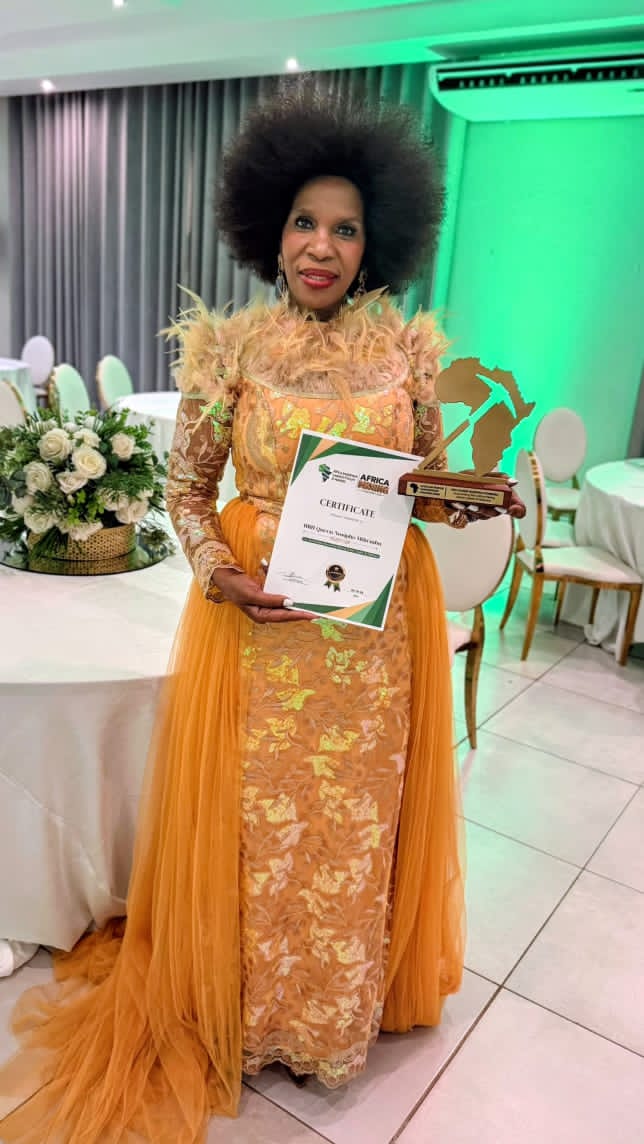
The Convener and Founder of the Africa Blue Economy Roundtable (ABER), Dr. Piriye Kiyaramo, has congratulated the Deputy Chairperson of the Women’s Forum and Director of Blue Sovereignty & Traditional Ocean Governance, HRH Queen Nosipho Mthembu, on her conferment of the Outstanding Pan-African Mining Sector Leader and Visionary Award – the highest honour at the Africa Mining Convention Awards (AMCA) in Victoria Falls, Zimbabwe.
The congratulatory message was contained in a statement issued by the Director of Communication & Public Affairs, Hajiya Medina Dauda Nadabo, in Abuja on Friday.
Dr. Kiyaramo described HRH Queen Mthembu as an invaluable asset to Africa, stating that her recognition is a testament to her ingenuity, visionary leadership and forward-looking enterprise in the blue economy.
Jury Citation
In its citation, the AMCA Jury stated: “On the sacred soil of Zimbabwe, a nation whose mineral wealth has shaped Pan-African history – the Africa Mining Convention Awards Jury proudly confers its highest honour on Her Royal Highness Queen Nosipho Mthembu.
In the land of Great Zimbabwe, built on gold and vision, we honour a Queen whose own vision has built bridges between mines and oceans, between policy and people, between wealth beneath the soil and prosperity in the community.
She is honoured for her outstanding Pan-African leadership in transforming how Africa governs its mineral resources – championing beneficiation over extraction, inclusion over exclusion, and community prosperity over enclave development.
Through her leadership at the ABER Women’s Forum and her pioneering concepts of the Africa Blue Ocean Economy Institute (ABOEI) and Pan-African Coastal Community College (PACC), she has given Africa a practical roadmap to domesticate the Africa Mining Vision and empower women and youth in mining communities from Durban to Lake Victoria to the Zambezi.
For embodying the spirit of Ubuntu in mining leadership and for making Zimbabwe proud as host of this historic recognition, she is hereby inducted into the Pan-African Mining Leaders Hall of Fame.”
About ABER’s Mandate and Scope
The Africa Blue Economy Roundtable (ABER) is a pan-African, multi-stakeholder platform established to accelerate the domestication and implementation of the African Union’s Africa Blue Economy Strategy, the Africa Mining Vision, Agenda 2063, the Lomé Charter on Maritime Security and Safety, and the UN Sustainable Development Goals, particularly SDG 14 – Life Below Water.
ABER’s broad mandate and scope cover four strategic pillars: Policy Advocacy and Institutional Alignment: Advocating for an integrated approach that merges mining, maritime, and ocean governance into one sustainable development framework. Inclusive Growth – Women and Youth at the Centre: Driving the AU’s agenda for inclusive growth through the ABER Women’s Forum and Youth in Blue Economy Initiative, with a deliberate focus on access to leadership, ownership, finance and markets for women and youth in coastal and mining communities.
Capacity Building, Research and Innovation: Through its knowledge institutions, ABER provides research, vocational training, and innovation in ocean governance, sustainable fisheries and aquaculture, green shipping, mineral beneficiation, and the preservation of traditional ocean knowledge systems.
Investment Facilitation and Community Prosperity: Promoting value addition and value retention through the REMAP AFRICA doctrine – moving Africa from exporting raw minerals to producing finished goods – under the principle of ‘From Pit to Port, From Mine to Market.’
Dr. Kiyaramo noted that HRH Queen Mthembu’s induction into the Pan-African Mining Leaders Hall of Fame affirms ABER’s integrated model as the future of Africa’s sustainable development.
In her acceptance remarks, HRH Queen Mthembu dedicated the honour to women in mining and coastal communities across Africa and to the people of Zimbabwe as host nation.
Business & Economy
HURIWA Raises Questions Over Tinubu’s Coastal Highway Realignment, Demands Accountability from Umahi
By Our Correspondent
The Human Rights Writers Association of Nigeria (HURIWA) has condemned the Federal Government’s decision to realign part of the Lagos-Calabar Coastal Highway with the existing East-West Road, describing the development as a disturbing indictment of the government’s infrastructure planning and accountability.
HURIWA said Works Minister David Umahi’s explanation that the realignment was necessary to address flooding and climate change had raised fundamental questions about the quality of the feasibility studies, engineering assessments and environmental evaluations conducted before the project was launched.
The association described the development as a potential national embarrassment, questioning why climate risks that should have been central to the original design were now being presented as a major justification for changing the route.
“How does a government embark on a multibillion-naira coastal highway project without adequately resolving fundamental questions about flooding, environmental risks and the most suitable route? Who approved the original plans, and who will take responsibility if avoidable errors are established?” HURIWA asked.
The association said Nigerians must not be expected to celebrate every change in project direction as a presidential achievement without first examining the reasons for the change, its financial implications and the consequences for the original project design.
HURIWA said Umahi’s disclosure that sections of the existing East-West Road would need to be raised by about two metres to address flooding exposed serious questions about whether the project’s environmental realities were adequately considered from the outset.
The minister had explained that President Bola Tinubu approved the use of the existing East-West Road for the stretch running from the Ondo State boundary into Edo State, rather than continuing with a new coastal alignment along that section.
Umahi also put the distance across the affected corridor at approximately 104 kilometres, including a proposed 45-kilometre bypass.
For HURIWA, the critical issue is not whether an existing road can be upgraded or a bypass constructed. It is whether the government conducted the necessary technical assessments before committing public resources to the original alignment.
“This is not a minor adjustment to a village access road. We are talking about one of the Federal Government’s flagship infrastructure projects. Nigerians deserve to know whether this change is the product of responsible engineering review or evidence of serious weaknesses in the original planning process,” the association said.
HURIWA warned that the government must not use climate change as a convenient explanation to avoid scrutiny of decisions taken before construction began.
While acknowledging that new technical information can legitimately require adjustments to major infrastructure projects, the association insisted that the government must demonstrate, with verifiable evidence, why the change became necessary and whether the risks could reasonably have been anticipated.
The association demanded that the Ministry of Works publish relevant feasibility studies, environmental impact assessments, engineering reports and documents explaining the revised alignment, subject to applicable legal and commercial restrictions.
It also called for disclosure of the financial implications of the change, including whether the realignment would increase or reduce project costs, affect contractual commitments or delay completion.
HURIWA urged the National Assembly to summon Umahi and relevant project officials to explain the circumstances surrounding the decision and establish whether due diligence was observed at every stage.
The association further demanded an independent technical and financial review to determine whether the original alignment was adequately assessed and whether public funds could be exposed to avoidable additional expenditure.
“If this government is serious about accountability, it cannot turn every presidential decision into a public relations victory while leaving taxpayers in the dark about the engineering and financial realities behind it,” HURIWA said.
The association added that any finding of negligence, professional misconduct or avoidable waste should attract appropriate sanctions, including disciplinary action against responsible officials and the removal of the minister where the evidence and applicable procedures justify such a measure.
HURIWA said the controversy also raised broader concerns about the tendency to announce ambitious infrastructure projects before Nigerians receive sufficient information about their technical foundations, financing arrangements, implementation risks and long-term sustainability.
It stressed that the Lagos-Calabar Coastal Highway must not become a project in which political visibility takes precedence over engineering discipline, environmental responsibility and value for public money.
“Nigeria is not a private estate, and public infrastructure is not a favour dispensed by political officeholders. Every major project must be properly conceived, transparently executed and open to scrutiny. If the original planning was deficient, Nigerians deserve the truth, not political applause for correcting a problem that should never have arisen,” the association said.
HURIWA maintained that the Federal Government owes Nigerians a detailed explanation of the realignment and must establish whether it represents a sound engineering decision, a necessary response to new information or a correction of shortcomings in the original project planning.
The association said accountability must follow the evidence, insisting that neither the President nor the Minister of Works should be shielded from legitimate public scrutiny over a project involving substantial public resources.

NASS Receives Proposals for New LGAs as Lagos Seeks 37, Akwa Ibom Missing in the List
By Our Correspondent The National Assembly has allegedly received proposals for the creation of additional local government areas (LGAs) across...


HURIWA Demands Immediate Withdrawal of Nutritionists’ Council Bill, Warns Against Criminalising Nigeria’s Indigenous Food Heritage
By George Mgbeleke The Human Rights Writers Association of Nigeria (HURIWA) unequivocally endorses the position of the Centre for African...

President Tinubu Flags Off 2027 Campaign In Kaduna, Seeks Renewed Mandate
By Our Correspondent The All Progressives Congress,( APC) has flagged off its campaign for the 2027 general elections on Saturday...
APC Flags Off 2027 Campaign In Kaduna, Tinubu Seeks Renewed Mandate. From Cyril Mbah, Abuja. The All Progressives Congress, APC, on Saturday flagged off its campaign for the 2027 general elections in Kaduna, with President Bola Tinubu seeking a second term on the strength of his administration’s record. Speaking at the Murtala Muhammed Square, Kaduna, President Tinubu said it was a great honour to return to the historic city where Nigeria’s early leaders converged before independence. Tinubu thanked Kaduna voters for the victory they gave him in 2023, saying he had come to thank them and seek their mandate for a second term to fulfil his promises of prosperity, continuity and progress. He dismissed opposition talk about hunger, saying “Who created it? They did. We are trying to eradicate it,” noting that his administration and APC governors now pay salaries regularly and are developing their states. The President urged supporters to get their Permanent Voter Cards, (PVCs), and come out en masse on January 16, 2027 to re-elect APC at all levels. “Fuel subsidy is in our past. No more corruption, no more falsification of invoices, no more smuggling. We are ushering in a new era,” he said. Vice President Kashim Shettima said Nigerians elected Tinubu in 2023 not because he was richest or best speaker, but because the alternative was calamity, and he urged Kaduna people to renew APC’s mandate. Shettima listed gains in Kaduna, including Federal University of Applied Sciences, Kachia, Federal University of Education, Zaria, vocational institutes in Rigachikun, Soba and Samaru Kataf with over 4,000 graduates, and NELFUND support for students. He said Tinubu has identified with the North for years, recalling how he gave political succour to former Vice President Atiku Abubakar in 2007, supported Nuhu Ribadu in 2011 and stood behind late President Muhammadu Buhari in 2015 and 2019, describing Tinubu as a man of honour. Director-General of APC Presidential Campaign Council, Senator Abdulaziz Yari, said Kaduna is the spiritual centre of Northern politics and that all northern governors were present to show support. Yari said Tinubu’s economic record, from exchange rate reforms to subsidy removal and trade balance, shows improvement, adding that APC will campaign with its records in infrastructure, health, education and cash transfers. Yari declared, “Northern Nigeria is 101 per cent for you, Asiwaju Bola Ahmed Tinubu, by God’s grace.” Governor Uba Sani, who welcomed guests, paid tribute to Tinubu and First Lady Senator Oluremi Tinubu for their love for Kaduna and the North, saying Renewed Hope Agenda has brought massive interventions in transport, education, healthcare, agriculture and security. Sani recalled that Tinubu defied security advice to travel to Birnin Gwari in December 2022, and has now fulfilled his promises, with N117 billion released for the 123km Kaduna-Birnin Gwari road abandoned for over 40 years, and restoration of security on the corridor. He also cited ongoing Zaria-Soba-Pambegua road, the $865 million Kaduna Metropolitan Red Line with $300 million already mobilized, N84 billion NELFUND benefit to North-West students, and 95 percent completion of N740 billion Abuja-Kaduna-Kano expressway. Sani challenged the “so-called Northern candidate” to show track record of 200km of road while in office, noting that over 1,000km of roads have been constructed in the North under Tinubu and Shettima. He warned supporters to be vigilant, alleging opposition has upgraded its campaign “from Facebook and Twitter to AI.”
By our correspondent As the 2027 election draws close, the All Progressive Congressive,(APC) on Saturday flagged off its campaign for...

Gov Fubara Inspects Creek Road Market, Assures Completion by January 2027
By George Mgbeleke Rivers State Governor, Sir Siminalayi Fubara, has expressed satisfaction with the pace and quality of work at...


Shouts of Joy Rock the World As Pastor Chris Opens Final Healing Streams Edition for 2026
By Our Correspondent Hundreds of millions participate in the global healing crusade as Pastor Chris ministers to the sick in...


Abuja land: Jordan Nyesom-Wike never admitted receiving $2.1m from anyone -Onoja
By Our Correspondent A Senior Advocate of Nigeria (SAN), Dr James Ogwu Onoja has warned social media commentators and bloggers...


Panel on death of 37dead illegal Miners: Commissioner alleges NSCDC goes beyond its official role of engagement
By Uthman Baba -Naseer,Minna The Commissioner for Homeland Security in Niger State Mr. Maurice Bello Magaji has alleged that the...
Abuja land: Jordan Nyesom-Wike never admitted receiving $2.1m from anyone -Onoja
By Our Correspondent A Senior Advocate of Nigeria (SAN), Dr James Ogwu Onoja has warned social media commentators and bloggers...

Sea Incursion: Senate Demands Urgent Shoreline Protection As Ayetoro Community Faces Extinction
By our correspondent Senate on Thursday called for immediate and comprehensive shoreline protection to save Ayetoro community in Ilaje Local...
-

 Politics1 year ago
Gov Okpebholo moves to end Cultism *Threatens action against leading cult groups *Vows to demolish more cult houses in Edo State
-
 Politics1 year ago
ASUU-NDU protest against FG loans, unpaid salaries,Non-Implementation of agreements …..says loans is generational slavery
-
 Business & Economy1 year ago
PC-NCG Issues Disclaimer on Purported Nigerian Coast Guard National Orientation Exercise In Anambra State
-
 Entertainment2 years ago
Jubilation galore as Parishioners of CKC Kurudu celebrate their cultural heritage ….FG should exploit our Cultural heritage to unite Nigerians-Rev Fr Dim
-

 Sports8 months ago
Bayelsa-born ex-football star’s son, Opuama donates spike shoes to Athletics Association
-

 General News2 years ago
Reps hold public hearing on FMC Ugwuaji Awkunanaw
-

 Law & Crime1 year ago
Legal practitioner raises alarm over threat to his life by CSP Muhammed Abdulkareem
-
 General News2 years ago
Celebration galore as UDA Successfully Elected New Exco ……I will digitalize processes that will raise UDA to greater height -Comr. Okejiri