
General News
FG unveils Unified Education Data Platform to tackle out-of-school crisis and embed entrepreneurship in tertiary institutions


By Our Correspondent
In abid to embed entrepreneurship training in the nation’s educational system,the Federal Government has moved to put Nigeria’s fragmented education data under one roof with the rollout of the Nigeria Education Data Infrastructure, NEDI, a platform designed to track learners from nursery to university, cut the number of out-of-school children, and embed entrepreneurship training across higher institutions.
Speaking at the Stakeholders’ Workshop on NEDI in Abuja, Hon. Minister of Education, Dr. Morufu Olatunji Alausa, said the initiative will serve as “a single, reliable source of educational data” for basic, secondary, and tertiary levels, consolidating inputs from agencies and examination bodies to drive evidence-based policy and accountability.
“For two and a half years ago, all our educational data was fragmented. We don’t even know the number of kids in our primary school,” Alausa said. “Today, that’s gone. I can tell you today, the primary school in the state, the number of students there, the number of boys, the number of girls, the number of teachers, the concentration of those teachers. And I can tell you the facilities in that primary school, just sitting in my office.”
The Minister said the he ministry has engaged Ernst & Young to design the system architecture and integration framework linking key education data sources nationwide. NEDI will aggregate data from pre-primary, primary, junior and senior secondary schools up to tertiary institutions, mapping it from school level to local government, state, and national levels.
Explaining further, he said the platform will also track infrastructure down to usable classrooms, computers, and washbasins, giving planners real-time visibility to direct investment and monitor outcomes.
Alausa disclosed that 80% of development partner and development bank financing over the last decade went to two geopolitical zones that simultaneously recorded the lowest reduction in out-of-school children.
“If we had used data before, we would have known where the investment needs to go,” he said. “Today, I’m happy to tell you that core practice is gone completely.”
He highlighted that central to NEDI is the introduction of a national Learner Identification Number, aligned with the National Identity Number system. The unique ID will contain the learner’s state, local government, school ID, year of admission, and serial number.
“Once they get into school, they have this unique ID number that will make the mutual to their national identity number,” Alausa explained. “So if a student started school in a new school today, and the parents move to Lagos, we know that this student started at this school, in this local government, at this school.”
The Minister said the system will make “miracle centers” and exam fraud unsustainable. Nigeria’s 250,000 schools will be geotagged, and officials will proactively intervene when a child drops out, instead of reacting after millions are lost to the system.
All candidates sitting for NECO and WAEC this year will receive a Learner ID, with a retroactive rollout starting from February 1. NYSC participants are also being enrolled immediately, the Minister said.
Linking Education to Jobs and Entrepreneurship, the Minister said NEDI will feed into a national skills gap analysis, matching student admissions to labor market needs at local government, state, and federal levels.
“We want to be able to guide them; What are the kind of jobs they need? Doctors, nurses, software engineers, scientists,” Alausa said. “A student in Niger State will be able to say, oh, there’s so much need for nursing, so much need for software engineering. So they’ll decide their career based on the quality of life they want.”
He announced that at the tertiary level, the Ministry is introducing entrepreneurship integration and business certification across all courses. A chemical engineering student, for example, will take entrepreneurship training throughout their five-year program.
“You want to create entrepreneurs as well as students, not job-seekers,” the Minister said. He cited recent reforms, including the elimination of the UTME requirement for Colleges of Education offering agricultural technology courses, as part of a push to widen access and raise teacher quality.
Alausa highlighted a shift in gender performance, noting that more women than men sat for the most recent JAMB exams. “Women are performing wonders in the country,” he said, addressing the Minister of Women Affairs. “This is very refreshing news.”
He thanked development partners, singling out UNICEF for saving 18 months on the digitalization agenda, and called on state commissioners, NYSC, the Federal Character Commission, and examination bodies like NECO and WAEC to ensure clean, timely data feeds into the platform.
“This will give us more improved governance. Education stands at the center of human capital development. It will be the backbone of any national economy,” Alausa said.
“We have a huge population. 70% of the population is young. We need to balance it. And what we need to do to do that is to take that very well, and if we want to take that very well, we need to have data at the center of everything we do today.”
The workshop included presentations by the NEDI coordinator and Ernst & Young on data collection, aggregation, disaggregation, and use cases. Stakeholders were invited to provide feedback before full national implementation.
The Minister says NEDI will be open to the public once fully deployed, with AI tools allowing users to query the data directly: “Whatever information you want, you just ask it.”
Speaking in her good will message, the Minister of Women Affairs and Social Development, Hon. Imaan Sulaiman-Ibrahim, commended the Federal Ministry of Education for convening a Stakeholders’ Workshop on the Nigeria Education Data Infrastructure (NEDI), describing it as a strategic step to strengthen the country’s education sector.
Sulaiman-Ibrahim said the workshop’s timing is significant, coming on the eve of the International Day of Families on May 15 and ahead of the 2026 National Children’s Day on May 27.
She noted that the period underscores the link between strong educational systems, stable family structures, and protected childhoods as foundations for national transformation.
The minister highlighted NEDI as a visionary initiative to reposition Nigeria’s education sector through integrated, credible, and technology-driven data governance. She said such a system would improve national planning, learning outcomes, and inclusive educational development across all levels.
Sulaiman-Ibrahim stressed that in a country of over 230 million people, where children and young persons form a large share of the population, a harmonised education data ecosystem is critical.
She added that education remains a key tool for social protection, noting global evidence that each additional year of schooling for a girl improves health outcomes, reduces child marriage, and boosts lifetime earnings.
She pointed to the urgency of the initiative against Nigeria’s challenge of over 10 million out-of-school children, saying reliable and actionable data is needed to guide targeted interventions, equitable resource allocation, and stronger child protection mechanisms.
The minister linked NEDI to the Renewed Hope Agenda of President Bola Ahmed Tinubu, particularly the Renewed Hope Social Impact Intervention (RHSII-774) under the Human Capital Development and Social Investment pillar.
She also noted that the Federal Government’s declaration of 2026 as the Year of Family and Social Development further reinforces the initiative’s relevance.
Sulaiman-Ibrahim called the workshop more than a technical engagement, framing it as a national conversation on the future of Nigeria’s children, families, and human capital.
She reaffirmed her ministry’s commitment to collaborating with development partners and stakeholders to advance inclusive education, gender equality, child protection, and social development.
“What we do with data today determines the opportunities we create for children tomorrow,” she said, urging that the workshop mark a milestone toward ensuring “no child is invisible, no family is forgotten.”
By Our Correspondent
In a bid to improve the welfare of Nigerian workers, the federal government declared on Friday that it has commenced consultations ahead of fresh negotiations on the national minimum wage..
Permanent secretary, federal ministry of Labour and Employment, Dr Kamil Shoretire, who disclosed this during a capacity-building workshop for labour correspondents in Abuja, said that although the government had not announced a timetable for the formal commencement of negotiations, background consultations were already underway.
He said: “We are yet to announce the timetable for that, but background discussions are already ongoing. When it’s time to get the press involved in what has been proposed and what is being negotiated, it will be revealed to you,”.
The permanent secretary stressed that the consultations were part of wider efforts to address wage and allowance issues across different sectors, noting that collective bargaining discussions were also ongoing with workers in sectors such as health and education.
According to him: “Various discussions with health, education and other sectors that have lots of issues in terms of wages and allowances are ongoing and they are being fast-tracked so that the ones that are agreed will reflect in next year’s budget,”.
The permanent secretary also disclosed that the Federal Government had responded to a complaint filed against it by the Nigeria Labour Congress (NLC) at the International Labour Organisation (ILO).
He said, Nigeria met the September 1 deadline set by the ILO to respond to outstanding issues raised in the complaint.
“Let me start with the ILO. We have met the deadline. We have responded to the request from ILO. I was there when a complaint was filed by the NLC against the Nigerian government at the ILO on some of the labour issues that are yet to be resolved in the country.
“We responded at the ILO, but we also got that certain areas were not addressed or were pending. So those ones were the ones that we got a deadline on September 1, and we have responded accordingly”, he said.
The NLC had petitioned the ILO at the International Labour Conference in Geneva, alleging violations of workers’ rights under the Right to Organise and Collective Bargaining Convention, 1949, otherwise known as Convention No. 98.

By David Owei, Yenagoa
As part of efforts to enhance the capacity of its staff to effectively lead and regulate the oil and gas industry, the Nigerian Content Development and Monitoring Board (NCDMB), on Thursday inaugurated its LearnFest Lecture Series, a platform for continuous learning among staff and oil and gas industry stakeholders.
LearnFest, an initiative under the Nigerian Content Academy (NCA), a specialised knowledge-sharing and training arm of the agency, will provide trainings on the mandate and inner workings of the Board.
Attended by all staff at the corporate headquarters in Yenagoa, the three-hour event was focused on raising awareness of the different directorates of the organisation, their constituent divisions and departments, as well as their specific responsibilities and how they function individually and collectively to advance corporate goals and objectives.
In a promo video, the Academy explained that NCDMB’s knowledge is spread across seven directorates and each has its own mandate, processes, expertise, responsibilities, and way of creating value.
It added that knowledge becomes more powerful when it does not exist in silos but moves from one department to the other with handshakes of different units.
According to the Academy, LearnFest is intended to help staff understand “how everything fits together,” the big picture, with respect to the mandate of the Board as well as institutional processes, practices, culture, and relationships. “When we understand what others do, we collaborate better, support one another better, and work as one integrated ecosystem,” it added.
In opening remarks at the event, the Director, Capacity Building Directorate, Engr. Abayomi Bamidele, stated that the LearnFest Lecture Series was informed by the need to create an understanding of Nigerian Content tools and processes among staff and other oil and gas industry stakeholders.
Industry players, he explained, need to understand and interpret the Nigerian Oil and Gas Industry Content Development (NOGICD) Act, 2010, operational principles as enshrined in the NCDMB Guideline for Nigerian Content Human Capital Development Implementation Strategy, the Nigerian Content Compliance Certificate (NCCC), Nigerian Content Plan (NCP), statutory reporting and matters relating to expatriate quota.LearnFest, he pointed out, “will make our work easier.”
He disclosed that industry operators and service companies, industry associations such as the Oil and Gas Trainers Association of Nigeria (OGTAN), academic institutions, and ministries, departments and agencies (MDAs), have been writing to the Academy to express interest in sending their staff for the specialised training provided there.
Engr. Bamidele further stated that the NCA is building a faculty, and that the Lecture Series is a way of preparing the grounds for its take-off. According to him, “The people presenting [the lectures] could form part of our faculty,” and those attending the event are expected to give feedback on the suitability of such resource persons for the said roles.
He also said that the Management of the Board has approved the use of the Board’s purpose-built facility in Opolo, along the Opolo-Elebele Road in Yenagoa as a centre for the NCA training programmes.
In the first presentation under the Lecture Series, the Manager, Planning and Policy Development Department, Engr. MofeMegbele, spoke on the theme “Understanding the Activities and Processes of the Planning, Research and Statistics Directorate,” with subheadings such as “Operating Framework for Planning Research and Statistics (PRS),” “Overview of Planning and Policy Development Department (PPD),” “Expatriate Quota,” and “Inter-Directorate/Division Relations,” “Research and Development Programme,” “Technology Commercialisation and Innovation,” “Overview of R&D Infrastructure,” “NOGIC JQS/NOGIC JQS User Communication,” “NCCF Objectives,”and “E-Marketplace and Stakeholders Engagement.”
He said the Directorate comprised two major Divisions, namely, PPD and Research and Statistics Development Division,” both of which are headed by General Managers. PPD, he explained, was established in September 2018 under Section 70 of the NOGICD Act, and has been responsible for “policies and guidelines for internal and external stakeholders,” whose implementation it also monitors.
The LearnFest Lecture Series will hold monthly for the next nine months, with a specific Directorate featured in each edition. Attendance, online and in-person, is mandatory for all staff of the NCDMB, while other oil and gas industry stakeholders could participate in subsequent editions.
General News
22nd ANEC Confrence: Media, Govt Must Meet at Point of Truth-Mbah …..bags plaque for good governance
By our correspondent
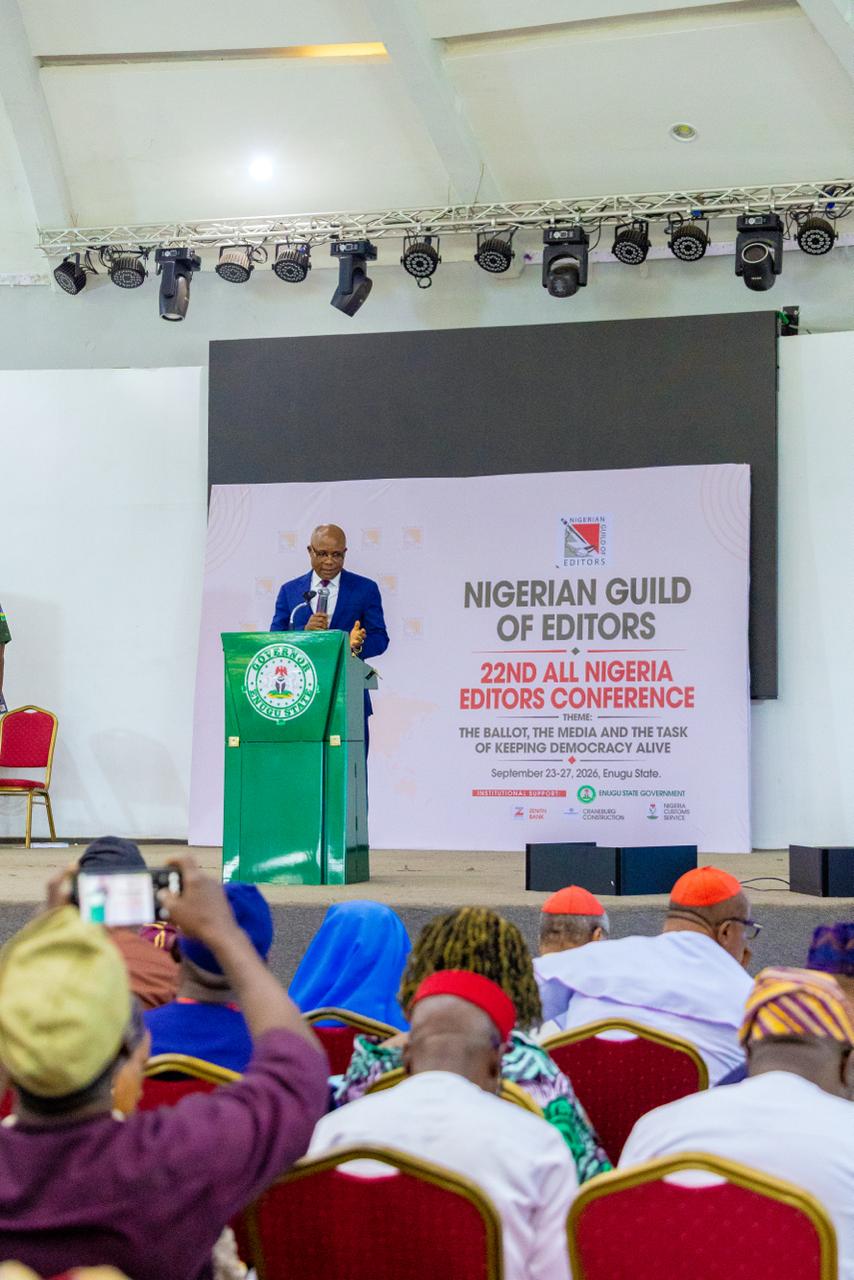
Enugu State Governor, Peter Mbah, has challenged the government and the media to meet at the point of truth, urging journalists to go beyond headlines and political narratives by independently establishing facts through evidence, investigation and context.
Mbah said government had a responsibility to be transparent about its actions and accountable for its results, while the press must independently scrutinise those actions and report the truth, whether the findings exposed shortcomings or revealed progress.
The governor stated this on Thursday while welcoming over 300 editors to the 22nd All Nigeria Editors Conference (ANEC) organised by the Nigerian Guild of Editors (NGE) in Enugu.
The conference has as its theme, “The Ballot, the Media and the Task of Keeping Democracy Alive,” while its sub-theme is “When Lies Look Real: Detecting and Debunking AI Misinformation Before, During and After Elections.”
Mbah said the relationship between government and the media should not always be defined by confrontation, stressing that both institutions had different responsibilities, but a common obligation to serve the Nigerian people.
“Government must be transparent about what it is doing and be accountable for the results. The press must establish the facts and report the truth.
“Sometimes that truth will expose failure. Sometimes it will reveal progress. The obligation for us both is the same in either case – serving the people of Nigeria,” he said.
The governor urged journalists to deepen investigative reporting, particularly at a time when artificial intelligence and other technologies were making it increasingly difficult to distinguish between genuine and fabricated information.
He said AI could be used to fabricate photographs, clone voices and manipulate videos to make people appear to say things they never said, warning that the development had increased the responsibility of professional journalists.
“My challenge to you, therefore, is simple – go deeper, beyond the surface,”Mbah told the editors.
According to him, rigorous journalism should not involve searching for evidence to support a position that had already been taken.
“Its value lies precisely in its independence: examine the evidence, test competing claims, establish what happened, and report what you find,” he said.
Mbah added that the same standard should apply to government and its critics, stressing that government achievements should not be ignored simply because they did not fit a particular political narrative.
“We have tried to build an Enugu government that is open about what it is doing and clear about what it is trying to achieve. Where we fall short, that should call for scrutiny and be reported. But the same principle applies when the evidence reveals progress,” he said.
The governor also used the occasion to highlight some of his administration’s projects, including more than 1,500 kilometres of roads constructed or reconstructed, over 7,000 classrooms, Smart Green Schools and Type-2 Primary Healthcare Centres across the state’s 260 wards.
He listed other interventions as water infrastructure, new transport terminals and CNG buses, Enugu Air, the revival of dormant industries and the development of a new city.
Mbah said the administration was working to position Enugu as an economic gateway to the South-East, with the ambition of making the state one of Nigeria’s leading economies and a national leader in human development and quality of life.
He also acknowledged the support of President Bola Tinubu and the Federal Government, particularly in areas of roads, aviation, energy and regional development.
The governor urged the editors to use their presence in Enugu to independently assess the developments in the state.
“Take some time to explore the city, speak to the people who live and work here, and get a sense of the direction in which Enugu is moving,” he said.
One of the highpoints of the opening ceremony was the presentation of a plaque for good governance to Governor Mbah by the Guild.


2027 : PDP Candidate re-connects Zanchita community with National grid after two years of darkness
By Uthman Baba-Naseer,Minna It was a celebration galore in Zanchita community in gbako local government area of Niger State,as former...


Insecurity ,displacement alters distribution of Christian communities in Niger state to 3,417,636
By Uthman Baba -Naseer,Minna Niger state Christian leaders have disclosed that out of the Seven million, four hundred and seventy...


Death of 37 suspected illegal Miners:11 member of Judicial commission of inquiry set for inauguration on Tuesday by govrrnor Bago
BY UTHMAN BABA-NASEER,MINNA Sequel to the constitution of the Judicial commission of inquiry by the governor Mohammed Umar Bago, to...


Thanksgiving Service Heralds Bayelsa 30th Anniversary Celebration
By Dabid Owei Bayelsa State Government on Sunday held an inter-denominational thanksgiving service to kick-start activities marking the 30th anniversary...


Former Speaker challenges substition of his name with Suleiman as winner of APC primary election at Minna Fed.High Court
By Uthman Baba-Naseer,Minna The Former Speaker of the Niger State House of Assembly,Rt Hon. Adamu Usman,has filed a lawsuit before...


SWAN President to Storm Bayelsa for 30th Anniversary Celebration, Igali Confirms*
By David Owei The President of the Sports Writers Association of Nigeria (SWAN), Benjamin Isaiah, has been confirmed among dignitaries...


Panic Grips Delta Residents as Deputy Director Dies After Alleged Assault
By Our Correspondent There is palpable tension among Delta residents following an alleged death of a deputy Director in Asaba,...

SPC 2026 Annual Wkshop: Journalists Deliberate on Legislative Oversight, Budget Integrity,Media Collaboration
By Our Correspondent The 2026 Capacity-Building Workshop of the Senate Press Corps will focus on strengthening legislative oversight and media...


The Day the Church ‘Blessed’ the Media
By Emmanuel Nnadozie Onwubiko For a media practitioner and a Catholic, Thursday, September 24, 2026, will remain a remarkable day....

As ‘Ọsọ Marwa’ Sweeps Across Nigeria’s Forests
By Emmanuel Nnadozie Onwubiko Today’s reflection is on a new and increasingly significant battlefront opened by the National Drug Law...
-

 Politics1 year ago
Gov Okpebholo moves to end Cultism *Threatens action against leading cult groups *Vows to demolish more cult houses in Edo State
-
 Politics1 year ago
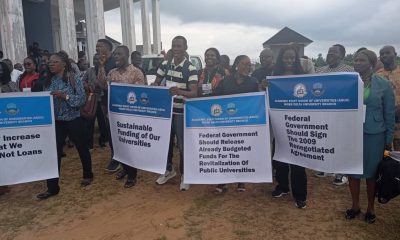
ASUU-NDU protest against FG loans, unpaid salaries,Non-Implementation of agreements …..says loans is generational slavery
-

 Business & Economy1 year ago
PC-NCG Issues Disclaimer on Purported Nigerian Coast Guard National Orientation Exercise In Anambra State
-
 Entertainment2 years ago
Jubilation galore as Parishioners of CKC Kurudu celebrate their cultural heritage ….FG should exploit our Cultural heritage to unite Nigerians-Rev Fr Dim
-

 Sports7 months ago
Bayelsa-born ex-football star’s son, Opuama donates spike shoes to Athletics Association
-

 General News2 years ago
Reps hold public hearing on FMC Ugwuaji Awkunanaw
-

 Law & Crime1 year ago
Legal practitioner raises alarm over threat to his life by CSP Muhammed Abdulkareem
-

 General News2 years ago
Celebration galore as UDA Successfully Elected New Exco ……I will digitalize processes that will raise UDA to greater height -Comr. Okejiri