
Opinion
HURIWA questions Plateau Security Votes As Killings Continue …..Demands Accountability


By George Mgbeleke
The Human Rights Writers Association of Nigeria (HURIWA) has expressed deep concern over the continuing killings in Plateau State despite the huge sums reportedly released as security votes by the state government, demanding an immediate explanation of how the funds have been deployed to protect citizens.
HURIWA said the latest revelation that Plateau State released N18.9 billion in security votes in 2024 and another N17.28 billion between January and September 2025 cannot be ignored against the background of the continuing attacks and killings of innocent citizens across the state.
The rights group in a statement signed its national coordinator,Comrade Emmanuel Nnadozie Onwubiko,said the issue is not simply about the size of the security vote but about accountability, transparency and measurable security outcomes.
HURIWA therefore asks the Plateau State Governor: What exactly is the government doing with these massive security votes if citizens continue to be killed and communities remain vulnerable to attacks?
The question becomes even more compelling because the Governor has publicly acknowledged the severity of the killings and insecurity confronting the state.
HURIWA said it is not accusing the Plateau State Government of diverting or misappropriating the funds. However, the enormous public expenditure on security creates a legitimate obligation for the government to demonstrate what the money has achieved.
The association’s position follows a Saturday PUNCH analysis of state budget implementation reports showing that 10 states—Borno, Plateau, Ondo, Ebonyi, Katsina, Nasarawa, Adamawa, Edo, Bayelsa and Delta—could collectively spend about N140 billion on security votes in 2026 if the current pattern continues.
The analysis showed that the 10 states released about N80 billion in 2024, representing 72.2 per cent of the N110.8 billion budgeted for security votes.
In the first nine months of 2025 alone, they reportedly released N87.87 billion from a collective provision of N127.36 billion.
HURIWA finds it troubling that security expenditure continues to rise in the face of persistent killings, kidnappings and attacks in several parts of the country.
Security votes are intended to assist governors in responding to security emergencies, intelligence gathering and rapid-response operations. But where billions of naira are released without detailed public disclosure of their utilisation, citizens are left with legitimate questions about the effectiveness and accountability of such spending.
HURIWA consequently calls on the Plateau State Government to provide citizens with a broad, transparent account of how its security votes have been deployed, including the security interventions financed by the funds and the measurable outcomes recorded.
While operational details that could compromise security operations need not be disclosed, the government should be able to account for the public resources entrusted to it.
HURIWA also calls on the Plateau State House of Assembly and other relevant oversight institutions to strengthen their scrutiny of security expenditure and demand evidence that appropriated funds are producing tangible improvements in the protection of lives and property.
The association recalls that citizens do not merely need budgetary announcements; they need security that can be felt in their communities.
HURIWA therefore urges the Plateau State Government to urgently review its security strategy, strengthen intelligence-led operations, improve protection for vulnerable communities and ensure that perpetrators of attacks are arrested and prosecuted.
The Governor must wake up to the urgency of the situation and stop the killings of Plateau citizens.
HURIWA insists that no security vote, no matter how large, should become a substitute for transparency, accountability and effective protection of human lives.
By
Ken Harries, Esq.
There is a point at which political contestation ceases to be an argument about ideas and becomes an assault on the very boundaries that make civil society possible. That point is reached when a private telephone conversation is allegedly recorded, extracted from its original context and released into the public domain as political ammunition.
The latest controversy surrounding an audio recording purported to be a telephone conversation between Senator Godswill Akpabio and Sandra C. Duru, a.k.a. Professor Mgbeke, therefore deserves to be examined beyond the personalities involved. It raises a much larger question: What happens to a society when private conversations become raw material for public propaganda?
Recent reports indicate that Sandra Duru released a nine-minute audio recording on social media and presented portions of it as a private conversation involving the Senate President. Yet, significantly, the recording has not been independently authenticated, and questions remain about the identity of the voices, the circumstances in which the conversation was recorded, and whether the excerpts constitute the complete conversation. Those uncertainties are not minor technicalities; they are at the heart of responsible public communication.
PRIVACY IS NOT A POLITICAL LUXURY
Nigeria’s Constitution is unequivocal in recognising privacy as a fundamental right. Section 37 guarantees and protects the privacy of citizens, including their homes, correspondence and telephone conversations. That constitutional safeguard does not disappear because the individuals involved are politicians, public officials, activists or controversial personalities. Indeed, public office should never be interpreted as a wholesale surrender of personal privacy.
The Nigeria Data Protection Act 2023 reinforces this principle by establishing a legal framework for protecting personal information and regulating its processing. Among its stated objectives are the protection of fundamental rights and freedoms, the safeguarding of personal data, and the requirement that personal data be processed in a fair, lawful and accountable manner.
The central question, therefore, is not whether an audio recording can generate political excitement; it obviously can. The question is whether private communication can be captured, processed, edited, reproduced and disseminated for political purposes without lawful justification, proper authorisation or regard for the rights of the people whose voices and personal information are involved. That is a much more serious question.
THE CYBER DIMENSION CANNOT BE IGNORED
The Cybercrimes (Prohibition, Prevention, etc.) Act, as amended in 2024, also contains provisions concerning unlawful interception of non-public computer communications and judicially authorised interception of electronic communications. The legislation defines interception broadly enough to include listening to or recording communication data in specified circumstances. But legal precision matters, particularly when criminal liability is being discussed.
It would be premature for commentators to declare, without establishing the facts, that the mere existence or publication of this particular audio automatically constitutes a criminal offence under the Cybercrimes Act. If, however, the evidence establishes that a private electronic communication was intercepted or obtained without lawful authority, the circumstances could raise serious questions under the applicable constitutional, data-protection and cybercrime frameworks. That is precisely why an independent investigation matters: the law should determine the legality, not social media.
PUBLIC INTEREST IS NOT A BLANK CHEQUE
There is another important distinction that the Nigerian public must begin to make. A matter involving a public official may be of public interest without every private conversation involving that official becoming public property. Public interest is not the same thing as public curiosity.
A genuine public-interest disclosure ordinarily requires more than the ability to attract clicks, outrage or political engagement. It requires consideration of authenticity, context, provenance, relevance and the legitimate rights of the people involved. A fragment of an alleged private conversation, detached from the circumstances in which it occurred and presented to millions of people without independent authentication, can easily become something very different from responsible whistleblowing.
It can become narrative engineering, particularly when selected material is used to encourage the public towards a predetermined interpretation. When such narrative engineering is repeatedly used to shape public perception, it begins to resemble propaganda rather than public accountability.
THE MORAL QUESTION
There is also a moral dimension that no statute can completely capture. Politics is already a theatre of suspicion, rivalry and competing narratives. If every private conversation is potentially a future weapon, trust disappears from public life. People stop speaking candidly, officials become afraid of legitimate conversations, and citizens become unwilling to engage public figures.
Political communication then gradually degenerates into a marketplace where the most sensational fragment—not necessarily the most truthful account—commands the greatest attention. This is where the conduct surrounding the dissemination of private conversations raises profound ethical questions.
A society that normalises the conversion of private conversations into political weapons risks producing a culture in which nothing is private, context is disposable and reputation is collateral damage. That is not democratic accountability; it is the erosion of the ethical architecture upon which democratic accountability depends.
THE PROBLEM WITH THE “MERCHANT OF PROPAGANDA” MODEL
There is a growing phenomenon in digital politics in which controversy itself becomes a political commodity. The objective is no longer necessarily to establish facts, but to generate a continuous stream of allegations, recordings, screenshots, insinuations and counter-allegations until the public becomes emotionally exhausted and truth becomes indistinguishable from repetition.
The danger is particularly acute when the communicator becomes both the source of the allegation and the narrator of the evidence. That model creates an obvious credibility problem because the public is effectively being asked to accept not merely the allegation but also the interpretation supplied by the person disseminating it.
That is why independent verification is indispensable. A recording should be authenticated, its provenance established, its full context examined and any editing disclosed. The circumstances of its acquisition should also be investigated. Where there are allegations of unlawful interception or misuse of personal data, the appropriate regulatory and law-enforcement authorities should be allowed to do their work.
FREEDOM OF EXPRESSION HAS RESPONSIBILITIES
Freedom of expression is indispensable to democracy, but so is the right to privacy. These principles should not be presented as enemies. Responsible journalism, legitimate whistleblowing and public-interest disclosure have their place, but none of them should become convenient labels for every unauthorised exposure of private communications.
The democratic answer to disputed conduct is evidence, investigation and due process—not digital vigilantism. If the recording is authentic and contains evidence of wrongdoing, the proper response is to submit the evidence to the appropriate institutions and allow the facts to be tested. If it is unauthorised, manipulated, selectively edited or misleadingly presented, those facts should also be established through proper investigation. Either way, the truth deserves a process more rigorous than a Facebook post.
THIS IS BIGGER THAN AKPABIO
The most important lesson from this episode should not be about Senator Godswill Akpabio alone; it should be about the Nigeria we are creating. Today, it may be a conversation involving a Senate President. Tomorrow, it could be a judge, journalist, businessman, civil servant, academic, clergy member or ordinary citizen.
If the principle becomes that anyone who possesses a private recording is entitled to publish it whenever politically convenient, then privacy ceases to be a right and becomes merely a temporary privilege enjoyed by those who have not yet been recorded. That is a dangerous trend with implications extending far beyond the personalities involved in the present controversy.
The constitutional guarantee of privacy cannot be selectively defended, data protection cannot become a slogan deployed only when convenient, and cybercrime legislation cannot be invoked selectively. Political communication cannot be allowed to become a free-for-all in which reputations are tried and convicted on social media before evidence is examined.
LET THE LAW SPEAK
There is, therefore, a compelling case for the relevant authorities to establish the facts surrounding any purported private telephone recording now circulating. Who made the recording? How was it obtained? Was consent given? Was the communication intercepted? Was it edited? Who first disseminated it, and for what purpose? What personal data were processed? Was there a lawful basis for that processing? And does the dissemination violate any applicable constitutional, statutory or judicial protection? Those are questions for evidence, not conjecture.
There is, however, a broader principle worth defending: private communication should not become political ammunition merely because it can generate attention. A democracy requires trust, evidence, restraint and respect for the law. Public accountability is strengthened, not weakened, when allegations are subjected to verification and established processes rather than determined by the velocity of social-media circulation.
The real moral deficit in contemporary public discourse is not that people disagree. It is that the boundaries between legitimate scrutiny and intrusion can become dangerously blurred when private material is circulated without adequate attention to authenticity, context, provenance and applicable law. Once society becomes indifferent to those boundaries, everyone—not merely public officials—has reason to be concerned about the future of privacy.
Ken Harries, Esq., is an Abuja-based Development Communication Strategist.
By Our Correspondent
The Human Rights Writers Association of Nigeria (HURIWA) has demanded the immediate cessation of what it describes as the unconstitutional harassment and intimidation of JKD Radio/Television journalist, Zainab Salihu Yabagi, by the Kaduna State Police Command.
HURIWA is particularly alarmed by reports that the police declared the female journalist wanted over a video explainer concerning Ibrahim Masari, a Special Adviser to President Bola Ahmed Tinubu, after heavily armed police personnel reportedly invaded the Millennium City, Kaduna studios of JKD Radio/Television on September 11, 2026.
According to reports available to HURIWA, the police initially claimed they were searching for Yabagi in connection with a “stolen phone.” However, during the operation, the organisation’s General Manager, Charles Abah, and a security personnel were reportedly arrested and detained for more than seven hours.
It was subsequently stated that Yabagi was being sought over allegations including criminal conspiracy, defamation, cyberstalking and bullying allegedly connected to Masari.
HURIWA therefore calls on the Inspector-General of Police, Tunde Disu, to immediately direct the Kaduna State Police Command to stop forthwith any harassment, intimidation or arbitrary pursuit of the journalist and other employees of JKD Radio/Television over the disputed broadcast.
If the Special Adviser believes that the broadcast defamed him, the appropriate response is to approach a competent court and seek redress, not to deploy the coercive machinery of the state against a journalist.
HURIWA strongly cautions against the abuse of the Cybercrime Prohibition Act as a convenient instrument for suppressing legitimate journalism and criticism. A cybercrime law must not become a backdoor mechanism for turning civil disputes over alleged defamation into criminal investigations, arrests and intimidation.
The Constitution is clear on the important role of the media. Section 22 of the 1999 Constitution places a constitutional responsibility on the press, radio, television and other mass media to hold government accountable and ensure that government remains responsible to the people.
Journalists cannot effectively discharge that constitutional responsibility if they are made to operate under the constant threat of police arrest simply because a public official is displeased with a report, commentary or video explainer.
HURIWA is not saying that journalists are above the law. Where there is credible evidence of a criminal offence, due process should be followed. But due process cannot mean sending armed police officers to raid a media organisation, arrest its personnel and declare a journalist wanted over a matter that can be subjected to judicial scrutiny.
The alleged use of police power in this manner is particularly troubling because of the reported involvement of a person serving as a Special Adviser to the President. No political appointment, proximity to the Presidency or access to government machinery should confer immunity from criticism or create a private police force for settling personal grievances.
HURIWA therefore urges the IGP to immediately review the circumstances surrounding the Kaduna operation and ensure that the police do not become instruments of self-help in what may essentially be a dispute over alleged defamation.
The Federal Government must also ensure that journalists, broadcasters and media organisations are allowed to operate freely, safely and without fear of arbitrary arrest, intimidation or reprisals.
The growing resort to criminal complaints, police invitations, arrests and searches against journalists over their professional activities risks further shrinking Nigeria’s civic space and weakening one of the constitutional pillars of democratic accountability.
HURIWA demands that the police stop forthwith the harassment of Zainab Salihu Yabagi and JKD Radio/Television and that any person alleging defamation should pursue the remedy available under the law rather than resort to state coercion.
By George Mgbeleke
The Human Rights Writers Association of Nigeria (HURIWA) has condemned in the strongest terms the reported death of 37 suspected illegal miners in the custody of the Nigeria Security and Civil Defence Corps (NSCDC) in Niger State, describing the incident as a grave state-sponsored human rights violation that must not be swept under the carpet.
In a statement by national coordinator of HURIWA ,Comrade Emmanuel Nnadozie Onwubiko, the group said Nigeria cannot continue to operate a system in which citizens are arrested alive by security agencies, taken into lawful custody and subsequently die in detention without an immediate, transparent and independent account of what happened to them.
The rights group says the reported deaths of the suspects in Minna raise disturbing questions about what occurred between the time they were arrested around the M.I. Wushishi/Lukoto axis on September 15 and 16, 2026, and the time their bodies were deposited at the General Hospital, Minna.
HURIWA asks bluntly: How did 37 people arrested alive end up dead in the custody of a government security agency?
The organisation says the sheer number of deaths makes the incident too serious to be treated as an ordinary internal disciplinary matter.
HURIWA notes that the NSCDC has announced an investigative panel and said the cause of death has not been medically or laboratory confirmed. The organisation welcomes the decision to investigate but insists that the NSCDC cannot investigate itself and expect Nigerians to accept the outcome as independent.
According to HURIWA, an institution whose personnel had custody of the deceased cannot simultaneously be the investigator, potential accused party and final authority determining whether its own officers bear responsibility.
“You cannot arrest citizens alive, lock them up under your custody and then investigate yourselves when they emerge dead. That is not independent justice,” HURIWA says.
The organisation therefore demands that President Bola Ahmed Tinubu and the Federal Government immediately constitute an independent judicial or multi-agency panel of inquiry into the deaths.
HURIWA wants the panel to include independent forensic pathologists, medical experts, the National Human Rights Commission, civil society representatives and other credible institutions with no connection to the detention operation.
The group demands full autopsies and independent laboratory and toxicological examinations to determine the precise cause of every death.
It also demands that investigators establish the condition of each suspect at the point of arrest, the number of detainees held, the cells and facilities used, the duration of detention, food and water provided, medical treatment administered, personnel on duty and every movement or transfer involving the suspects.
HURIWA further demands that all available CCTV footage, detention registers, medical records, arrest records, duty rosters and communication logs relating to the detainees be preserved and subjected to independent scrutiny.
The organisation says any officer found, after due process, to have unlawfully caused, facilitated or negligently contributed to the deaths must face criminal prosecution, including murder or other appropriate charges where the evidence supports such charges.
HURIWA also calls for the immediate suspension of officers directly implicated by preliminary evidence, pending the outcome of the independent investigation.
The rights group says officers of the state must understand that lawful custody does not confer a licence to abuse, torture, neglect or unlawfully expose detainees to conditions capable of causing death.
“A suspect is not a corpse. An arrest warrant is not a death warrant. Custody is not a licence to kill,” HURIWA says.
The organisation demands that the families of all the deceased be formally notified, allowed access to independent medical information and involved in the process of establishing the circumstances surrounding the deaths.
Where state responsibility is established, HURIWA demands ₦100 million compensation for each deceased victim, in addition to prosecution of responsible officials and any other remedies available under Nigerian law.
HURIWA says the Federal Government must also immediately account for every person currently detained in connection with the Niger State mining enforcement operation and ensure that their health, safety and fundamental rights are protected.
The organisation warns against any attempt to attribute the deaths to an alleged disease before credible medical and laboratory evidence establishes such a conclusion.
HURIWA says the deaths must not disappear into the familiar cycle of arrest, death, internal investigation and silence.
The group insists that Nigeria’s security agencies must understand that the constitutional rights of citizens do not disappear at the entrance of a detention facility.
HURIWA therefore calls on the Federal Government to treat the Niger deaths as a national human rights emergency and immediately establish an independent inquiry capable of determining responsibility, securing justice for the dead and preventing a repetition.


HURIWA questions Plateau Security Votes As Killings Continue …..Demands Accountability
By George Mgbeleke The Human Rights Writers Association of Nigeria (HURIWA) has expressed deep concern over the continuing killings in...


Igbo group condemns chieftaincy title conferred on Tinubu’s wife, Remi by Igbo traditional rulers
By Our Correspondent Controversy trails recent chieftanicy title conferred on the first lady Sen. Oluremi Tinubu as a Pan Igbo...

Don’t arrest Atiku now, it lacks tact, MURIC warns FG
ByCorrespondent The Muslim Rights Concern, MURIC, has cautioned the Federal Government against arresting former Vice President Atiku Abubakar over renewed...
*WHEN PRIVACY BECOMES CONTENT:* The Dangerous Normalisation of Leaked Private Conversations
By Ken Harries, Esq. There is a point at which political contestation ceases to be an argument about ideas and...


FCTA denies Teachers’ harassment allegations, defends redeployment policy
By Our Correspondent The Federal Capital Territory Administration (FCTA) has rejected allegations of harassment against teachers, insisting that its ongoing...

Governor Diri Charges Permanent Secretaries on Stronger Bureaucracy, Better Governance in Bayelsa
By David Owei Bayelsa State Governor, Senator Douye Diri, has stressed the importance of a strong and professional civil service...

HURIWA Tells IGP: Stop Police Harassment of JKD Journalist, Let Masari Go to Court
By Our Correspondent The Human Rights Writers Association of Nigeria (HURIWA) has demanded the immediate cessation of what it describes...

ADC Alleges State-Backed Political Violence, Warns 2027 Election Integrity Already Under Threat*
By George Mgbeleke The African Democratic Congress, ADC, has accused the ruling All Progressives Congress, APC, and security agencies of...
HURIWA Advocates Conversion of N22bn VP Residence to General Hospital
By George Mgbeleke The Human Rights Writers Association of Nigeria (HURIWA) says the continued non-utilisation of the official residence built...

Tinubu’s Third Straight UNGA Absence: Nigeria Must Not Pay For His America Baggage-Atiku
By David Owei *A seat was reportedly secured for Bola near United States President Donald Trump at the world’s most...
-
 Politics1 year ago
Gov Okpebholo moves to end Cultism *Threatens action against leading cult groups *Vows to demolish more cult houses in Edo State
-
 Politics1 year ago
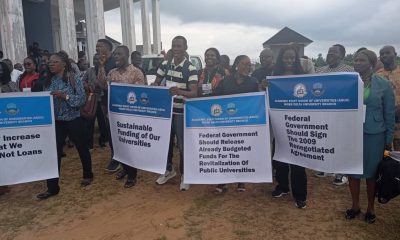
ASUU-NDU protest against FG loans, unpaid salaries,Non-Implementation of agreements …..says loans is generational slavery
-

 Business & Economy1 year ago
PC-NCG Issues Disclaimer on Purported Nigerian Coast Guard National Orientation Exercise In Anambra State
-
 Entertainment2 years ago
Jubilation galore as Parishioners of CKC Kurudu celebrate their cultural heritage ….FG should exploit our Cultural heritage to unite Nigerians-Rev Fr Dim
-

 Sports7 months ago
Bayelsa-born ex-football star’s son, Opuama donates spike shoes to Athletics Association
-

 General News2 years ago
Reps hold public hearing on FMC Ugwuaji Awkunanaw
-
 Law & Crime1 year ago
Legal practitioner raises alarm over threat to his life by CSP Muhammed Abdulkareem
-
 General News2 years ago
Celebration galore as UDA Successfully Elected New Exco ……I will digitalize processes that will raise UDA to greater height -Comr. Okejiri