
Politics
Tinubu Cannot Govern Outside Nigeria Indefinitely, HURIWA Counters Akpabio, Demands Senate Action


By Our Correspondent
The Human Rights Writers Association of Nigeria (HURIWA) has strongly rejected the position of the President of the Senate, Senator Godswill Akpabio, that President Bola Ahmed Tinubu can continue to exercise presidential powers indefinitely from outside Nigeria simply because modern technology allows him to issue instructions through the internet.
Akpabio, while speaking in Akwa Ibom State, reportedly said he was not the Acting President because President Tinubu remained in power, insisting that there was no absence in Aso Rock because the President could continue to direct the affairs of government from abroad.
HURIWA says the argument completely misses the point of Section 145 of the 1999 Constitution, as amended.
The Constitution does not make the constitutional procedure for presidential absence dependent on whether a President has access to the internet, can make telephone calls, attend meetings virtually or issue instructions from another country.
Section 145(1) expressly provides that whenever the President proceeds on vacation or is otherwise unable to discharge the functions of his office, he shall transmit a written declaration to the President of the Senate and the Speaker of the House of Representatives. Until he transmits a written declaration to the contrary, the Vice-President is to perform the functions of the President as Acting President.
More importantly, Section 145(2) provides that where the President is unable or fails to transmit the required declaration within 21 days, the National Assembly shall, by a resolution supported by a simple majority in each chamber, mandate the Vice-President to perform the functions of the office of President as Acting President until the President formally communicates that he is available to resume his functions.
HURIWA therefore considers it constitutionally inappropriate for the Senate President to substitute technological connectivity for a constitutional procedure.
The State House itself announced on September 21 that President Tinubu, who left Nigeria on August 30 for a working vacation, had extended his stay abroad by a few days and was expected to return at the weekend. The Presidency also said he had continued directing government affairs while abroad.
While HURIWA acknowledges that a President does not cease to be President merely because he travels outside Nigeria, the critical constitutional question is different: what happens when the constitutional procedure governing presidential absence is triggered?
The answer cannot be supplied by political assurances, personal interpretations or the availability of the internet. It must be determined by the Constitution itself.
HURIWA is particularly concerned by Akpabio’s assertion that “I am the only person who can declare a vacancy.”
That statement is, at the very least, misleading in the context of Section 145. The Constitution does not confer upon the President of the Senate a unilateral power to determine whether the Section 145 procedure has been triggered.
Rather, Section 145(2) expressly places the relevant constitutional action in the hands of the National Assembly, requiring a resolution supported by a simple majority of each House to mandate the Vice-President to perform the functions of President as Acting President where the President fails or is unable to transmit the required declaration within 21 days.
HURIWA therefore challenges the Senate President to point to the constitutional provision that gives him the exclusive authority to declare that there is, or is not, a presidential vacancy or constitutional absence.
The Constitution must remain supreme over political convenience.
HURIWA further says that the Senate President, as the presiding officer of one of the two chambers of the National Assembly, has a special responsibility to defend and enforce constitutional governance rather than provide political cover for the Executive.
By publicly dismissing constitutional concerns and reducing the question of presidential absence to the ability to send instructions through the internet, the Senate President risks weakening the constitutional checks and balances that the National Assembly is expected to protect.
HURIWA therefore calls on Senators to urgently examine the conduct and pronouncements of the Senate President in relation to his constitutional responsibilities.
Where Senators believe that the Senate President has acted contrary to the interests or constitutional responsibilities of the Senate, the Constitution provides a clear mechanism for his removal from office.
Section 50(2)(c) of the Constitution provides that the President of the Senate may be removed from office by a resolution of the Senate supported by not less than two-thirds of the members of the Senate.
HURIWA consequently urges Senators who believe that Senator Akpabio has failed in his constitutional responsibility to initiate the appropriate procedure under Section 50, rather than allow political loyalty to supersede constitutional duty.
This is not about President Tinubu personally. It is about whether Nigeria is governed by constitutional provisions or by political interpretations of those provisions.
The President may retain his office while abroad. But the Constitution has established a specific procedure for situations in which the President is on vacation or otherwise unable to discharge the functions of his office.
The National Assembly must therefore act within the four corners of the Constitution and provide Nigerians with clarity on whether the requirements of Section 145 have been satisfied.
HURIWA calls on all members of the National Assembly to place the Constitution above partisan considerations and ensure that no arm of government becomes stronger than the
Politics
First Niger Bridge Must Not Become Tinubu’s Billboard-HURIWA Tells Works Minister …..Rejects Personalisation of Public Infrastructure

By George Mgbeleke
The Human Rights Writers Association of Nigeria (HURIWA) has strongly rejected the directive by the Minister of Works, David Umahi, to decorate the First Niger Bridge with photographs of President Bola Tinubu, describing the move as an unacceptable personalisation of a public asset.
HURIWA in a statement signed it national coordinator, Comrade Emmanuel Nnadozie Onwubiko said the First Niger Bridge belongs to the Nigerian people and must not be converted into a platform for political personality promotion.
The rights group said it was particularly concerned by the minister’s statement directing the Senior Special Assistants to the President in the South-East and South-South to beautify and colour the bridge with photographs of the President.
Umahi had said:
“The South-South and South-East SSAs to Mr President, they have to fertilise the bridge. They’ll beautify, they’ll colour it with the President’s pictures.”
According to the minister, the President “deserves to be appreciated” for what he described as the quick intervention and quality of work being undertaken on the bridge.
But HURIWA says rehabilitation of public infrastructure cannot legitimately be presented as a personal favour by the President.
HURIWA says the First Niger Bridge was not built with the personal resources of President Tinubu, neither is its rehabilitation being financed from his private resources. It is a public infrastructure funded through public resources and therefore belongs to the Nigerian people.
The organisation says government has a constitutional and administrative responsibility to provide, protect and maintain public infrastructure for the common good.
HURIWA therefore rejects any attempt to personalise the bridge to President Tinubu or any other political office holder.
Public infrastructure must remain public. The First Niger Bridge should not become a billboard for the President, the ruling party or any individual politician.
Whether the project was initiated by a previous administration or rehabilitated under the present administration, it remains a national asset. No President acquires personal ownership of public infrastructure merely because his administration funds its rehabilitation.
HURIWA says Nigerians should be allowed to see public projects as investments belonging to them and not as political gifts from individual office holders.
The rights group further warned that the display of political photographs on public infrastructure could blur the distinction between government activities and partisan political promotion.
HURIWA says the Ministry of Works should instead focus on ensuring the structural integrity, safety and durability of the bridge.
The organisation noted that Umahi also directed the removal of unauthorised advertisements from the bridge, installation of additional solar lights, completion of CCTV facilities and an assessment of the bridge above and below the water level.
HURIWA says those measures are legitimate responsibilities of the relevant authorities and should be pursued without attaching the personality of any politician to the infrastructure.
The group therefore calls on the Minister of Works to withdraw the directive for the display of President Tinubu’s pictures and ensure that the First Niger Bridge remains a neutral national asset.
HURIWA says Nigeria must move away from the culture of naming, branding and decorating public infrastructure around individual political office holders. Public projects should be remembered for their service to citizens, not for the political personalities occupying office when they are constructed or rehabilitated.
By Our Correspondent
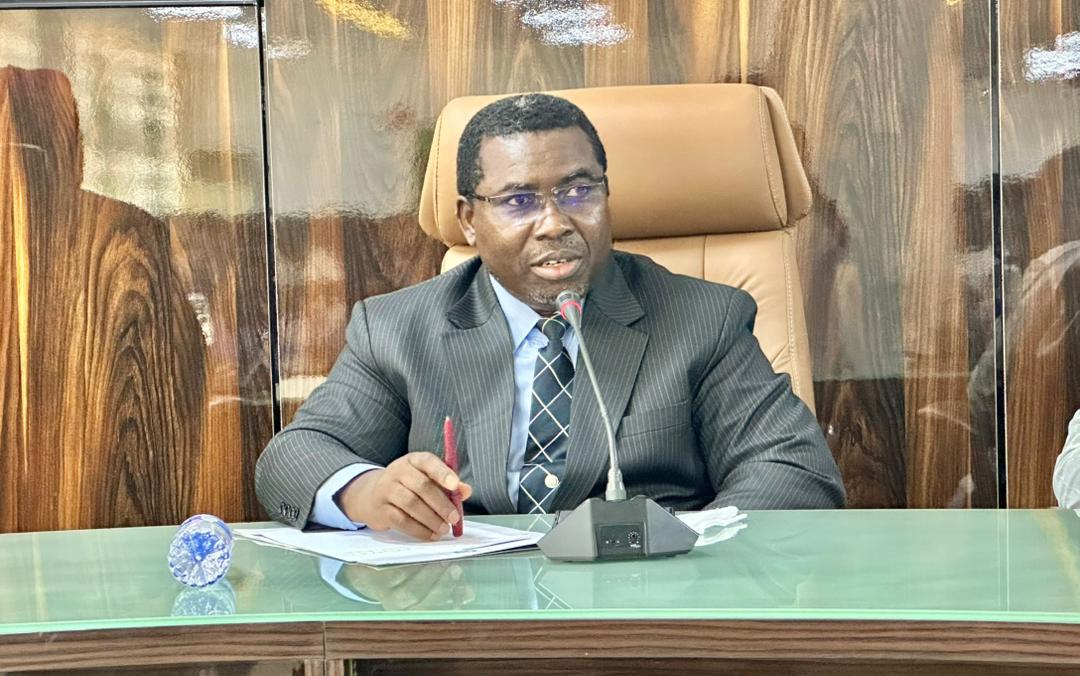
Chairman of the Independent National Electoral Commission (INEC), Prof. Joash Amupitan, has said adequate funding of elections is critical to providing the security and logistics required for successful conduct of the 2027 general elections.
Amupitan stated this on Wednesday in Owerri, Imo State, while delivering a goodwill message at the sixth edition of the Conference and Retreat for Senior Police Officers, themed: “Developing a Nigeria Police Roadmap for Effective Management of Security During Elections.”
The INEC chairman was accompanied by National Commissioners Dr. Ken Nnamdi Ukeagu and Rear Admiral Jamila Abubakar Malaga (Retd.), OFR, mni; the Resident Electoral Commissioner (REC) for Imo State, Chukwuemeka C. Ibeziakor, Esq.; and the Chief Press Secretary/Media Adviser to the Chairman, Mr. Adedayo Oketola. Also on the entourage were Mustapha Muhammad Dogondaji, Personal Assistant; Ahmad Yusuf, Executive Assistant (Finance); and Barr. Ezeh N. Emmanuel, Head of Legal, INEC Imo State.
Amupitan said although the commission’s funding was constitutionally provided as a first-line charge on the Consolidated Revenue Fund, the scale of its responsibilities required sustained financial support to enable it to conduct elections effectively.
He explained that INEC was responsible not only for presidential and National Assembly elections, but also for governorship and state House of Assembly elections, voter registration and the registration of political parties.
According to him, the commission also has statutory powers to request the deployment of security agencies for elections and voter registration, making security an integral part of the electoral process.
He said: “Sometimes, it is not what you would like to do that you are able to do because of financial constraints. The system does make allocations of what is available and what is affordable at a particular time for the expenses and appropriation of the agencies, including the police and also including INEC.”
Amupitan stressed that voter registration remained the foundation of credible elections, saying an inaccurate or outdated voters’ register could undermine the inclusiveness of the electoral process.
He argued that because INEC conducts elections affecting the three tiers of government, election expenditure, including security-related costs, should be approached as a collective national responsibility.
The chairman said adequate funding was particularly important for the deployment of personnel and electoral materials to local government areas, wards, registration areas and polling units.
According to him, even where security agencies succeed in maintaining peace, inadequate logistics could still undermine the conduct of an election.
Amupitan said INEC had made both security and logistics priorities under his leadership, adding that the commission was working with government and security agencies to ensure that operational challenges did not undermine the 2027 polls.
He also highlighted the role of the Inter-Agency Consultative Committee on Election Security (ICCES), describing it as a platform that brings INEC and relevant security and government agencies together to coordinate election security.
He said the committee, which began as a coordinating arrangement after the 2011 general elections following concerns over post-election violence, had evolved into a structured mechanism for election security coordination.
According to him, ICCES now operates at federal, state and local government levels, with the Inspector-General of Police participating at the national level, commissioners of police at the state level and divisional police leadership represented at the local level.
The INEC chairman said stronger coordination among the agencies would be necessary ahead of 2027, noting that the police remained the lead agency when it came to election security.
He also cited recent off-cycle elections as evidence of the importance of adequate security and coordination, recalling that security agencies had helped to resolve incidents that could otherwise have disrupted the electoral process.
Amupitan said the experience of recent elections should be used to strengthen preparations for the 2027 general elections, particularly in intelligence gathering, logistics and inter-agency coordination.
He added that Nigerians expected a highly effective electoral system but must also recognise that achieving such standards required adequate resources.
“In Nigeria, we want the best. We want our electoral system to be 100 per cent. But sometimes we don’t ask ourselves the question: if we want the nation to be perfect, there must be a cost for it,” he said.
He urged the relevant authorities to provide the resources required by security agencies and INEC to perform their respective responsibilities effectively.
Reaffirming the Commission’s commitment to deepening operational synergy through ICCES, the Chairman expressed optimism that the Owerri retreat would produce an actionable, forward-looking roadmap ahead of the 2027 General Elections.
He charged senior police managers to sustain absolute professional neutrality, proactive intelligence gathering, and seamless inter-agency coordination to continuously protect the integrity of the ballot.
President of the Nigerian Bar Association (NBA), Oyinkansola Badejo-Okusanya,
charged the leadership and operational personnel of the Nigeria Police Force to extend their unalloyed support and synergy to the INEC Chairman in fulfilling his mandate.
The NBA President emphasised that robust policing support remains vital to safeguarding the electoral process and guaranteeing the delivery of free, fair, credible, and transparent elections across the nation.
E- Signed:
Politics
CNPP raises alarm over alleged plot to compromise 2027 general elections …Warns against plot by INEC to recruit partisan individuals
By our correspondent
The Conference of Nigeria Political Parties, (CNPP), has raised serious concerns over potential compromise in the recruitment, screening, appointment and deployment of electoral personnel ahead of the 2027 general elections.
In a statement issued on Wednesday by its Deputy National Publicity Secretary, Comrade James Ezema, the group urged the Independent National Electoral Commission, (INEC), to ensure no individual with demonstrable partisan commitments occupies sensitive electoral positions.
The warning follows reported endorsement of President Bola Ahmed Tinubu for re-election by more than 600 senior academics from public universities in Northern Nigeria at a meeting convened in Kaduna in September 2026 by Ibrahim Masari, Special Adviser to the President on Political Matters.
The CNPP noted that reports indicated that the invitation expressly sought endorsement and active support for the President’s 2027 re-election, but said identities of the 600 participants have not been publicly established, while some persons named as participants have denied attending.
The umbrella body of registered political parties said it recognises the constitutional right of every Nigerian, including academics, to support candidates, but stressed that persons who openly express support for a candidate should not be recruited into sensitive electoral positions.
It noted that concern has become important because INEC has commenced recruitment of ad-hoc personnel for 2027, including Supervisory Presiding Officers, Presiding Officers, Assistant Presiding Officers, RAC Managers and Registration Area Technical Support personnel.
The CNPP cited Section 27(1) of the Electoral Act 2022 which provides that INEC shall not appoint as election officer any person who is a member of a political party or who has openly expressed support for any candidate.
It said INEC’s own position ahead of 2023 was that university staff who were card-carrying members of political parties or had obvious political leanings should not be nominated, with Collation and Returning Officers to swear oath of neutrality.
Consequently, the CNPP asked INEC to publicly clarify whether any of the academics reported to have endorsed Tinubu have applied or been considered, how it will verify political endorsements, and what documentary standards it will use to determine open support under Section 27.
The group also called for publication of names of persons appointed to sensitive collation positions, a transparent objection mechanism for parties and civil society, and clarification that no ministry or political actor has role in recommending electoral personnel.
The CNPP warned that if Nigerians believe officials were selected based on loyalty rather than neutrality, confidence in polling and collation could be weakened, urging proactive observation of recruitment, training and result management to protect integrity of 2027 polls now.

No Nation Can Realise Full Potential without Gender Inclusion-Senate Leader
By George Mgbeleke Leader of the Senate, Senator Opeyemi Bamidele Thursday observed that no nation could meaningfully realise its full...

Igbo socio-cultural group lauds Abia first lady over social interventions on vulnerable Abians
By Our Correspondent An Igbo socio-cultural group, Igbo Union (Nzuko Ndi Igbo),has lauded the wife of Abia State Governor, Mrs...

NECO declares 1,406 Candidates indulge in Examination Malpractice in the 2026 SSCE Internal
By Uthman Baba-Naseer,Minna The National Examinations Council (NECO),has revealed that One Thousand, Four Hundred and Six candidates were involved in...

Regional Dev.Ministry Retires 24 Retirees … urges outgoing staff to remain active after retirement
By George Mgbeleke The Ministry of Regional Development has feted 24 retirees, appealing to them to remain active in whatever...

First Niger Bridge Must Not Become Tinubu’s Billboard-HURIWA Tells Works Minister …..Rejects Personalisation of Public Infrastructure
By George Mgbeleke The Human Rights Writers Association of Nigeria (HURIWA) has strongly rejected the directive by the Minister of...

2027: Election security depends on adequate funding, says INEC chairman
By Our Correspondent Chairman of the Independent National Electoral Commission (INEC), Prof. Joash Amupitan, has said adequate funding of elections...
CNPP raises alarm over alleged plot to compromise 2027 general elections …Warns against plot by INEC to recruit partisan individuals
By our correspondent The Conference of Nigeria Political Parties, (CNPP), has raised serious concerns over potential compromise in the recruitment,...


Tinubu Cannot Govern Outside Nigeria Indefinitely, HURIWA Counters Akpabio, Demands Senate Action
By Our Correspondent The Human Rights Writers Association of Nigeria (HURIWA) has strongly rejected the position of the President of...

Edo ASSEMBLY APPROVES STATE POLICE BILL
By Our Corresponent The Edo State House of Assembly has approved the Constitution Alteration Bill seeking the establishment of State...

NECO Register commends staff on their Contributions to growth ,development of the examination body
By Uthman Baba-Naseer,Minna The Registrar of the National Examinations Council (NECO), Professor Dantani Ibrahim Wushishi, has commended staff of the...
-
 Politics1 year ago
Gov Okpebholo moves to end Cultism *Threatens action against leading cult groups *Vows to demolish more cult houses in Edo State
-
 Politics1 year ago
ASUU-NDU protest against FG loans, unpaid salaries,Non-Implementation of agreements …..says loans is generational slavery
-
 Business & Economy1 year ago
PC-NCG Issues Disclaimer on Purported Nigerian Coast Guard National Orientation Exercise In Anambra State
-
 Entertainment2 years ago
Jubilation galore as Parishioners of CKC Kurudu celebrate their cultural heritage ….FG should exploit our Cultural heritage to unite Nigerians-Rev Fr Dim
-
 Sports7 months ago
Bayelsa-born ex-football star’s son, Opuama donates spike shoes to Athletics Association
-

 General News2 years ago
Reps hold public hearing on FMC Ugwuaji Awkunanaw
-
 Law & Crime1 year ago
Legal practitioner raises alarm over threat to his life by CSP Muhammed Abdulkareem
-
 General News2 years ago
Celebration galore as UDA Successfully Elected New Exco ……I will digitalize processes that will raise UDA to greater height -Comr. Okejiri