
Business & Economy
HURIWA: Fire at Alaba Market Amid Rising Demolitions Sparks Worry Over Targeted Economic Displacement

By George Mgbeleke
The Human Rights Writers Association of Nigeria (HURIWA) has expressed concern over the recurring pattern of fires and demolition exercises affecting major markets and commercial areas dominated by Igbo traders in Lagos State, warning that the trend poses a grave threat to national unity and economic stability.
This follows Tuesday’s fire outbreak at the Alaba International Market, Ojo, which razed several shops and warehouses, destroying goods worth several billions of naira. The Lagos State Fire and Rescue Service confirmed its personnel were on the scene to contain the inferno, but videos shared on social media showed traders in anguish as flames engulfed sections of the market.
HURIWA, in a statement issued in Abuja on Wednesday, described the Alaba fire as “a tragic addition to the growing list of incidents undermining the economic base of a specific segment of Nigerians in Lagos,” and called for an independent investigation to determine the cause of the fire and assess the response time of relevant emergency agencies.
The association noted that the incident comes barely weeks after the Lagos State Government carried out large-scale demolitions at the Lagos International Trade Fair Complex in Ojo, despite widespread public condemnation and appeals for dialogue with affected traders. Similar demolitions have also been reported in Alaba Rago, Abule Ado, and parts of Ikota and Lekki, where several businesses owned by Nigerians of southeastern origin were destroyed.
According to HURIWA, these repeated incidents have created a perception of selective enforcement and economic targeting, particularly against Igbo traders, and have deepened ethnic mistrust in the state. The association warned that such actions, whether deliberate or coincidental, have the potential to inflame ethnic tension and should be addressed with urgency and transparency.
“HURIWA has consistently maintained that Lagos remains Nigeria’s commercial capital — a city built by diverse peoples whose contributions sustain its growth,” the statement read. “Any attempt, direct or indirect, to economically or socially alienate a particular ethnic group in Lagos is unconstitutional and unacceptable.”
The rights group also recalled previous statements and incidents that have contributed to ethnic polarisation in the state, including a controversial social media post by presidential aide Bayo Onanuga during the 2023 general elections, which told Igbos to “stay away from Lagos politics,” and threats made by Lagos NURTW chairman, Alhaji Mustapha Adekunle, popularly known as “Sego,” warning that non-supporters of the ruling party would be dealt with in 2027.
HURIWA criticised the failure of security agencies to decisively address such inflammatory rhetoric, describing it as “a dangerous double standard” that encourages hate speech and undermines Nigeria’s constitutional democracy. It called on the Department of State Services (DSS) and the Nigeria Police Force to ensure that all citizens, regardless of political affiliation or ethnic identity, are protected equally under the law.
The association further urged Governor Babajide Sanwo-Olu to publicly reassure Lagos residents that no section of the state would be subjected to targeted economic policies or selective enforcement of urban regulations. It called for a transparent review of recent demolitions and for compensation to be paid where legitimate businesses were affected without due process.
HURIWA emphasised that the real indigenes of Lagos (known historically for their openness and hospitality) have always coexisted peacefully with other Nigerians, and that current tensions are being fuelled by political actors who seek to divide the city for selfish ends.
“Lagos has always been a model of inclusion,” HURIWA stated. “Those attempting to rewrite that heritage through divisive policies or political vendetta are endangering not only the state’s economy but also Nigeria’s fragile unity.”
The group reiterated its call for the Federal Government, the National Human Rights Commission, and the National Assembly to monitor developments in Lagos closely and intervene where necessary to ensure the protection of citizens’ rights and property.






Business & Economy
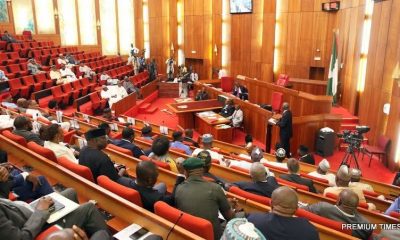
Budget : AGF under fire as Senators lambast him over zero capital allocation to MDAs … Non payment of executed contracts …Centralized payment System
By George Mgbeleke
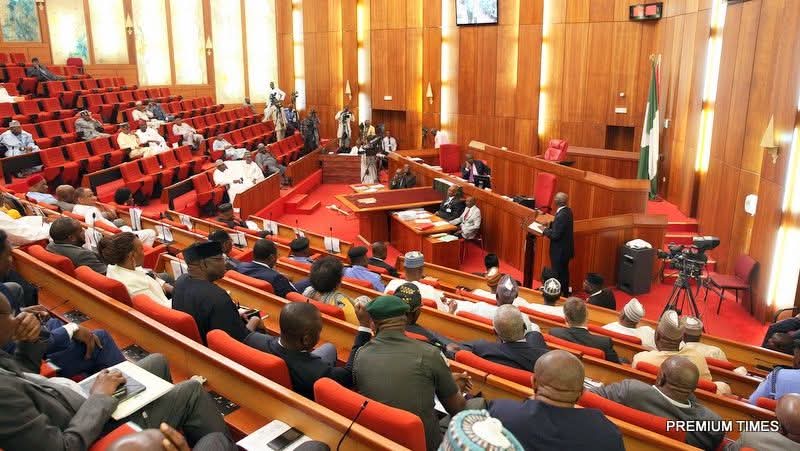
In a bid to put the record straight on the delays in disbursement of funds to Ministries, Departments and Agencies of government,(MDAs) in the previous fiscal year,the Accountant General of the Federation ( AGF) , Dr Shamseideen Ogunjimi was thoroughly grilled by the Senate Committee on Finance during budget defence session on Thursday .
In his opening remarks , Chairman of the Committee , Senator Sani Musa ( Niger East) , raised questions at the AGF , on poor releases of funds to MDAs , statutory bodies and what they termed , frustrating Centralized Payment System for contractors .
Musa pointedly told the AGF that the attitude of his office to the committee , is unfriendly and must change for the good of all .
” We are not going to take your budget until when we are satisfied that your office is ready to do things that will make things work for Nigerians through expected assurances from you .
” One of the issues that must be urgently resolved is the envelope budgeting system being used by the federal government on yearly basis but not producing desired results , requiring alternative model like performance based one “, he said .
In his comments , Senator Danjuma Goje ( Gombe Central) , told the AGF that the Senate and by extension, Nigerians generally , are embarrassed by poor budget implementation being experienced since 2024.
” Here at the National Assembly , we have never seen contractors bombarding us on weekly basis for intervention on non payment of executed contracts .
” Impression given to us and Nigerians by government is that with removal of subsidy and harmonization of forex market , more revenue or more money , where is the money now? Why are contractors owed ? And why was it zero allocation for capital votes of most of the MDAs in 2025?”, he queried.
He added that the situation at hand in the country as far as poor budget implementation is concerned , is very embarrassing and baffling .
Senator Muntari Dandutse ( Katsina South ) in his comments , wondered why N28triilion was reportedly generated by revenue agencies and yet 85% of contractors are being owed and zero allocation for most of the MDAs in 2025 capital component budget , asking ” what happened to the N28trillion “.
” Even the introduced Centralized Payment System is not helping matter at all . The system is very compromised and seriously affecting the integrity of government “, he said .
Other Senators like Abdul Ningi ( Bauchi Central ) , Asuquo Ekpenyong ( Cross River South) , Adams Oshiomhole ( Edo North ) ,Aminu Abbas ( Adamawa Central ) and Patrick Ndubueze ( Imo North), who admonished the AGF to tell President Bola Tinubu to look inward in guarding against sabotage ; also made punchy remarks .
However in his response , the AGF said indiscriminate contracts award made by many of the MDAs without availability of fund , created the mess at hand which according to him , brought up directive banning MDAs from contracts award without availability of funds .
He explained to the lawmakers that though challenges being faced with operation of Centralized Payment System, were not envisaged , but said that they are being addressed for seamless operation
” Yes, as the Accountant General of the Federation , my office is expected to disburse fund to relevant agencies at appropriate time but that can only be done if the fund is available because I must have the fund before I can disburse.
” I also want to remind us that ‘Ways and Means’ used in the past for such funding is no more for the good of the Nation’s economy “, he said .
For further critical engagement with the AGF, the committee thereafter went into closed door session with him .

By George Mgbeleke
In its bid to develop the nation’s road infrastructure and complete abandoned projects ,Minister of Works, David Umahi, has declared that the Ministry’s 2026 capital budget will prioritise the completion of major highways and four “legacy” projects initiated by the Presidency.
Defending the Ministry’s proposal before the Senate and House of Representatives Committees on Works, the Minister said the 2026 capital estimate stands at N3.244 trillion.
He explained that many projects were rolled over after the administration inherited 2,064 ongoing projects in 2023.
Highlighting funding constraints, he disclosed that only N210.318 billion, about 9.7 per cent of the expected capital releases for 2025, has been paid so far.
He added that contractors are owed approximately N2.2 trillion for certified work carried out between 2024 and 2025.
The Minister said rising costs following the removal of fuel subsidy and the floating of the naira forced the government to re-scope and reprioritise projects.
Mr. Umahi listed key legacy projects, including the Lagos–Calabar Coastal Highway and the Sokoto–Badagry Superhighway, assuring lawmakers that delivery would be phased, with some sections scheduled for commissioning by May 29, 2026.
He noted that about 70 per cent of unfinished 2025 projects were carried into the 2026 plan, adding that new phases would be funded in stages to ensure timely completion.
During the session, Mr. Umahi announced an aggressive road infrastructure plan for 2026, termed an “Action Year,” aimed at completing major highway projects and four “legacy” projects initiated by the administration.
The Minister emphasized that road infrastructure is critical for security and economic recovery, noting that the 2026 budget intends to fix major arterial roads.
To ensure accountability, Mr. Umahi announced that all 10-kilometer stretches of federal road construction will now feature signboards identifying the ministry and displaying the President’s photograph.
The Nigeria’s Minister of Works praised President Bola Tinubu for his support, stating that the President has never directed him to award contracts to specific individuals, which has eased the procurement process.
Business & Economy
2026 budget:Oyetola proposes ₦10.5bn 2026 Marine and Blue Economy Budget, Laments Inadequate Funding
By George Mgbeleke
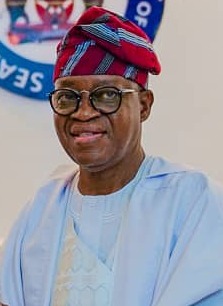
The Minister of Marine and Blue Economy, Dr Adegboyega Oyetola, on Tuesday presented a ₦10,499,984,667.10 budget proposal for the Federal Ministry of Marine and Blue Economy for the 2026 fiscal year, lamenting that the allocation was grossly insufficient to effectively execute the ministry’s wide-ranging mandate critical to Nigeria’s trade, transport efficiency and food security.
Oyetola made this known while defending the ministry’s budget before a joint sitting of the Senate Committee on Marine Transport and the House of Representatives committees on Ports and Harbours; Maritime Safety, Education and Administration; Shipping Services; Inland Waterways; and Ocean and Fisheries.
He said the proposed budget, which comprises ₦8.24 billion for capital expenditure, ₦453.86 million for overheads and ₦1.81 billion for personnel costs, would only sustain minimal operational continuity rather than deliver meaningful reforms or sectoral growth.
The Minister explained that the ministry oversees interconnected subsectors including ports, shipping, inland waterways, fisheries and aquaculture, which collectively handle over 90 per cent of Nigeria’s international trade by volume, national food and nutrition security, and economic competitiveness. He noted that while agencies such as the Nigerian Ports Authority, Nigerian Maritime Administration and Safety Agency and Nigerian Shippers’ Council were self-funding and made significant remittances to the Consolidated Revenue Fund, their operations were being severely constrained by excessive deductions at source by the Office of the Accountant-General of the Federation.
According to him, these deductions had weakened liquidity and reduced the operational flexibility of key agencies responsible for maritime safety, port efficiency and regulatory oversight, with far-reaching consequences including port congestion, higher logistics costs, delayed cargo movement, revenue losses and inflationary pressures. He stressed that what appeared to be an accounting issue had become a national economic concern.
Oyetola also said that the 2026 budget of the Council for the Regulation of Freight Forwarding in Nigeria (CRFFN) was wrongly placed by the Budget Office under the Federal Ministry of Transportation despite the fact that it is an agency under the Federal Ministry of Marine and Blue Economy, saying the misalignment undermined clarity in oversight and policy coherence within the maritime logistics value chain.
On inland waterways, the Minister appealed for increased funding to curb accidents and loss of lives. He said water transport is globally recognised as significantly cheaper than road transport. He noted that Nigeria’s heavy reliance on road haulage for over 80 per cent of freight movement had worsened road deterioration and increased the cost of goods, arguing that safer and more efficient inland waterways would ease pressure on roads and lower logistics costs.
On fisheries and aquaculture, Oyetola said Nigeria’s annual fish demand of over 3.6 million metric tonnes far exceeded domestic production of about 1.4 million metric tonnes, sustaining imports valued at more than one billion dollars annually. He added that post-harvest losses of up to 30 per cent further reduced supply, despite fish being one of the most affordable sources of animal protein for Nigerian households. He assured that the Ministry is working hard to increase local fish production and reduce importation.
The minister disclosed that in 2025, the ministry’s revised capital budget of ₦3.53 billion recorded an actual cash release of just ₦202.47 million, representing about 1.7 per cent, while overhead releases stood at 35 per cent.
He said engagements were ongoing with the Ministry of Budget and Economic Planning to address the funding gaps in line with the Federal Government’s drive to diversify the economy through the marine and blue economy.
The Chairman of the Senate Committee on Marine Transport, Senator Wasiu Eshilokun, assured that the National Assembly would carefully examine tc he proposals, noting the strategic importance of the marine and blue economy to national development and economic resilience.

ADC Flags Off Membership Revalidation, Mobilisation and Registration; …… Inaugurates State MRMR Committees in Abuja
By Our Correspondent The African Democratic Congress (ADC) has successfully flagged off its nationwide Membership Revalidation, Mobilisation and Registration (MRMR)...

Budget : AGF under fire as Senators lambast him over zero capital allocation to MDAs … Non payment of executed contracts …Centralized payment System
By George Mgbeleke In a bid to put the record straight on the delays in disbursement of funds to Ministries,...
Real-time Transmission of Election Results Doesn’t Translate to E-Voting, Senate Clarifies …..Says IReV wasn’t specifically designed for electronic voting ……Faults claims that it declined the use of IReV for 2027 polls
By George Mgbeleke The Senate has clarified that the electronic transmission of election results in real time does not translate...
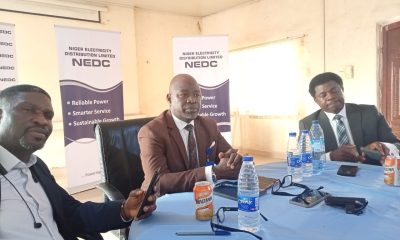

NEDC Strengthens Ties with Journalists to Boost Public Awareness
BY UTHMAN BABA-NASEER,MINNA The Niger Electric Distribution Company Limited (NEDC) has announced plans to partner with journalists to improve development...


Bayelsa High court Jails a 29 -Year-Old man For Sexually Assaulting A minor
By David Owei,Bayelsa A Bayelsa State High Court sitting in Yenagoa has sentenced a 29-year-old man, Ebimie Ajalla of Polobubo...
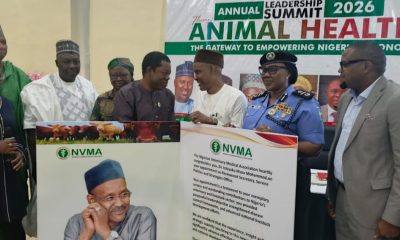

Veterinarians crucial to successful agenda on food security, employment -FG
By Abdul-Ganiyy Akanbi, The Federal Government has said veterinary professionals have a critical role to play in the realization of...
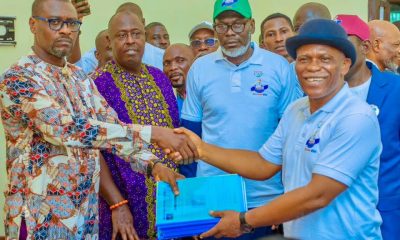

INC scribe, Engr. Ebipamowei Wodu, submits nomination form for position of President …. gets wide endorsement from aspirants
By David Owei The National Secretary of the Ijaw National Congress INC, Engineer Ebipamowei Wodu has submitted his interest/nomination form...

Niger state Judiciary launches its Electronic Filling (E- Filling) system across all High courts
By Uthman-Baba Naseer, Minna In a significant move towards digitalizing the Judicial process,the Niger State High Court has formally launched...


Lagos-Calabar, Sokoto-Badagry Coastal Highway Top N3.2trn Works Budget-Umahi
By George Mgbeleke In its bid to develop the nation’s road infrastructure and complete abandoned projects ,Minister of Works, David...

AIG Disu Assumes Duty as 55th AIG of FCID Annex Alagbon, Lagos.
Jonas Ezieke, Abuja The Force Criminal Investigation Department (FCID) Annex, Alagbon Close, Ikoyi, Lagos, of the Nigeria Police Force NPF...
-
 Politics6 months ago
ASUU-NDU protest against FG loans, unpaid salaries,Non-Implementation of agreements …..says loans is generational slavery
-
 Politics9 months ago
Gov Okpebholo moves to end Cultism *Threatens action against leading cult groups *Vows to demolish more cult houses in Edo State
-
 Business & Economy6 months ago
PC-NCG Issues Disclaimer on Purported Nigerian Coast Guard National Orientation Exercise In Anambra State
-
 Entertainment2 years ago
Jubilation galore as Parishioners of CKC Kurudu celebrate their cultural heritage ….FG should exploit our Cultural heritage to unite Nigerians-Rev Fr Dim
-

 General News2 years ago
Reps hold public hearing on FMC Ugwuaji Awkunanaw
-
 General News2 years ago
Celebration galore as UDA Successfully Elected New Exco ……I will digitalize processes that will raise UDA to greater height -Comr. Okejiri
-
 Law & Crime8 months ago
ICPC pledges to collaborate with FIDA to end Sex for Marks in tertiary institutions
-
 Law & Crime7 months ago
Legal practitioner raises alarm over threat to his life by CSP Muhammed Abdulkareem