
Opinion
How Akpabio’s Leadership Secured Nigeria’s Electoral Future* *

By Rt.Hon Eseme Eyiboh mnipr
In the evolving story of Nigeria’s democratic consolidation, few issues have provoked as much intensity as electoral reform. The signing into law of the Electoral Act (Repeal and Re-enactment) Bill 2026 by President Bola Ahmed Tinubu marked another chapter in this journey, drawing applause, skepticism, and fierce debate in equal measure.
At the centre of this moment stands Godswill Akpabio, President of the Senate, who has consistently articulated a position that blends institutional caution with reformist intent. His assertion that the National Assembly met “the aspirations of Nigerians, not a few people who make noise” reflects not merely rhetorical flourish, but a deeper philosophy of lawmaking anchored in constitutionalism, legislative procedure, and national peculiarities.
To understand Akpabio’s positioning, one must situate the reform within Nigeria’s broader democratic trajectory. Since the country’s return to civilian rule in 1999, electoral reforms have often oscillated between technological optimism and structural reality. The 2026 re-enactment does not discard innovation; rather, it recalibrates it. In defending the new Act, Akpabio emphasized that the National Assembly undertook a “painstaking” and “thorough” process, mindful of the country’s infrastructural limitations, judicial precedents, and the ultimate objective of preventing disenfranchisement.
A key flashpoint in the debate was the question of electronic transmission of results. For many reform advocates, real-time electronic transmission became symbolic of transparency. Yet Akpabio’s argument was not against technology; it was against rigidity detached from capacity. He consistently maintained that technology must serve democracy, not endanger it. In a country where broadband penetration is uneven, where insecurity disrupts network infrastructure across multiple states, and where power supply remains inconsistent, embedding inflexible “real-time” mandates into statute could, in his view, expose elections to avoidable litigations and invalidation.
This perspective aligns with the constitutional role of the legislature. The Senate does not conduct elections; it makes laws. The responsibility for operational modalities rests with the Independent National Electoral Commission (INEC), which applies the law within its administrative and technical capacity. By leaving room for INEC to determine timing and modalities of transmission, the Act reflects a respect for institutional boundaries. Akpabio’s defense of this approach underscores his insistence that Parliament legislate for posterity, not for transient political advantage.
At the State House signing ceremony, President Tinubu reinforced this institutional clarity. He observed that Nigeria’s elections remain “essentially manual.” Ballots are cast manually, counted manually, and declared by human beings. While electronic viewing enhances transparency, the core process remains human-centered. Tinubu’s caution about broadband readiness and cyber vulnerabilities echoes Akpabio’s reasoning. Together, their statements project a governance philosophy that privileges clarity and feasibility over performative reform.
Perhaps the most celebrated innovation in the new Act is the formal legal recognition of the Bimodal Voter Accreditation System (BVAS) result viewer, commonly referred to as IReV. This recognition represents a significant milestone. For the first time since independence in 1960, electronic viewing of polling unit results is explicitly grounded in statutory authority. Under the amended framework, results transmitted electronically—even if delayed due to connectivity issues—must ultimately reflect on the IReV portal once network is restored. This creates a verifiable digital trail that citizens, observers, and parties can scrutinize and interrogate.
Akpabio described this as a landmark safeguard against a historic problem: tampering between polling units and collation centres. By ensuring that Form EC8A—the primary polling unit result form signed by presiding officers and party agents—feeds into a publicly accessible portal, the law strengthens accountability without discarding manual collation procedures validated by courts.
The Supreme Court’s pronouncements in post-2023 election litigation had clarified that IReV, as previously configured, was not the definitive legal record of results. Rather than ignore this judicial interpretation, the legislature responded by integrating electronic viewing into statutory text while preserving the evidentiary primacy of signed result forms. This harmonization of law and jurisprudence illustrates legislative maturity.
Critics, including the opposition parties, alleged that the Act’s signing reflected partisan fear. Civil society voices such as Yiaga Africa described the reform as incremental where transformation was needed. Yet even among critics, a pragmatic thread emerged.
The Civil Society Legislative Advocacy Centre and the Transition Monitoring Group urged acceptance of the law while focusing attention on demanding credible conduct from INEC. This convergence suggests that while disagreements persist about optimal reform design, there is recognition that institutional strengthening is iterative.
Akpabio’s stance during earlier debates further illuminates his approach. On February 8, at a public presentation of Senator Effiong Bob’s book in Abuja, he cautioned against hasty conclusions about an amendment process still underway. His insistence that commentators wait until Votes and Proceedings were finalized before passing judgment reflects a proceduralist ethos.
Legislative drafting is iterative. Clauses are debated, amended, harmonized between chambers, and only then crystallized into final text. By defending this process against what he termed premature media trials, Akpabio positioned himself as a guardian of institutional integrity.
His critique of “retreat politics” is equally telling. Consultative retreats, he argued, are valuable but not binding. Final authority rests on the Senate floor, where clauses are debated and voted upon. This distinction reinforces parliamentary sovereignty within Nigeria’s constitutional framework. It also shows a deeper democratic principle: advocacy informs lawmaking, but elected representatives deliberate and decide.
Another noteworthy provision in the amended Act concerns internal party democracy. By empowering party members to vote directly for candidates during primaries, the law dilutes the dominance of small delegate blocs. In theory, this broadens participation, reduces transactional politics, and enhances legitimacy. Akpabio’s highlighting of this reform signals an understanding that electoral integrity begins within parties, not merely at polling units.
The Act also addresses scenarios where leading candidates are disqualified by courts. By mandating fresh elections in such circumstances, it prevents outcomes where significantly lower-polling candidates assume office by default. This provision closes a loophole that had generated controversy in past cycles. In doing so, the legislature strengthens the moral authority of electoral outcomes.
The reduction of statutory notice for elections from 360 days to 300 days, may appear technical but carries practical implications. It allows scheduling flexibility, including the possibility of avoiding sensitive religious periods such as Ramadan and Lent. This demonstrates legislative sensitivity to socio-cultural realities—a recurring theme in Akpabio’s rhetoric about Nigeria’s peculiarities.
Opposition criticisms deserve engagement. The PDP characterized the signing as hurried and partisan. Yet the legislative timeline reflects deliberation across chambers, conference committee harmonization, and eventual executive assent. Moreover, the principle of the legislative-executive cooperation is intrinsic to constitutional governance. The swift assent by President Tinubu can be interpreted not as haste but as responsiveness to parliamentary consensus.
Support from figures like Nyesom Wike reinforces the perception that the reform commands cross-sectional backing within the governing architecture. Wike’s description of democracy as a “work-in-progress” aligns with Akpabio’s incrementalist philosophy. Reform, in this view, is evolutionary rather than revolutionary.
Central to Akpabio’s defense is the rejection of absolutism. Mandating real-time electronic transmission in a context of infrastructural fragility could render entire states’ results vulnerable to nullification due to network outages. He invoked comparative examples, including electoral disputes in advanced democracies, to illustrate that even technologically sophisticated systems encounter anomalies. The lesson he draws is humility: laws must anticipate worst-case scenarios.
This caution is not synonymous with conservatism. By embedding IReV recognition in statute, the Act advances transparency beyond previous frameworks. It creates a hybrid model—manual voting and collation complemented by electronic visibility. Such hybridity may represent a uniquely Nigerian pathway, blending global best practices with domestic constraints.
Akpabio’s rhetorical framing—distinguishing “noise” from lawmaking—has attracted attention. While critics may interpret it as dismissive, it also speaks to a tension in contemporary democracies: the amplification of vocal minorities through media ecosystems. Legislative legitimacy, however, derives from electoral mandate and constitutional procedure. By emphasizing the “generality of Nigerians,” Akpabio situates himself within a majoritarian democratic theory tempered by rule of law.
The question of disenfranchisement further illuminates his position. If technological failure in insecure or rural areas invalidated results, marginalized communities could bear disproportionate impact. By allowing delayed electronic uploads once connectivity is restored, the Act seeks to reconcile inclusivity with transparency. This compromise reflects distributive sensitivity.
In evaluating Akpabio’s stewardship, one must also consider his broader legislative philosophy. He repeatedly asserts that laws must outlast individuals. This intergenerational perspective discourages tailoring statutes to immediate partisan contests. Whether one agrees with every clause, the emphasis on durability highlights a statesmanlike orientation.
The reactions from civil society, though critical, implicitly acknowledge the dynamic nature of reform. Calls to continue advocating improvements indicate that the 2026 Act is part of an ongoing process. Akpabio himself has stated that doors remain open. This openness suggests confidence rather than defensiveness.
Ultimately, the measure of electoral reform lies not only in statutory text but in implementation. INEC’s capacity, political party behavior, judicial adjudication, and citizen vigilance will shape outcomes. Yet legislation provides the framework within which these actors operate. By integrating electronic viewing, clarifying collation hierarchies, strengthening internal party democracy, and closing disqualification loopholes, the National Assembly has recalibrated that framework.
In positioning Akpabio in a favorable light, it is important to avoid hagiography. Democratic leadership entails contestation. However, his consistent themes—respect for process, infrastructural realism, institutional boundaries, and posterity—form a coherent narrative. Rather than capitulate to populist maximalism or resist reform altogether, he charted a middle course.
Nigeria’s democracy, like many across the globe, navigates between aspiration and capacity. Technological for determinism offers seductive simplicity; constitutional prudence demands complexity. In the crucible of electoral reform, Akpabio has presented himself as a custodian of that prudence. Whether history ultimately vindicates every provision of the 2026 Act will depend on future elections. But as of its enactment, the legislative record reflects a deliberate attempt to harmonize innovation with stability.
The broader democratic project requires precisely this balance. Transparency without feasibility breeds litigation. Feasibility without transparency breeds distrust. By embedding electronic visibility within a manual backbone, the Act seeks equilibrium. In championing this architecture, Akpabio aligns himself with a vision of reform that is incremental yet substantive, cautious yet forward-moving.
As Nigeria approaches future electoral cycles, the real test will be whether citizens experience greater confidence, fewer disputes, and clearer outcomes. Should that occur, the painstaking deliberations defended by the Senate President may be remembered not as noise, but as necessary groundwork. In that sense, Akpabio’s insistence that lawmaking differ from clamor may prove less a rebuke than a reminder: democracy flourishes not only through passion, but through patient construction of rules capable of enduring the storms of politics. Nigeria’s Electoral Future shall have Senator Godswill Akpabio positively mentioned in its repository.
Rt Hon Eseme Eyiboh mnipr
Special Adviser on Media/Publicity and official Spokesperson to the President of the Senate
By Emmanuel Nnadozie Onwubiko
In Nigeria and in so much of the black continent of Africa, the institutions of law enforcement are only strong to the extent that those who are subjected to the full wrath of the law are not connected to the powers that be. In Nigeria, the citizens are not all equal before the law because most times, the law enforcers look at the faces of the people they ought to arrest and if they are connected to senior government officials, they are spared. In Nigeria, only the poor suffer whilst those connected to those who are in authority are excluded from the scrutiny mounted by the police. It is said that the officials of the law enforcement agencies are dictated to by senior government officials and instructed on how to go about enforcing the law.
In Nigeria, for instance, family members of those who wield political influences and powers such as the Governors and the President, are treated as sacred cows and the country pays so much to provide security cover for these privileged persons with filial connection to the public office holders. Definitely, in Nigeria, the direct children of the president and governors are assumed by the police to be above the law. Nigeria has been made to be a country in which individuals who wield political influences, behave as if they are bigger than even the institutions of law enforcement.
If for instance, the brother of the president is accused of any infraction such as the allegation of having sex with underage girls, or suspicion of misconduct in public office, it is definitely not possible to expect that the Nigeria Police Force can effect the arrest and prosecution of the accused individual. As stated earlier, those who have any direct links to those in political offices are treated differently from the rest of the people who are assumed to be the commoners.
In a lot of nations of Africa, for instance, in Nigeria or Uganda, the sons of the president behave as if they are above the law and these people enjoy unfettered access to the highest number of armed security forces moving about with them. In Uganda, the President somehow managed to find a slot in the Ugandan Army for his first son just as the Uganda political establishment railroaded the first son of the president of Uganda to the rank of a General and the father appointed him as head of the Defence sector. That first son of Yoweiri Museveni has been involved in high profile politically charged controversial incidents. He was recently accused of ordering the arrest of the opposition politician who recently challenged his father during the last presidential election which reportedly saw his father winning the election even after he has been the president for over three decades.
In Nigeria, the first son of the president, Mr. Seyi is living so large so much so that he enjoys very elaborate security details at public costs. Seyi is reportedly protected by soldiers, DSS operatives and the police. The son of president Tinubu is also rumoured to be so powerful and influential that he has been directly linked to some persons who got high federal appointments in his father’s administration through his influence.
It is even said in the media circles that within the office of the president, that there are two distinct cabals headed by Seyi and the other by the Chief of Staff to President Tinubu and these cabals are alleged to be influencing most of the decisions made by the current administration in Nigeria. Nobel laureate Professor Wole Soyinka recently voiced his condemnation of the massive security forces that protect just one person only because he is Seyi Tinubu. Soyinka’s public outburst was significant going by the fact that Soyinka had rarely spoken out against the actions or inactions of president Tinubu even when the administration has inflicted the harshest economic recessions in the history of Nigeria. Soyinka have always maintained sealed lips against President Tinubu. But he spoke out about Seyi who is enjoying so much of privileges only because he is the son of the president.
But this is not the same with advanced societies. In the United Kingdom, a senior member of the Royal family Andrew is under arrest by the police.
Andrew Mountbatten-Windsor, who until he was stripped of his Royal title of a Prince, has been arrested on suspicion of misconduct in public office after police opened an investigation linked to his dealings with the late sex offender Jeffrey Epstein. Jeffrey Epstein is the character behind the infamous Epstein files in which Andrew and several other powerful figures around the World were mentioned.
Thames Valley Police said officers detained a man in his sixties from Norfolk on Thursday morning and carried out searches at addresses in Berkshire and Norfolk. The force did not name the suspect, in line with national guidance. Multiple British media outlets, including the BBC and The Guardian, identified the man as Andrew Mountbatten-Windsor.
Police confirmed the man “remains in police custody at this time”. Assistant Chief Constable Oliver Wright said: “Following a thorough assessment, we have now opened an investigation into this allegation of misconduct in public office. It is important that we protect the integrity and objectivity of our investigation as we work with our partners to investigate this alleged offence.”
He added: “We understand the significant public interest in this case, and we will provide updates at the appropriate time.”
International media cited photographs published on Thursday showed unmarked police vehicles and plainclothes officers at Wood Farm on the Sandringham estate in Norfolk shortly after 8am.
The BBC reported that searches were also under way at Royal Lodge in Windsor Great Park, where Mountbatten-Windsor lived until recently. Norfolk Constabulary said it was “supporting a Thames Valley Police investigation into misconduct in a public office”.
The arrest took place on Mountbatten-Windsor’s 66th birthday. He moved earlier this month to Wood Farm on the Sandringham estate.
Already the King of England, King Charles 111 has publicly supported the decision of the police to arrest his brother who is eight in line tk the Royal throne. This is extraordinary and this truly demonstrates the principle that nobody is above the law.
King Charles has officially released a statement as follows:
“I have learned with the deepest concern the news about Andrew Mountbatten-Windsor and suspicion of misconduct in public office,” Charles said, per the BBC. “What now follows is the full, fair and proper process by which this issue is investigated in the appropriate manner and by the appropriate authorities. In this, as I have said before, they have our full and wholehearted support and co-operation. Let me state clearly: the law must take its course. As this process continues, it would not be right for me to comment further on this matter. Meanwhile, my family and I will continue in our duty and service to you all. Charles R.”
A British media outlet wrote that King Charles and other senior royals have maintained a “business as usual” approach this week, and “some senior royals” even have engagements later today.
A statement from the police reads “As part of the investigation, we have today (19/2) arrested a man in his sixties from Norfolk on suspicion of misconduct in public office and are carrying out searches at addresses in Berkshire and Norfolk. The man remains in police custody at this time. We will not be naming the arrested man, as per national guidance. Please also remember that this case is now active so care should be taken with any publication to avoid being in contempt of court.”
The lessons or lesson for us in Nigeria and so much of the African continent, is that a society that does not respect equality before the law for all citizens, is unworthy of being categorised as civilised and democratic because civilisation and democracy only thrive when all citizens are treated equally before the law. And the truth is that until we in Nigeria and Africa allow the institutions of law enforcement to operate independently and freely and to ensure that nobody is above the law, then Nigeria and these African nations will continue to revolve around the chair of lack of development and we would be far from civilisation. Nigerians and Africans must be vigilant and insist on the supremacy of the rule of law.

By George Mgbeleke
The Human Rights Writers Association of Nigeria (HURIWA) has dismissed the recent legal moves targeting the Minister of Interior, Olubunmi Tunji-Ojo, as a politically motivated distraction aimed at undermining his growing national profile, insisting that the attacks appear driven by speculation about a possible governorship ambition in Ondo State; an ambition the minister has not even declared.
Reacting to reports that the Federal High Court in Abuja granted an activist permission to question the minister’s WAEC certificate while rejecting a separate request relating to his NYSC discharge, the group described the pattern of litigation as a coordinated smear campaign disguised as civic engagement. Besides, HURIWA expressed disappointment that someone could go to court just to verify a WAEC result that can seamlessly be accessed by buying WAEC scratchcard and then verify in real time.
In a statement issued in Abuja, HURIWA said it finds it disturbing that credentials already accepted by statutory institutions such as the West African Examinations Council and the National Youth Service Corps are suddenly being dragged into public controversy through the courts without credible evidence of wrongdoing.
The association noted that Justice Binta Nyako granted leave for inquiry into the minister’s secondary school certificate, while Justice Joyce Abdulmalik declined the broader NYSC-related request, ruling that the applicant failed to establish sufficient public interest. According to the group, the latter decision exposes the intrusive and speculative nature of the demands.
HURIWA argued that academic credentials used for university admission and completion of national service already undergo several layers of institutional verification, making fresh court-driven probes unnecessary unless supported by concrete proof of forgery or misconduct.
The group said the development reflects a familiar Nigerian political pattern in which litigation, petitions and media narratives are deployed to weaken perceived frontline contenders ahead of election cycles. It expressed concern that even though the minister has not indicated any intention to contest the next governorship election in Ondo State, political actors fearful of that possibility appear to be mounting pre-emptive attacks against him.
HURIWA warned that turning the courts into arenas for speculative credential disputes risks trivialising the justice system and weaponising transparency mechanisms for partisan objectives.
The organisation further stressed that public accountability must not be reduced to fishing expeditions into personal records, financial history or service documentation without compelling justification, cautioning that normalising such tactics could expose many public officials to harassment by political opponents posing as whistleblowers.
HURIWA therefore urged political stakeholders in Ondo State to prioritise governance debates and policy alternatives rather than personality-driven attacks. It described it as deeply unfortunate that a serving minister focused on national responsibilities is being targeted based on assumptions about a governorship ambition he has not expressed.
The group also called on civil society organisations to resist being drawn into elite political rivalries, warning that advocacy loses credibility when it appears selective or strategically timed.
HURIWA concluded that while lawful scrutiny of public officials remains legitimate, such actions must be evidence-based, proportionate and genuinely in the public interest; not deployed as a pre-election weapon against individuals whose rising influence unsettles entrenched interests.
By Abdul-Ganiyy Akanbi
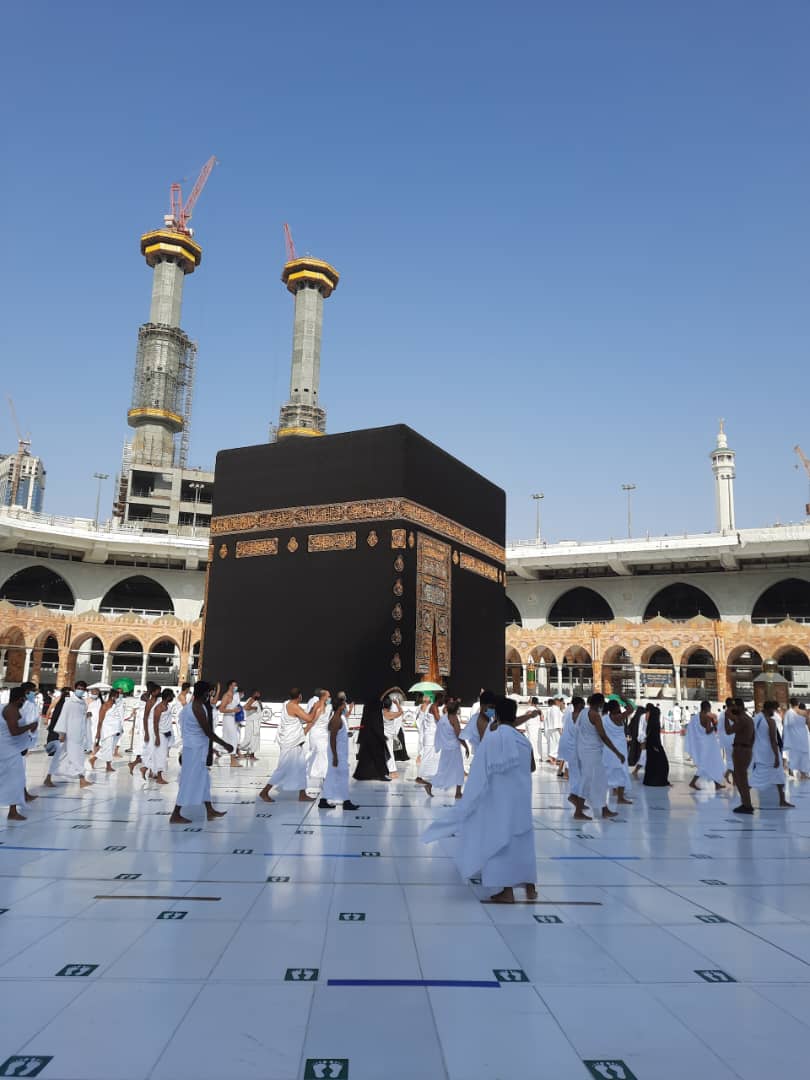
President Bola Tinubu has written to the Senate seeking confirmation of the nomination of Ambassador Ismail Abba Yusuf as the chairman of the National Hajj Commission of Nigeria, NAHCON.
This was disclosed on Tuesday, via a letter addressed to the Senate President, Senator Godswill Akpabio and read during plenary.
Tinubu explained that the request was made in compliance with the provisions of the law guiding appointments into the commission, and therefore, urged the upper legislative chamber to expedite consideration of the nominee in line with Section 3(2) of the NAHCON Act, 2006.
“While it is my hope that the senate will consider and confirm the appointment expeditiously, please accept, Mr Senate President and distinguished Senators, the assurances of my highest regards,” the letter read.
Tinubu had last week nominated Yusuf, a retired career diplomat, and the immediate past Ambassador of Nigeria to the Republic of Turkiye as the NAHCON’s new chairman following the resignation of Professor Abdullahi Saleh Usman a.k.a Pakistani.
Born on July 7, 1962 at Mubi, Adamawa State, Yusuf graduated from Usman Danfodio University, Sokoto in 1985 with an Honors degree in Political Science. He completed the mandatory National Youth Service Corps, NYSC program at the Ijebu Chamber of Commerce, Industry, Mines and Agriculture in 1986, and immediately gained employment into the Foreign Service in December 1986.
The chairmanship nominee attended several advance professional courses and rose to the rank of Director in 2013. He was subsequently appointed Ambassador extra-ordinary and Plenipotentiary to the Republic of Turkiye in 2021.
He played a pivotal role in accelerating strategic relationship with Turkiye focused heavily on defense, security, trade and investment, and industrial


How Akpabio’s Leadership Secured Nigeria’s Electoral Future* *
By Rt.Hon Eseme Eyiboh mnipr In the evolving story of Nigeria’s democratic consolidation, few issues have provoked as much intensity...

Senate Tackles Economy Team on unrealistic budgets assumptions , implementation failures …Upload your cash plans by Monday-Finance Minister tells MDAs
By George Mgbeleke The Senate on Thursday tackled economic team of the federal government on poor annual budgets implementation largely...

Fear grips residents of Ibadan as suspected herdsmen behead woman … Council boss appeals for calm, reaffirms reinforcement of ban on open grazing
By Our Correspondent There was panic and fear among residents of Ido Local Government Area of Oyo State following the...
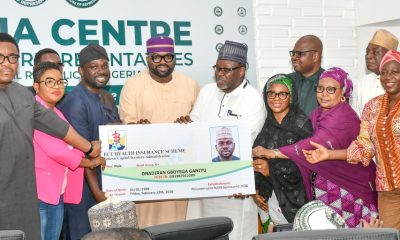

House of Reps Press Corps Members Get Health Insurance Coverage
By Our Correspondent To secure the health condition of its members,Over one hundred members of the House of Representatives Press...

Electoral Law: ADC Vows to Mobilise Nigerians -Says Tinubu has Corrupted Democracy
By George Mgbeleke The African Democratic Congress (ADC) has said President Bola Tinubu’s hasty assent to the controversial Electoral...
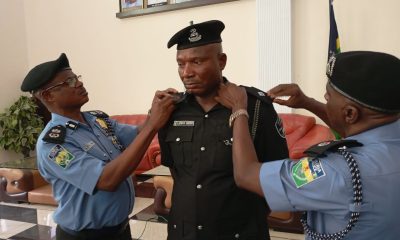

Police promotes 228 Inspectors to ASP in Bayel
By David,Bayelsa Authorities of the Nigerian Police Force has promoted 228 Policemen in the Bayelsà Command from the rank of...
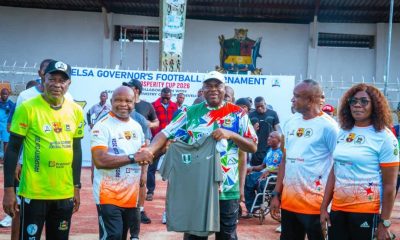

Gov. Diri Restates Call for IOCs to Fund Prosperity Cup … As Tournament Organizers Conclude Season 8 Draws
By David Owei,Bayelsa Bayelsa State Governor, Senator Douye Diri has charged multinational oil companies and other corporate organizations operating in...


Ex-prince Andrew’s arrest, lessons for Nigeria
By Emmanuel Nnadozie Onwubiko In Nigeria and in so much of the black continent of Africa, the institutions of law...


Niger state Police Command urges newly promoted ASPs to reciprocate new ranks,imbibe discipline in discharge of duty
BY UTHMAN BABA-NASEER,MINNA Newly promoted Assistant Superintendent of Police,(ASPs) in Niger State Police Command,have been admonished to reciprocate their new...


Diri Tasks Team Bayelsa on Title Defence as Contingent Departs for NDDC Games
By David Owei,Bayelsa Bayelsa State Governor, Senator Douye Diri, has charged Team Bayelsa to retain its title at the forthcoming...
-
 Politics6 months ago
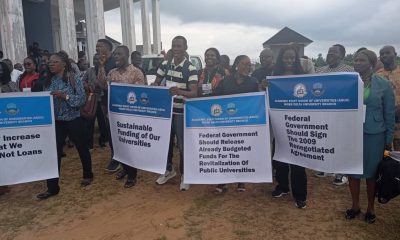
ASUU-NDU protest against FG loans, unpaid salaries,Non-Implementation of agreements …..says loans is generational slavery
-
 Politics9 months ago
Gov Okpebholo moves to end Cultism *Threatens action against leading cult groups *Vows to demolish more cult houses in Edo State
-
 Business & Economy6 months ago
PC-NCG Issues Disclaimer on Purported Nigerian Coast Guard National Orientation Exercise In Anambra State
-
 Entertainment2 years ago
Jubilation galore as Parishioners of CKC Kurudu celebrate their cultural heritage ….FG should exploit our Cultural heritage to unite Nigerians-Rev Fr Dim
-

 General News2 years ago
Reps hold public hearing on FMC Ugwuaji Awkunanaw
-
 General News2 years ago
Celebration galore as UDA Successfully Elected New Exco ……I will digitalize processes that will raise UDA to greater height -Comr. Okejiri
-
 Law & Crime9 months ago
ICPC pledges to collaborate with FIDA to end Sex for Marks in tertiary institutions
-
 Law & Crime7 months ago
Legal practitioner raises alarm over threat to his life by CSP Muhammed Abdulkareem