
Politics
When Transparency Becomes Luxury: INEC and ₦1.5B FOI Controversy

By Chike Walter Duru
When the Independent National Electoral Commission (INEC) recently demanded a staggering ₦1.5 billion from a law firm for access to the national register of voters and polling units, many Nigerians were left bewildered. The request was made under the Freedom of Information (FOI) Act, 2011 – a law designed to make public records accessible, not to commercialize them. INEC’s justification, couched in legalese and bureaucratic arithmetic, raises a deeper question: Is Nigeria’s electoral umpire genuinely committed to transparency and accountability?
At the heart of this controversy is a simple statutory principle. Section 8(1) of the Freedom of Information Act clearly stipulates that where access to information is granted, the public institution may charge “an amount representing the actual cost of document duplication and transcription.” The framers of this law envisioned modest fees; not financial barriers.
INEC, however, appears to have stretched this provision beyond reason. By invoking its internal guideline of ₦250 per page, the Commission arrived at the colossal figure of ₦1,505,901,750 for 6,023,607 pages – supposedly the total pages needed to print the entire national voters’ register and polling unit list. It is a mathematical exercise that may be sound on paper, but absurd in context and intent.
Let us be clear: transparency is not a privilege that comes with a price tag. It is a fundamental right. The Freedom of Information Act exists precisely to ensure that institutions like INEC cannot hide behind bureaucracy or cost to deny citizens access to information that belongs to them.
INEC’s justification, however elaborate, falls flat against the law’s overriding provisions. Section 1(1) of the FOI Act affirms every Nigerian’s right to access or request information from any public institution. More importantly, Section 1(2) establishes that this right applies “notwithstanding anything contained in any other Act, law or regulation.” This means that no internal guideline, regulation, or provision of the Electoral Act can supersede the FOI Act, within the context of access to information.
By relying on Section 15 of the Electoral Act 2022 and its own “Guidelines for Processing Certified True Copies,” INEC seems to have elevated its internal processes above a federal statute – a position that is both legally untenable and administratively misguided.
Civil society organisations have rightly condemned INEC’s response. The Media Initiative Against Injustice, Violence and Corruption (MIIVOC) called the fee arbitrary and unlawful, while the Media Rights Agenda (MRA) described it as a deliberate attempt to frustrate legitimate requests under the FOI Act. These reactions are not misplaced. Charging ₦1.5 billion for public records is tantamount to weaponising cost – turning what should be a transparent process into a pay-to-play system.
The Attorney-General of the Federation’s FOI Implementation Guidelines pegged the standard charge for duplication at ₦10 per page. Even at that rate, printing the same documents would not amount to anything close to ₦1.5 billion. Moreover, in an age of digital data, it is difficult to believe that the only way INEC can share information is through millions of printed pages.
It is worth noting that the National Register of Voters is a digital database – already compiled, stored, and backed up electronically. The polling unit list is also digitised and publicly available. What, then, justifies this astronomical fee?
Democracy thrives on openness. The credibility of any electoral body depends not just on the conduct of elections, but also on the degree of public confidence in its processes. If the cost of accessing basic electoral data runs into billions, how can civil society, researchers, or ordinary citizens participate meaningfully in democratic oversight?
The African Commission on Human and Peoples’ Rights’ Guidelines on Access to Information and Elections in Africa (2017) are explicit: election management bodies must proactively disclose essential electoral information, including voters’ rolls and polling unit data. Nigeria, as a signatory to this framework, is obligated to promote – not restrict access to such information.
By placing financial barriers in the way of public access, INEC risks undermining not only its own credibility but also Nigeria’s broader democratic integrity. Transparency should not be a privilege of the rich or the powerful. It should be a right enjoyed by all.
This incident presents an opportunity for reflection and reform. INEC must immediately review its internal cost guidelines for information requests and align them with the FOI Act and the Attorney-General’s Implementation Guidelines. More importantly, it should embrace proactive disclosure by publishing the national register of voters and polling units in digital formats that are freely accessible to the public.
There is no reason why information already stored electronically should require billions to access. Doing so not only contravenes the spirit of the FOI Act but also erodes public trust in the Commission’s commitment to open governance.
Access to information is the lifeblood of democracy. It empowers citizens to hold institutions accountable and ensures that governance remains transparent. INEC’s ₦1.5 billion charge is not merely excessive; it is a dangerous precedent that could embolden other public institutions to commercialize public data and silence scrutiny.
If Nigeria must advance its democratic gains, the culture of secrecy and bureaucratic obstruction must give way to openness and accountability. INEC should lead that transformation, not stand in its way.
The Commission owes Nigerians not just elections, but the truth, transparency, and trust that sustain democracy.
Dr. Chike Walter Duru is a communications and governance expert, public relations strategist, and Associate Professor of Mass Communication. He chairs the Board of the Freedom of Information Coalition, Nigeria. Contact: walterchike@gmail.com






By Our Correspondent
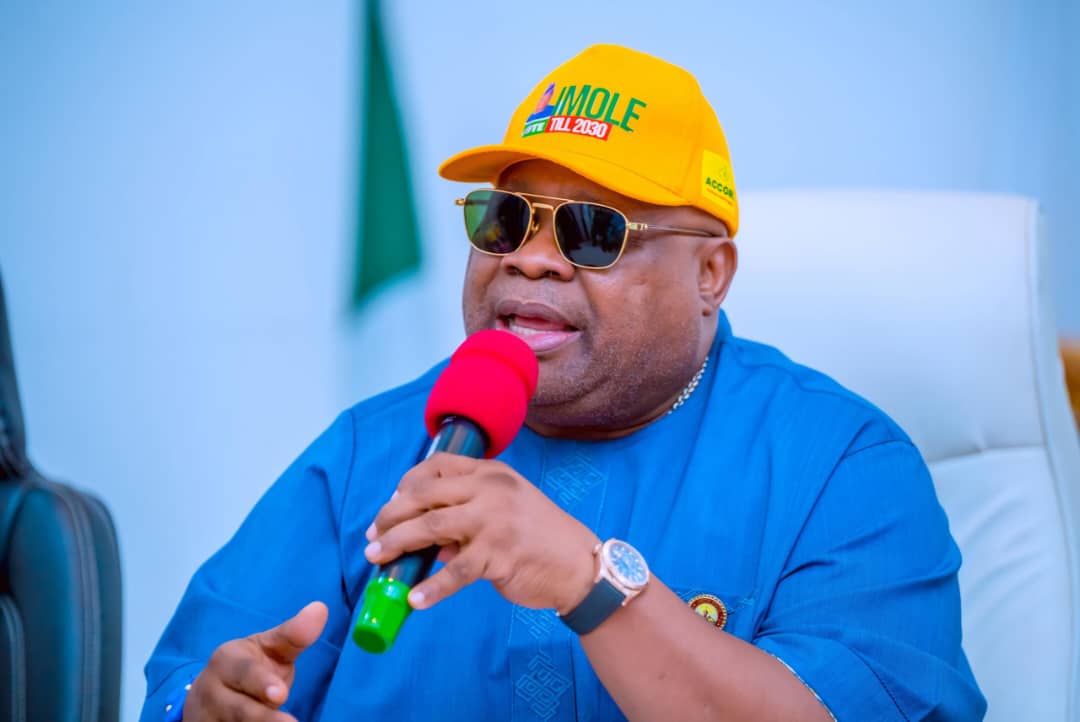
In dramatic twice the All Progressives Congress (APC) has filed an application seeking to withdraw the petition challenging the victory of Governor Ademola Adeleke.
The withdrawal came amid conflicting positions within the party’s legal team over whether the
APC had authorised the petition challenging the outcome of the August 15 governorship election.
Daily Champion reports that the APC, and the Peoples Democratic Party, PDP, challenged the outcome of the August 15, 2026, Osun Gubernatorial elections.
The APC’s petition, marked EPT/OS/GOV/01/2026, which was filed by its governorship candidate, Bola Oyebamiji, listed Adeleke, the Accord, and the Independent National Electoral Commission, INEC, as respondents in the petition challenging the election outcome.
Meanwhile, a Notice of Motion to Withdraw Petition dated September 8, 2026, filed by a counsel for APC, Barrister Oluseyi Oyagbile, before the Osun State Governorship Election Petition Tribunal, indicated the petitioners’ decision to discontinue the case.
The document seeks an order of the tribunal permitting the petitioners to withdraw the election petition.
However, an APC legal team led by Abiodun Layonu, SAN, had earlier disowned the petition, insisting that the party and its candidate had decided not to challenge Adeleke’s victory at the tribunal.
Also, the APC campaign council distanced itself from reports claiming that its governorship candidate, Oyebamiji (AMBO), filed a petition challenging the outcome of the August 15, 2026 governorship election at the Election Petition Tribunal.
A statement made available by the campaign spokesperson, said, “We state categorically that neither the All Progressives Congress ( APC) nor its governorship candidate, Asiwaju Munirudeen Bola Oyebamiji (AMBO) filed any petition at the tribunal challenging the outcome of the August 15 governorship election.
“The purported claim is therefore completely untrue and should be regarded as nothing more than a rumour being circulated by individuals seeking to mislead members of the public and create unnecessary tension.
“We urge members of the public, supporters of our great party and the media to discountenance the claim and refrain from giving credibility to unverified information designed to cause confusion.
“The APC and Asiwaju Munirudeen Bola Oyebamiji remain committed to lawful and democratic processes and will continue to act responsibly in the interest of peace, stability and the good people of Osun State.
“We urge the public to rely only on official statements from the APC and the Campaign Council on matters concerning the party, its candidate and the outcome of the August 15 governorship election.”

By Our Correspondent
A chieftain of the All Progressives Congress (APC), Ntufam Hilliard Eta, has called on the nation’s anti-corruption agencies to fully investigate allegations and petitions against former Vice-President Atiku Abubakar and prosecute him if evidence establishes any criminal offence.
Addressing journalists in Abuja on Tuesday at the APC National Secretariat, Eta said the call was driven by the principle of accountability, not political considerations.
He stressed that public office must never become a shield against scrutiny and that political ambition should not stop institutions from acting on credible allegations.
The APC chieftain said he was not asking for a conviction in the court of public opinion, but that the evidence be subjected to the process of court of law. “That distinction is fundamental,” he stated.
Eta referenced a petition reportedly received by the EFCC on September 1, 2026, calling for the reopening of financial-crime allegations against Atiku dating back to investigations conducted around 2005-2006.
He also cited renewed discussions around a 2010 United States Senate report on suspicious financial transactions.
Eta noted that while the report was not a criminal conviction, the allegations contained in it were serious enough to warrant examination by Nigerian authorities.
According to him, the first set of allegations concern the movement of more than US$40 million in suspect funds into the United States between 2000 and 2008 through offshore corporations linked to Jennifer Douglas, Atiku’s wife. The Senate report said about US$25 million was transferred into U.S. accounts opened by Douglas.
The second allegation concerns payments connected to Siemens AG. Eta said the Senate report stated that Douglas received at least US$1.7 million in alleged bribe payments, while an SEC civil complaint alleged US$2.8 million in bribe payments from Siemens.
He stressed that these were allegations contained in historical records, not convictions.
Third, Eta mentioned questions over approximately US$14 million transferred by offshore corporations to American University for consulting services related to the university’s establishment in Nigeria, as examined in the Senate report.
He also listed allegations of the use of Special Purpose Vehicles, SPVs, to divert public funds during Atiku’s tenure as Vice-President from 1999 to 2007. These resurfaced in 2023 following claims by Michael Achimugu and a petition by Festus Keyamo to the EFCC, ICPC and CCB.
Other allegations, he said, border on money laundering, criminal breach of trust, criminal misappropriation, conspiracy and possible violations of the Code of Conduct, as well as questions concerning accounts associated with Marine Float and other companies.
Eta argued that allowing allegations of this magnitude to become mere political ammunition during an election season is dangerous and he said the same standard of accountability must apply to government and opposition figures alike.
He therefore called on the EFCC and other competent authorities to examine every credible petition, obtain relevant records, invite appropriate persons and “follow the money” without fear or favour.
“A serious democracy asks: Was a crime committed? Is there admissible evidence? If yes, prosecution should follow. If no, the matter should be closed,” Eta said, adding, “No sacred cows. No political immunity. No selective justice. Just evidence, due process and the law.”
By David Owei
Governor of Bayelsa State, Senator Douye Diri, has observed that the political arena in Nigeria was shifting from violence and intimidation to knowledge-based politics.
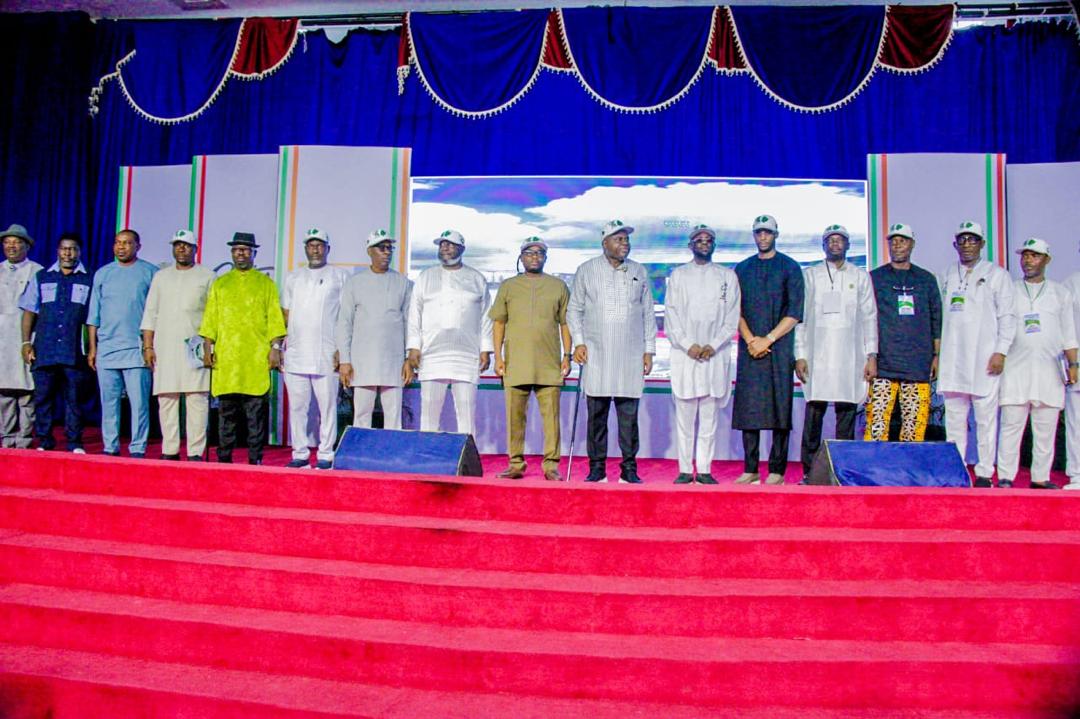
Speaking during the State Working Committee Retreat of the City Boy Movement (CBM) in Yenagoa, Governor Diri lauded the socio-political group for leading the paradigm shift, insisting that politics should never be about violence.
He noted that while the CBM had been vocal about the re-election of President Bola Tinubu in next year’s election, he urged its members to work with the structures of the All Progressives Congress (APC) in the state and at the national level.
The Bayelsa governor described the movement as strategic and advised it to go beyond social media advocacy to grassroots mobilisation.
Explaining why he pitched tents with the APC, Diri recalled how President Tinubu supported the state’s development by approving the construction of the second phase of the Nembe-Brass road and that he also granted waivers for the state’s imported gas turbines, stressing that the President deserved the support of the people of Bayelsa.
He also restated his position on a restructured Nigeria, saying democracy thrives only when there was justice and fairness, and that given his antecedence, Tinubu was the right man to restructure Nigeria.
His words: “The use of guns and intimidation is giving way to knowledge-based electoral process and I commend the City Boy Movement for this. We are not animals and we do not need to be flogged before we move. I am happy that gradually our politics is changing for the better.
“All of the various support groups must know that the party structure is the number one structure and I am happy that the City Boy Movement is working with the party.
“In this state, APC is a no-go area. Our chances of winning the 2027 election is very high.
“This is one good thing I have seen that a youth group coming together to strategise for an election. We all want our President to come back but it wild not happen by chance. We all have to play our roles not just on social media but at the grassroots. It is our duty to go from door to door.
“President Tinubu has supported the development of Bayelsa State and deserves the support of the people. He responded swiftly to the request for the second phase of the Nembe-Brass road and also gave us waivers for the gas turbines.
“I am an advocate of restructuring and President Tinubu is doing things that people had not succeeded in doing such as state policing. For us in Bayelsa, we want to control our resources and pay tax to the centre and I believe that if we must acheive that, this President is one we must follow. We have seen a President who is stable and capable. Let us allow him to complete his second term.”
In his remarks, Bayelsa State APC chairman, Hon. Warman Ogoriba, thanked Governor Diri for his support to the party, saying the APC decided to be strategic rather than joining issues with people or other parties.
Ogoriba said the APC parades the best candidates and that the party will mobilise to ensure victory for them in the 2027 elections.
In a welcome address, Bayelsa State Director of the City Boy Movement, High Chief Osomkime Blankson, said the retreat was to strategise for the re-election of President Tinubu as he deserved a second term by reason of his performance and achievements.
He expressed appreciation to the governor for his supportive leadership and commitment to peace and development of the state.
Also, the Director-General of the City Boy Movement, Mr. Francis Shoga, described Tinubu as a courageous leader who has taken painful but beneficial decisions and that the movement would take the achievements of his administration to the grassroots.
He thanked the people of Bayelsa for their support, expressing optimism that the state would contribute significantly to the potential 10 million youth votes of the movement for Tinubu.


HURIWA Mourns Bello Mandiya, Hourns a Dependable Ally of Human Rights
By George Mgbeleke The Human Rights Writers Association of Nigeria (HURIWA) mourns the death of former Senator representing Katsina South...


HURIWA DEMANDS IMMEDIATE REMOVAL OF HANDCUFFS FROM Ufoma Joseph Immanuel
By George Mgbeleke The Human Rights Writers Association of Nigeria (HURIWA) says the Nigerian Correctional Service must immediately stop the...
Northern Senator Forum Mourns Senator Bello Mandiya
By George Mgbeleke The Northern Senators Forum has received with profound sadness the news of the passing of Distinguished Senator...
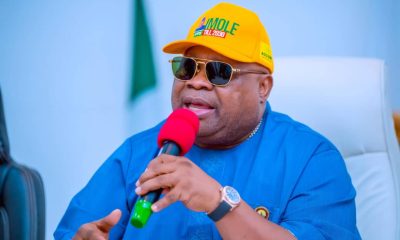

APC withdraws petition challenging Gov.Adeleke’s Victory
By Our Correspondent In dramatic twice the All Progressives Congress (APC) has filed an application seeking to withdraw the petition...

NUJ FCT Raises N5.01m Trust Fund for Late Chairman’s Children …265 members raised N5.01m to secure education, welfare of Osadebamwen’s three children
By Our Correspondent In a bid to ensure a good welfare package for its departed members and their families, the...


APC chieftain demands probe, prosecution of Atiku over $40M, SIEMENS, SPV allegations
By Our Correspondent A chieftain of the All Progressives Congress (APC), Ntufam Hilliard Eta, has called on the nation’s anti-corruption...
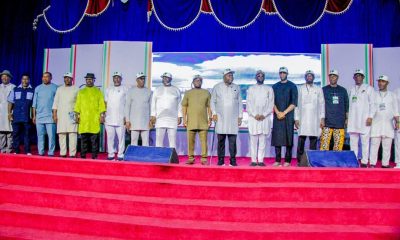

Nigerian Politics Becoming Less Violent, Says Gov Diri As CBM Holds Bayelsa Retreat
By David Owei Governor of Bayelsa State, Senator Douye Diri, has observed that the political arena in Nigeria was shifting...
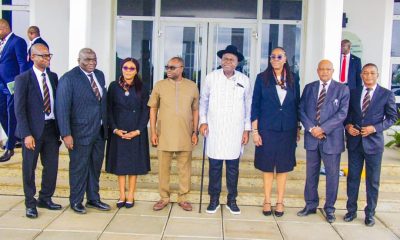

Gov Diri Seeks Increase In Law Students Quota At NDU
By David Owei Governor of Bayelsa State, Senator Douye Diri, has appealed to the Council of Legal Education to increase...


Nembe Spill: HOMEF demands cleanup, compensation, accountability
By David Owei The Health of Mother Earth Foundation (HOMEF) on Tuesday demanded urgent cleanup, compensation and accountability over an...


NCDMB to Feature Nwabuikwu’s The Pain and The Promise In Book Reading Session
By David Owei The Nigerian Content Development and Monitoring Board (NCDMB) will host the fifth edition of its Book Reading...
-
 Politics1 year ago
Gov Okpebholo moves to end Cultism *Threatens action against leading cult groups *Vows to demolish more cult houses in Edo State
-
 Politics1 year ago
ASUU-NDU protest against FG loans, unpaid salaries,Non-Implementation of agreements …..says loans is generational slavery
-

 Business & Economy1 year ago
PC-NCG Issues Disclaimer on Purported Nigerian Coast Guard National Orientation Exercise In Anambra State
-
 Entertainment2 years ago
Jubilation galore as Parishioners of CKC Kurudu celebrate their cultural heritage ….FG should exploit our Cultural heritage to unite Nigerians-Rev Fr Dim
-

 Sports7 months ago
Bayelsa-born ex-football star’s son, Opuama donates spike shoes to Athletics Association
-

 General News2 years ago
Reps hold public hearing on FMC Ugwuaji Awkunanaw
-
 Law & Crime1 year ago
Legal practitioner raises alarm over threat to his life by CSP Muhammed Abdulkareem
-
 General News2 years ago
Celebration galore as UDA Successfully Elected New Exco ……I will digitalize processes that will raise UDA to greater height -Comr. Okejiri