
Law & Crime
TINUBU AND THE BOY WHO KILLED HIS DAD


BY EMMANUEL NNADOZIE ONWUBIKO
I was just a very innocent boy of about 10 and had just stubbornly followed my immediate elder sister Francisca to enrol into a secondary school known as KAFANCHAN TEACHERS COLLEGE.
My Dad gave his unqualified approval that I jumped to form one from my primary 5 at the Aduwan 1 primary school since I was such in a hurry to be in secondary school.
I met a lot of school mates and given the huge size of the students, I was assigned to Class 1 P. There were some three thousand students in my form but the school was considerably massive in terms of structures and infrastructure.
The school was a neat one with teachers and a principal who were clearly no-nonsense disciplinarians. The Vice principal was such a fine gentleman who also played the role of an informal counsellor. He was instrumental to my becoming fascinated about becoming a journalist. Together with my Father Mazi Osonduagwuike Okorieocha ONWUBIKO who often sent me to buy copies of Champion Newspapers and Imo Statesman from the newsstand near the main market in Kafanchan, these legends pushed into journalism.
Our class teachers were very friendly but disciplined so we were made to know the boundary between friendship and falling in line in the area of strict compliance to the rules and regulations of the school.
One of those abominable sins was coming late to school. Lateness to school was strictly forbidden just as offenders are made to face corporal punishments and caning which were regimented and very awkward but these disciplinary actions moulded us into respecters of authority and order.
Discipline and order were virtues that most of us were already used to from our homes. Dad made sure we do not stray into the arena of rascality and malfeasance. My Dad did not mind flogging anyone who derailed.
And so, it was an anathema to hear that one of us in the school by the name of Godwin was such a very stubborn chap to an extent that rumours swirled around the ears of students that he occasionally fought his Dad. His Dad was disabled in one leg but all the same was a highly educated Nurse who was highly placed in his place of work in the only publicly funded hospital in Kafanchan.
The man was so diligent in his tasks as a Nurse but there is something we suspected made it possible for Godwin to deviate from the societal norms and to have had the effrontery to physically confront his Dad. This was the existential fact that his mother deals on local brews of alcohol known as burukutu and this line of business attracted all kinds of bad characters into their living environment whereby the mother does her business. Godwin was uniquely badly behaved and indulged in all kinds of misbehaviour including smoking and drinking of alcoholic beverages. We hus contemporaries failed to correct Godwin.
It was strange to know that a son could fight his Dad but to Godwin, engaging in fisticuffs with his biological Dad was just one of those normal things. The news wasn’t palatable to our ears because it was a huge anathema to contemplate that a son could even engage his Dad in the exchange of words talk more of physically battling the man who co-created him and brought him to life.
This bad habit escalated. Then all of a sudden, Godwin fought his Dad with a knife and succeeded in stabbing him to death. This was the kind of news that as kids of just 10, it was traumatic to hear.
The entire school and thousands of students received this shocking news with considerable amount of disappointment that the boy Godwin could kill the man who brought him to the world. Godwin was picked up by the police and that ended his education as he was taken straight into detention and then prosecuted for murder.
But given his tender age, he was not subjected to the death penalty which was the legal sanction for such a heinous crime but he was consigned to the borstal home which was a prison yard for juveniles for decades. The killing of his Dad by Godwin thus ended his normal life. He lost all his friends and hung the stigma of a killer of his Dad.
But if you are reading this story, you might be asking yourself why i remembered a story that took place almost 40 years ago.
Yes, the memory of this incident flashed into my thinking faculty when I busied myself over a cup of coffee in reflecting about the political scenarios been created by the current Nigerian president known as Bola Ahmed Tinubu and precisely the angle that the president is actively working to kill off constitutional democracy and multiparty democracy. Everyone who works for sustainable development, would naturally work to nurture constitutional and multiparty democracy which is our best system of government as it were.
President Tinubu once said, he was so happy that the opposition political parties that gave him the toughest challenges during the year 2023 poll were in internal turmoils. These internal infighting were promoted and funded by the supporters of the second term ambition of president Tinubu who seems mortally afraid of strong opponents who may torpedo him in 2027 given the poor records he has built in the field of economy, insecurity and general wellbeing of the citizens.
The truth is that the President and his political party the All Progressives Congress, are actively engaged in the deliberate demolition of peoples Democratic Party and the Labour party and has also extended his tentacles into the newly registered African Democratic Congress which obviously is one opposition party whereby the fiercest rivals of Bola Ahmed Tinubu have congregated including Atiku Abubakar, Aminu Tambuwal, Nasir Elrufai and Peter Obi. Tinubu is allegedly using Economic and Financial Crimes Commission as his foot soldiers to threaten serving governors belonging to PDP most of whom have soiled their hands and they are jumping into APC like frogs running away from a consuming fire and because Adams Oshiomhole a former National Chairman of APC said anybody joining APC wouldn’t be haunted by the EFCC and ICPC because their ‘sins’ are forgiven, these fearful politicians of the opposition parties are lining up into APC for protection from the troubles of EFCC.
What the president and the APC are collectively doing by forcing elected office holders of the other political parties to cross over illegally into the APC so as to weaken the opposition parties to soften the ground for the incumbent president to re-contest for the second and the last constitutionally permitted tenure in less than a year from now, is just the same as the actions of the boy who killed his father in my high school days in KAFANCHAN.
Democracy is obviously the result of struggles and agitation by people who stake their lives to wrestle power from the military coupists who drove away civilians in 1982 and held on to power up until 1999. One of those agitators who struggled for civilian led constitutional democracy to take roots in Nigeria is the man who is president today who obviously took over power through a contentious general election in the year 2023. He is attempting by all means to muzzle political opposition by allegedly funding internal schism and because most politicians in Nigeria are not ideological but are ready to be bought over, the All Progressives Congress has used public funds as slush funds to sponsor infighting in political opposition including the appointment of a PDP member as minister whose duty is to destroy the once harmonious PDP. The courts in Nigeria are as corrupt as the Supreme Court of Venezuela so the president is also using them to destroy the opposition parties.
So if this leading agitator who contributed to the arrival of constitutional multiparty democracy is now misusing his presidential powers to whittle down political opposition parties with the aim of creating a one party state, it won’t be wrong to remember the boy Godwin who killed his Dad and to draw a parallel with the incumbent Nigerian President as the boy who is killing multiparty democracy if he is not resisted.
But like Godwin the boy in KAFANCHAN of the 1980s who made sure he ended the life of his boisterous and joyous Senior Nurse and father and then ended his life, if Tinubu’s programme to exterminate multiparty democracy sails through, then Tinubu’s legacy as a warrior of democracy would come to a scratching end.
But since unlike during my childhood days that I and my contemporaries failed to correct Godwin and to compel him to desists from fighting his Dad, a negligence that dovetailed into the eventual killing of his Dad by Godwin, since we are aware that Tinubu intends to kill multiparty democracy, we owe our consciences the debts to speak out and mobilise active resistance to this political anathema and suicide that is about to happen in Nigeria.
The history of multiparty democracy is illustrious and we may do well to look at what political scholars gave us as the historicity and etymology of multiparty democracy.
Ancient Democracy:
Political groupings in ancient Greek democracies and in the Roman Republic were typically formed around leaders whose wealth, oratorical skills or achievements could sway the citizenry around issues of war, trade, property and public services.
Factions often formed around two main societal interests — the wealthy aristocracy and common property holders, traders and artisans. These groups held different views of democracy somewhat in the manner political parties do today. The most famous Athenian politician, Pericles, won enduring majorities of the citizens’ assembly in part through his success at extending political participation to the less wealthy and in part through his adept management ─ for a time ─ of Athens’ foreign policy.
Unlike Athens, Rome was governed through layers of representative institutions and officials according to class and wealth. The dominant law-making institution was the Senate, which represented patricians, or the elite landowning class. The Plebeian Council represented the rest of the citizenry, including smaller landowners and merchants. In this setting, there were no political parties but rather supporters or opponents of individual politicians based on personal interests or on their views regarding the balance of Senatorial privilege and the power and rights of plebeians.
British Political Parties
The first modern political parties arose in Great Britain out of the English Civil Wars and became defined in the Exclusion Crisis of 1679-81. Those known as Tories defended absolutist prerogatives and hereditary succession. Whigs favored greater constitutional limits on the monarchy. Their history offers an example of political party development.
The Exclusion Crisis occurred when Whigs sought to bar the brother of the restored king, Charles II, from succession to the monarchy due to his adoption of Roman Catholicism and fears that he would again try to assert absolute powers over parliament — the cause of the English Civil Wars earlier that century. In the minority at that time, the Whigs’ effort failed. James II assumed the throne in 1685 on his brother’s death. But the Whigs’ fears were soon realized as James II sought to transgress parliament’s authority. Acting now in the majority after a new election, the faction acted to depose James II in the Glorious Revolution of 1688. They invited his Protestant daughter, Mary, and her Protestant husband, William of Orange and King of the Netherlands, to assume the throne, uniting the two kingdoms for a brief period. Whigs then passed bills asserting power over monarchical succession, parliamentary authority and citizens’ rights (known as the English Bill of Rights).
Whigs and Tories vied for power thereafter as political parties. Whigs were dominant for much of the 18th century and Tories in the late 18th and early 19th centuries. In John Stuart Mill’s categories, Whigs were the “change” party, supporting parliamentary supremacy, expanding the franchise and free trade. The Tories were the “stability” party protecting rural, aristocratic and Church interests as well as the prerogatives of the monarchy. There were also independent members. They would be central to ending the slave trade and abolition of slavery, gaining support from leaders of both Whigs and, at times, Tories.
Nigeria borrowed our political system mainly from Great Britain. So why does Tinubu intend on killing multiparty democracy in the Country? Why must all the opposition party governors and legislators be conscripted into the All Progressives Congress of Tinubu?
*EMMANUEL NNADOZIE ONWUBIKO is the founder of HUMAN RIGHTS WRITERS ASSOCIATION OF NIGERIA and a former COMMISSIONER OF THE NATIONAL HUMAN RIGHTS COMMISSION OF NIGERIA.





By Our Correspondent
Barely three weeks after the Independent National Electoral Commission (INEC) declared governor Adeleke of Accord party winner of Osun election, the All Progressives Congress, (APC) and the Peoples Democratic Party, (PDP) have challenged the outcome of the August 15, 2026, Osun Gubernatorial elections incumbent governor’s victory as Tribunal displays two Petitions
The petitions were confirmed in a notice sighted by our correspondent at the tribunal secretariat in Osogbo on Monday, formally commencing the legal process arising from the August 15 governorship election.
The development followed confirmation by the secretary of the tribunal, Pefe Belemore, that petitions challenging the election outcome had been filed.
According to Belemore, “The necessary notices would be displayed on the tribunal’s notice board before noon on Monday.”
At the opening of the tribunal earlier in the day, Belemore was present in the courtroom alongside other officials of the secretariat as preparations were made for the commencement of proceedings.
The APC and PDP are challenging the outcome of the election, which returned Adeleke as governor for another term in office.
The display of the petitions is expected to pave the way for the service of legal processes on the parties involved and subsequent proceedings before the tribunal.
The APC’s petition, marked EPT/OS/GOV/01/2026, was filed by its governorship candidate, Bola Oyebamiji.
Oyebamiji listed Adeleke, the Accord and the Independent National Electoral Commission, INEC, as respondents in the petition challenging the election outcome.
The PDP’s petition, marked EPT/OS/GOV/02/2026, was filed by Adebayo Olugbenga Adedamola against Adeleke, INEC and the Accord.
Law & Crime
IPC-SPJ Hub Condemns Attack on Kano Journalists, …. Tasks Security Agecies on Protection during Political Rallies

By David Owei
The Safety and Protection of Journalists (SPJ) Hub of the International Press Centre (IPC) condemns the attack on journalists who were returning from covering the All Progressives Congress (APC) rally at the Sani Abacha Stadium in Kano on Saturday, 5th September 2026.
Reports reaching the Hub states that, “a vehicle conveying four Radio Nigeria Pyramid FM staff, a journalist from Guarantee Radio and another from Daily Trust, was attacked by hoodlums, who repeatedly hit the vehicle, leaving the driver to sustain injuries, while some of the journalists were hit by broken glass from the damaged vehicle.”
“The incident happened after the APC had held the Tinubu Support Group rally at the Sani Abacha Stadium in Kano,” the report further revealed.
The Executive Director of IPC, Mr. Lanre Arogundade in a statement described the unfortunate incident, as a serious concern and threat to press freedom, considering the damage on a Radio Nigeria, Pyramid FM vehicle.
Mr. Arogundade noted that, “the campaigns and rally just recently started, and journalists should not be subject to any form of attack at this time, when political activities are gradually increasing ahead of the general elections.”
The Hub is therefore calling on all security agencies to at this time be intentional about safeguarding journalists, especially those deployed to the field to cover political activities, especially during large gatherings where journalists are exposed to potential risks.
The Hub is also admonishing media organisations and journalists covering elections to always conduct security scan and safety consciousness in coverage of electoral issues.

By George Mgbeleke
The Human Rights Writers Association of Nigeria (HURIWA) has demanded the immediate suspension of officials in charge of the National Cash Transfer Office and ordered a full-scale investigation into the N33.75 billion cash transfer that the Auditor-General for the Federation and states have failed to properly account for.
HURIWA in a statement by its national coordinator, Comrade Emmanuel Nnadozie Onwubiko emphasized that Nigerians cannot continue to watch helplessly as billions of naira meant for poor and vulnerable citizens disappear into unverifiable transactions.
The group called on the Economic and Financial Crimes Commission (EFCC) to launch a vigorous forensic investigation, trace every naira, and recover any amounts determined to have been wrongly paid, diverted, or misapplied.
The Auditor-General’s findings revealed a significant breakdown in financial controls governing one of the Federal Government’s most sensitive social intervention programs, as payments to 3,295,207 households across 35 states in 2023 could not be authenticated.
HURIWA demands explanations for incomplete beneficiary details on payment vouchers and the unavailability of necessary Remita statements for reconciliation purposes. Disturbingly, auditors were reportedly obstructed by National Cash Transfer Office staff from accessing these records.
HURIWA insists on a thorough investigation to follow the money from government accounts to the final recipients, stating that no official should use bureaucracy to shield themselves as unverified billions remain in limbo. The organization urges the EFCC to verify each payment and identify genuine vulnerable Nigerians among the beneficiaries. Misallocated funds must be recovered, and those responsible held accountable.
Moreover, HURIWA stresses that this situation extends beyond the N33.75 billion, highlighting additional discrepancies totaling N36.74 billion and stressing the need for a comprehensive audit of the entire National Cash Transfer Programme.
HURIWA challenges President Bola Ahmed Tinubu to uphold public accountability and restore faith in government poverty-alleviation efforts. The organization insists that political connections should not shield individuals from accountability and demands prompt action.
HURIWA demands the Federal Government:
1. Suspend officials of the National Cash Transfer Office pending investigation.
2. Direct the EFCC to conduct a full forensic probe into the N33.75 billion and related transactions.
3. Trace every naira and identify persons/entities that received funds.
4. Recover misallocated funds and return them to the Treasury.
5. Publish credible disbursement records.
6. Investigate and prosecute those obstructing auditors.
7. Conduct a full audit of the social intervention programme and publish findings.
8. Prosecute culpable individuals following investigations and due process.
HURIWA urges that the funds meant for vulnerable citizens must reach them and calls for immediate action to restore public trust in government operations.
Find the money. Recover the money. Name those responsible. Prosecute the culpable. Return Nigerians’ money to the Treasury.**
That is the minimum accountability Nigerians deserve.


HURIWA Mourns Bello Mandiya, Hourns a Dependable Ally of Human Rights
By George Mgbeleke The Human Rights Writers Association of Nigeria (HURIWA) mourns the death of former Senator representing Katsina South...

HURIWA DEMANDS IMMEDIATE REMOVAL OF HANDCUFFS FROM Ufoma Joseph Immanuel
By George Mgbeleke The Human Rights Writers Association of Nigeria (HURIWA) says the Nigerian Correctional Service must immediately stop the...
Northern Senator Forum Mourns Senator Bello Mandiya
By George Mgbeleke The Northern Senators Forum has received with profound sadness the news of the passing of Distinguished Senator...

APC withdraws petition challenging Gov.Adeleke’s Victory
By Our Correspondent In dramatic twice the All Progressives Congress (APC) has filed an application seeking to withdraw the petition...

NUJ FCT Raises N5.01m Trust Fund for Late Chairman’s Children …265 members raised N5.01m to secure education, welfare of Osadebamwen’s three children
By Our Correspondent In a bid to ensure a good welfare package for its departed members and their families, the...

APC chieftain demands probe, prosecution of Atiku over $40M, SIEMENS, SPV allegations
By Our Correspondent A chieftain of the All Progressives Congress (APC), Ntufam Hilliard Eta, has called on the nation’s anti-corruption...
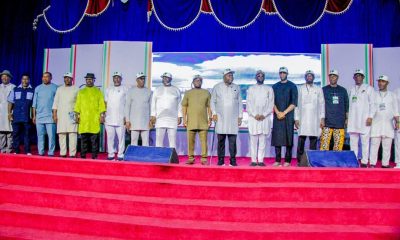

Nigerian Politics Becoming Less Violent, Says Gov Diri As CBM Holds Bayelsa Retreat
By David Owei Governor of Bayelsa State, Senator Douye Diri, has observed that the political arena in Nigeria was shifting...
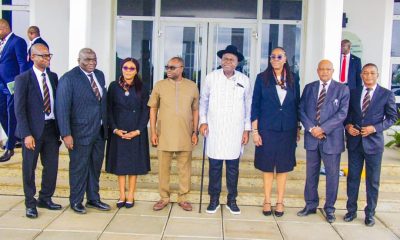

Gov Diri Seeks Increase In Law Students Quota At NDU
By David Owei Governor of Bayelsa State, Senator Douye Diri, has appealed to the Council of Legal Education to increase...


Nembe Spill: HOMEF demands cleanup, compensation, accountability
By David Owei The Health of Mother Earth Foundation (HOMEF) on Tuesday demanded urgent cleanup, compensation and accountability over an...

NCDMB to Feature Nwabuikwu’s The Pain and The Promise In Book Reading Session
By David Owei The Nigerian Content Development and Monitoring Board (NCDMB) will host the fifth edition of its Book Reading...
-
 Politics1 year ago
Gov Okpebholo moves to end Cultism *Threatens action against leading cult groups *Vows to demolish more cult houses in Edo State
-
 Politics1 year ago
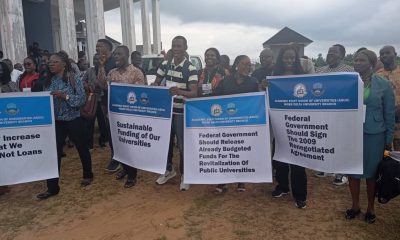
ASUU-NDU protest against FG loans, unpaid salaries,Non-Implementation of agreements …..says loans is generational slavery
-
 Business & Economy1 year ago
PC-NCG Issues Disclaimer on Purported Nigerian Coast Guard National Orientation Exercise In Anambra State
-
 Entertainment2 years ago
Jubilation galore as Parishioners of CKC Kurudu celebrate their cultural heritage ….FG should exploit our Cultural heritage to unite Nigerians-Rev Fr Dim
-

 Sports7 months ago
Bayelsa-born ex-football star’s son, Opuama donates spike shoes to Athletics Association
-

 General News2 years ago
Reps hold public hearing on FMC Ugwuaji Awkunanaw
-
 Law & Crime1 year ago
Legal practitioner raises alarm over threat to his life by CSP Muhammed Abdulkareem
-
 General News2 years ago
Celebration galore as UDA Successfully Elected New Exco ……I will digitalize processes that will raise UDA to greater height -Comr. Okejiri