
Uncategorized
HUNGRY ABUJA PIKIN: A REFLECTION


By Emmanuel Nnadozie Onwubiko
When in 1992, the then self -styled military president of Nigeria, four stars General, the gap-toothed Ibrahim Badamasi Babangida, effectively transferred the nation’s political capital from Lagos to Abuja, the expectation of a lot of Nigerians is that given the centrality of the geolocation of the Federal Capital Territory, the planners of this new city would work a lot more to ensure equal opportunities for all genres of Nigerians.

So many years after this physical transfer was done, Abuja has carved a niche for itself as one of the most expensive places on the surface of the earth to live especially for one particular genre of the citizenry: poor and deprived children abandoned to cruel fate on the harsh, sunny, and hunger biting streets of Abuja metropolitan city. Whilst thousands of these street children starve to near-death, the minister of the FCT is expending billions of dollars building flyovers and highways whereas these children are left to rot on the streets of Abuja without any consideration for their future which is even a big threat to our national security as we will see towards the end of this piece.
Abuja also represents the typical Igbo cosmology that says that “A person who is right inside the ocean but soap has entered his eyes”, or we can take it a notch further by equating Abuja to a banquet in which only very few privileged citizens are admitted whilst the bulk of the population are starving to the point of near-death whilst a small percentage of the citizens admitted to the elitist banquet are dining, wining and are even going to special lavatory called VOMITORUM whereby each one of them who eats to stupor, can simply go into the lavatory to vomit out some of the edibles in their tummies so as to create rooms for more of the newly arrived foods. If you doubt this statement, just take a drive around the Abuja streets and then spend some few hours in the 5 star hotels that dot Abuja. You will see hungry kids in their thousands on the streets and you will see few elites who sleep in these expensive hotels whereby they pay over N1 million per suite per night. Some politicians pay as much as one year upfront for hotel rooms where they quarter their mistresses made up of male and female prostitutes who earn in dollars.
The above-mentioned scenario can simply be deciphered just by driving around Maitama, Wuse two, Asokoro and the three arms zone or central business district. What you will see on each of the stops at the streetlights, are hundreds of children who look emaciated, unkempt, hungry and are clearly in need of foods, shelter and parental care. I see these kids daily and I’m pained that I lack the economic strength to reduce their unfathomable suffering.
The irony is that the majority of these children abandoned by the nation to the harsh realities of the dangerous streets are drawn from the North of Nigeria. The North have more states. The North have more senators and representatives in the lower legislative chambers in Abuja and therefore should get more budgetary allocations especially in the area of constituency projects which basically include empowerment and other economic enhancing and sustainability initiatives.
A reason offered for the high numbers of Northern Nigerian children roaming the streets of Abuja is traced to the practice of almajiri or pupillage in the practice of one of Nigeria’s two dominant religions. But I ask, why are only neglected, heavily marginalised, hunger inflicted children are left to roam the streets of Abuja in destitution? The troubling side of this unfortunate social problem is that little girls are also found roaming the streets of Abuja begging for money to survive in a city flowing with milk, honey and dollars for only very few politicians holding sway as cabinet ministers, directors of agencies of government and legislators at the National Assembly. So why are over 60, 000 kids starving and roaming about the streets in Abuja in absolute destitution whereas some individuals own houses in Abuja numbering in their hundreds?
An average director in any of the Federal ministries or agencies in Abuja owns over 24 houses in highbrow areas whereby each of these houses costs between N200 million to N500 million. So, why are Nigerian children left to starve on the streets? To even think that the politician overseeing Abuja said he would remove these kids from the streets by force but provided no remedies for the hunger, destitution, lack of education, lack of skills that afflict these children and many more others too weak physically to roaming about the traffic stops in Abuja? This us gross irresponsibility and insensitivity.
I will lift the newspaper report in which the Abuja minister described these kids as the wretched of the earth who should be thrown away to God knows where. After that reportage, I will return to lift some references from the confiscation of houses amassed by corrupt politically exposed persons as effected by the courts on the initiatives of the Economic and Financial Crimes Commission. These two scenarios and ironies would then present to us the harsh realities of starving children amidst plenty.
The Federal Capital Territory Administration last year’s July said it has launched a major crackdown to rid Abuja and its satellite towns of street beggars, scavengers, illegal traders, and other miscreants.
The exercise, tagged Operation Sweep Abuja, was disclosed on Wednesday in a statement released by Mr Lere Olayinka, Senior Special Assistant on Public Communications and Social Media to the FCT Minister, Nyesom Wike.
Olayinka stated that the operation was carried out in accordance with the directive of Wike to rid Abuja and its satellite towns of all forms of nuisance, including the “one chance” syndicate.
One chance refers to a form of robbery where criminals pose as transport operators to lure unsuspecting passengers into their vehicles with the intent to rob them of their valuables.
He explained that the move was in line with the Abuja Environmental Protection Act and other relevant laws.
He said, “Our nation’s capital should be a secure symbol of pride and beauty, not a site for street beggars and scavengers, most of whom are agents of criminal elements.
“To achieve this, a Joint Task Force, comprising security agencies and relevant FCT Secretariats, Departments and Agencies, has been deployed to apprehend any persons found begging, scavenging, loitering or engaging in other acts inimical to the security and well-being of the residents.
Then the Executive Chairman of the Economic and Financial Crimes Commission, EFCC, Mr. Ola Olukoyede last year’s October disclosed that under his leadership, the Commission has made unprecedented progress in the fight against economic and financial crimes in the last two years by recovering over N566 billion alongside other currencies and assets.
He made this disclosure in Abuja on Thursday, October 23, 2025, while addressing journalists at the corporate headquarters of the Commission as part of activities marking his second anniversary in office.
Olukoyede, who was appointed on October 18, 2023, and confirmed by the Senate the following day, said the period has witnessed significant reforms and record-breaking achievements across all operational fronts of the Commission.
The EFCC’s boss who spoke through the Director of Public Affairs of the Commission, Commander of the EFCC, CE Wilson Uwujaren said between October 2023 and September 2025, the Commission received over 19,000 petitions, conducted 29,240 investigations, filed 10,525 cases in court, and secured 7,503 convictions.
He disclosed that within the same period, the Commission recovered ₦566,319,820,343.40, $411,566,192.32, £71,306.25, €182,877.10, and other foreign currencies from proceeds of financial and economic crimes.
Olukoyede also announced the recovery of 1,502 non-monetary assets, comprising 402 properties in 2023, 975 in 2024, and 125 so far in 2025.
“Among these recovered assets are two notable landmarks: the final forfeiture of 753 units of duplexes in Lokogoma, Abuja, and the forfeiture of Nok University, now the Federal University of Applied Sciences, Kachia, Kaduna State,” he said.
The question to pose to our political leaders right from the top to the heads of the agencies of government is: how come there are a lot of money being stolen and diverted to private pockets whereas thousands of children of Nigeria roam about hungry in Abuja streets?
The conclusion is to ask for an effective remedy: government must get these children back to schools on scholarship and deliberate efforts should be made to teach them skills and vocational skills in addition to academic development so we don’t continue breeding hungry, starving and angry citizens.
These hungry kids are watching the elite cruise about in exotic cars. These kids see their mates cruise around in exotic automobiles bought for them by their privileged parents and they know that their contemporaries whose privileged parents are working as functionaries in government, send these children to expensive schools abroad and in Abuja whereas these other kids roam about hungry.
These kids are feeling a deep sense of deprivation and if nothing is done quickly to train, educate and economically empower them, they would become the terrorists of tomorrow and they would become the deadliest of the terrorists because they are groomed in urban areas in a climate of starvation amidst plenty.
I would finally say that “A stitch in time, saves nine”. Equal opportunities must become a reality for all citizens here and not just a theory we read in law books.
*EMMANUEL NNADOZIE ONWUBIKO is the founder of HUMAN RIGHTS WRITERS ASSOCIATION OF NIGERIA and was NATIONAL COMMISSIONER OF THE NATIONAL HUMAN RIGHTS COMMISSION OF NIGERIA.






Uncategorized
Shouts of Joy Rock the World As Postor Chris Opens Final Healing Streams Edition for 2026
By Our Correspondent
Hundreds of millions participate in the global healing crusade as Pastor Chris ministers to the sick in Healing Lines and prays for a worldwide audience; Day One features remarkable testimonies of healing, restoration and renewed hope.
Shouts of joy, thanksgiving and praise to God reverberated across nations on Friday, October 23, 2026, as the 18th edition of the Healing Streams Live Healing Services with Pastor Chris opened with remarkable accounts of healing, restoration and renewed hope.
The three-day global programme, the final edition of the year, brought together hundreds of millions of participants from practically all countries and communities under Heaven for a time of worship, the teaching of God’s Word, testimonies and healing ministrations led by the President of LoveWorld, Reverend Chris Oyakhilome, DSc, DSc, DD.
From those brought before Pastor Chris in the Healing Lines to participants connecting remotely from across the world, Day One was marked by celebrations from people who reported experiencing healing from various ailments. Many were seen rising from wheelchairs, abandoning crutches and other mobility aids, and rejoicing over what they described as remarkable changes in their physical conditions.
The service unfolded in an atmosphere of faith, expectation and thanksgiving, with the healing ministration extending beyond those physically present at the venue to participants whose images were projected on giant screens from different nations.
As the final Healing Streams edition of 2026 commenced, the day’s central message emerged clearly through the teaching, testimonies and ministrations: faith in God’s Word and the importance of believing and acting on it.
“HAVE FAITH, YOUR CHANGE HAS COME!”
Setting the tone for the opening day, Pastor Deola Phillips, Executive Minister of the Healing School and convener of the event, welcomed participants to the October edition with a stirring declaration: “Have Faith, Your Change Has Come!”
Addressing the global congregation, she emphasised the significance of the occasion and encouraged participants to approach the service with faith and expectation.
“This is your moment of change. Do you want to be well? God’s Word is a stream of grace, and streams of healing are coming to you through the songs, testimonies, and exhortations. Receive the Word in your spirit, refuse to be distracted, and believe that today is your day. You will rise. You will walk. You will live. And by the time we’re done, you’ll be singing your testimony of praise.”
Her charge established the atmosphere for the programme, encouraging participants to remain attentive to the Word and expectant of the changes they desired.
The Loveworld Singers subsequently led the congregation in an uplifting session of worship, after which senior ministers of the Healing School took turns leading prayers and sharing testimonies from previous editions.
Rev. Tom Amenkhienan urged participants to recognise the spiritual significance of the gathering and prepare themselves to receive.
“Heaven is focused on you. You are in the place where the healing power of God is flowing, and lives are being transformed. Get ready for an extraordinary time in the presence of the Lord.”
He also highlighted the special significance of the October edition, which coincides with the Month of Mercies, drawing attention to the abundance of God’s tender mercies throughout the three-day programme.
Similarly, Pastor John De Beer underscored the personal nature of the event, encouraging participants to approach the service with expectation.
“Everything that is being done in this program is centered around you. It has been made and specifically tailored for you. You must be expectant. Prepare your spirit to receive.”
Rev. Ray expressed appreciation to Pastor Chris for the global impact of the Healing Streams initiative, emphasising that distance was no barrier to participating in the service.
“This is Healing Streams with the Man of God, Pastor Chris, and you are right in the presence of a miracle. Wherever you are participating, the power of God is right where you are.”
Reflecting on testimonies from the July edition, he recalled the account of Joseph, a 10-year-old boy in Peru who reportedly received healing from an inability to speak, and Osan in Costa Rica, who reportedly regained his ability to walk after six months.
Drawing attention to the expectations surrounding the October gathering, he declared, “If it was great then, you can imagine what it will be now, because the glory of the latter house shall be greater.”
“YOU ARE RIGHT NOW IN THE PRESENCE OF DESTINY”
The atmosphere of expectation intensified as Pastor Chris took the stage to deliver a message centred on faith, the power of God’s Word and the importance of making a conscious decision to believe.
Welcoming participants to the service, he described the gathering as a divinely appointed moment in their lives.
“I want to welcome you specially to this very predestinated service. You are right now in the presence of destiny,” he declared.
“Before you were born God planned this very hour for you. It’s a special moment in your life. And you’re going to have to do what you choose with it. Make up your mind you’re going to do the right thing with it.”
The declaration established the foundation for his teaching, which focused on the capacity of human beings to believe and act on their convictions.
Explaining the uniqueness of this capacity, Pastor Chris said:
“There is something that God made possible for human beings. Animals don’t have it. Angels don’t have it. Of course Demons don’t have it. It was only given to human beings; and you have to do something with it.”
He further emphasised the importance of exercising faith, declaring:
“Your Faith in God is important. Only Humans are given the capacity to act on their faith, to believe and act accordingly.”
Addressing the belief that some people are incapable of exercising faith, he challenged participants to recognise that believing or refusing to believe is a personal choice.
“Some people say, ‘I can’t believe.’ But every human can. You choose to believe or not believe. It’s always a choice,” he declared.
Illustrating the simplicity of believing, he pointed to how children trust the words and promises of their parents and act accordingly.
“Believing is very simple. Even children learn to believe while they are very young. If Mummy or Daddy makes a promise to a child, they believe and act on the word that Mummy or Daddy spoke. They don’t need a seminar on believing,” he said.
He also explained that faith is already woven into everyday human experience, with people routinely trusting institutions, professionals and systems.
“You have faith in the school; that’s why you attended it. You have faith in your neighbour; that’s why you chose to live next to him,” he explained.
Challenging participants to apply the same principle to their relationship with God, he added:
“But when it comes to the things of God, you say, ‘I don’t know.’ Well, that was your choice.”
In a related emphasis, he reiterated:
“Only humans are given the capacity to act on their faith, to believe and act accordingly. That’s so important. You have the capacity to believe and act on it. It’s always a choice, to believe and not to believe. Believing is very simple; even children dare to believe.”
He further declared, “All the structures of human societies are built on faith. Your faith is working all the time.”
Through these illustrations, Pastor Chris encouraged participants to recognise faith as a practical principle and to approach God’s Word with confidence rather than uncertainty.
“THE GOSPEL OF CHRIST IS THE POWER OF GOD TO SAVE”
Drawing from Romans 1:16, Pastor Chris emphasised the importance of believing the Gospel as the basis for receiving the salvation offered through Jesus Christ.
“The gospel of Christ is the power of God to save. If you don’t believe it, it cannot save you. You have to believe it to be saved,” he declared.
He explained that, according to the Christian faith, God had accomplished His work through Jesus Christ, while the individual’s responsibility was to believe and receive what Christ had done.
“God has already done His part in Jesus Christ. Your part is to believe in what He did,” he said.
The teaching formed an important part of the spiritual foundation of the service, with Pastor Chris encouraging participants to recognise the significance of faith in receiving God’s promises.
He also drew from Mark 9:22–23, highlighting the biblical declaration that all things are possible to the one who believes.
“FEAR NOT! BELIEVE ONLY AND SHE SHALL BE MADE WHOLE”
A major highlight of the message was Pastor Chris’s reference to the account of Jairus and his daughter in Luke 8:41–56.
Jairus, a ruler of the synagogue, had approached Jesus for help because his daughter was dying. While Jesus was on His way to the man’s house, news arrived that the girl had died.
Pastor Chris drew attention to Jesus’ response to the devastating news, emphasising the instruction to reject fear and continue believing.
“Sometimes when you are believing God for something, the condition can get worse. But Jesus said, ‘FEAR NOT! BELIEVE ONLY AND SHE SHALL BE MADE WHOLE,’” he declared.
He explained that Jesus did not allow the report of the girl’s death to override His response to Jairus’ original request.
The account, he noted, illustrates the importance of maintaining faith even when circumstances appear to contradict what a person is trusting God to do.
“Don’t struggle. Only believe,” he urged.
He also referred to Mark 9, which recounts the healing of a boy tormented by a demon, drawing attention to the father’s appeal to Jesus for compassion.
Through these biblical accounts, Pastor Chris encouraged participants to remain steadfast in their faith, even when confronted with discouraging circumstances.
“BELIEVE THE WORD, NOT THE SYMPTOMS”
Expanding on the relationship between faith, God’s Word and healing, Pastor Chris drew from several passages of Scripture, including Proverbs 4:20–22, John 6:54–63, John 1:14 and Leviticus 17:11–14.
He explained that Jesus’ words concerning His flesh and blood should be understood in the context of the spiritual life communicated through God’s Word.
Referring to John 6:63, he highlighted Jesus’ declaration that it is the Spirit who gives life. He connected this to John 1:14, which declares that the Word became flesh and dwelt among humanity, explaining that Jesus was the Word of God manifested in human form.
“It was not about eating His body. It was about receiving His Word. If you received His Word, you received Him. You got everything,” he said.
He further explained that God’s Word communicates life to those who receive it, drawing attention to Proverbs 4:20–22, which describes God’s words as life to those who find them and health to their flesh.
“Through the Word of God, we can all receive the life that He gives. Wherever you are in the world, when you receive His Word, you receive His life,” he declared.
Reaffirming the authority of Scripture, he also referenced John 14:6, in which Jesus declares, “I am the way, the truth and the life.”
He then emphasised the reliability of God’s Word, urging participants to give precedence to it over contrary physical symptoms and circumstances.
“The Word of God is truth. It is reality.
“It doesn’t matter what the symptoms are telling you. Believe the Word, not the symptoms.”
In the same vein, he referenced John 17:17, which declares, “Thy word is truth,” explaining that God’s Word is reality and that God is faithful to His promises.
His message was a call to participants to place their confidence in what Scripture declares rather than allowing adverse circumstances to determine their expectations.
“HE IS TRULY HERE”
Pastor Chris also reminded participants of Jesus’ promise concerning His presence among those gathered in His name, encouraging the global audience to recognise that physical distance does not limit their participation in the service.
“Jesus said when we are together in His name He is right there with us. Can you believe it? Only believe,” he said.
He urged participants to accept the words of Jesus as absolute truth, emphasising that His promises were entirely reliable.
“Believe that what He said is absolute truth. He never exaggerated. He never lied to anyone. Anything he ever said was absolute truth. So He is truly here,” he declared.
The message reinforced the atmosphere of faith and expectation as participants continued to connect to the service from different nations, joining in prayer and celebrating the experiences they attributed to God’s power.
During the teaching, Pastor Chris also referred to a testimony from a participant who said doctors had told him he would never walk again but who subsequently regained the ability to walk and run.
The account served as an illustration of the healing experiences being celebrated during the programme and reinforced the minister’s message about maintaining faith in the face of difficult circumstances.
SHOUTS OF JOY AS PASTOR CHRIS MINISTERS TO THE SICK
Following the teaching, the service moved into one of its most anticipated moments as Pastor Chris began ministering to individuals in the Healing Lines in the Name of Jesus Christ.
The scenes evoked the healing encounters recorded in the Gospels, as the minister prayed for those who had come seeking healing and restoration.
Participants subsequently reported remarkable changes in their physical conditions, with celebrations erupting as people rose from stretchers, abandoned wheelchairs and crutches, and expressed joy over their experiences.
The atmosphere was filled with thanksgiving and praise to God as testimonies of relief from pain, renewed strength and restored mobility emerged.
The Healing Lines formed a significant part of the opening day’s proceedings, bringing individuals seeking healing before Pastor Chris for prayer.
But the ministration did not end with those physically present before him.
FROM THE HEALING LINES TO THE NATIONS
In a remarkable extension of the healing ministration, Pastor Chris turned his attention to the worldwide audience, praying for participants connecting to the service from nations across the globe.
Images of participants joining remotely were projected on giant screens as the minister prayed, bringing the global congregation into focus during the service.
The audience included people participating from churches, healing centres and crusade grounds, as well as individuals following the broadcast from their homes and other locations.
As Pastor Chris ministered in prayer, celebrations reportedly erupted across participating locations, with people rejoicing over healings they attributed to the power of God.
From those brought before him in the Healing Lines to the worldwide audience projected on the giant screens, the ministration underscored the international reach of the Healing Streams Live Healing Services.
For those unable to attend physically, the live broadcast provided an opportunity to participate remotely in the prayer and healing service.
The global nature of the programme was evident throughout the proceedings, as people from different countries united in worship, prayer and thanksgiving.
TESTIMONIES THAT SPEAK: STORIES OF HEALING AND RESTORATION
The testimony segment, anchored by Evangelist Eddy Owase, renowned host of Real Miracles Today and Senior Minister of the Healing School, provided another major highlight of the service.
Participants from previous editions took the stage to recount experiences of healing and restoration, sharing accounts of recovery from debilitating conditions and describing changes that had affected their daily lives.
Their testimonies, accompanied by accounts of visible transformations, encouraged participants around the world and reinforced the atmosphere of faith and expectation as the October edition continued.
The opening day also featured a series of reported healing experiences from participants in different countries, illustrating the international reach of the service.
Senegal: Travail Reports Passing of Kidney Stones
In Senegal, Travail recounted a dramatic experience involving two kidney stones discovered the previous Thursday.
According to his testimony, doctors had recommended surgery because one stone, measuring almost 7mm, was considered too large to pass through the ureter. The second stone measured 5mm and remained in the kidney.
Travail said he had endured excruciating pain for nine days and had been taking medication daily. While watching the programme, he heard the testimony of a man who had reportedly been freed from kidney stones.
Minutes later, he felt the urge to urinate and subsequently reported that both stones had passed from his body.
Expressing his joy over the experience, he declared, “I’m free, Glory to God.”
Solomon Islands: Nine-Year-Old Patrick Finds Relief
In the Solomon Islands, nine-year-old Patrick, the son of a Healing Streams translator for the Temotu language in Temotu Province, had reportedly endured severe fever and distress for more than a month.
During the testimony segment of the programme, Patrick reportedly experienced relief and, for the first time in four weeks, was able to fall asleep and rest.
The experience brought encouragement to his family as they participated in the global service.
Kenya: Veronica Reports Restored Strength and Mobility
Veronica from Kenya testified to a dramatic turnaround after two years of severe leg weakness that had left her barely able to walk and eventually forced her to stop working.
The condition had also affected her back, causing her to walk in a bent position.
As Pastor Chris ministered on Day One, Veronica reported an immediate return of strength to her legs, prompting her to spring up from her seat.
She also testified that her back had been healed and that she could bend freely again.
Her account was among the reports of restored mobility that contributed to the atmosphere of celebration during the service.
India: Laveen Reports Relief from Bodily Heaviness and Pain
Watching from Bangalore, India, Laveen described experiencing bodily heaviness extending from the back of the head, alongside severe soreness throughout the body, before the programme.
While watching Healing Streams, Laveen reported experiencing peace and a sensation of healing extending from the top of the head to the soles of the feet.
The experience was shared as part of the testimonies emerging from participants connecting to the service remotely.
Kenya: Doreen Reports Improved Eyesight and Emotional Relief
Doreen, also from Kenya, shared a testimony of transformation after two years of eye problems and depression that had affected her performance at work and at home.
She disclosed that the condition had sometimes been accompanied by thoughts of ending her life.
During the programme, Doreen reported that Pastor Chris’s teaching gave her a more hopeful perspective on life. She said the feelings associated with her depression lifted, her body felt lighter and her heart was filled with joy.
She also testified that her eyesight had been restored.
Her account was among the day’s deeply personal testimonies, highlighting the emotional as well as physical challenges participants described facing before the service.
Together with the other reports, these experiences added to the stream of testimonies shared during the opening day, as participants continued to recount what they described as healing, renewed strength and restoration.
“EVERY CONDITION WILL BE REVERSED TO PERFECTION”
As the service progressed, Pastor Chris continued to encourage participants to receive God’s Word with faith and confidence, reinforcing the central message of the day.
Drawing from Scripture and the testimonies shared during the programme, he emphasised the importance of trusting God’s promises and recognising the significance of the opportunity to participate in the service.
Concluding his message, he declared:
“Every condition will be reversed to perfection. You will be made whole.”
The declaration captured the spirit of the opening day, as participants across the world joined in prayer, worship and thanksgiving, with reported healings prompting celebrations at participating locations.
The service also provided an opportunity for people to respond to the Gospel. Moved by the demonstration of God’s love as presented during the programme, many reportedly gave their hearts to Christ, while others reaffirmed their commitment to His Lordship over their lives.
As accounts of healing and restoration continued to emerge, the opening day ended with a renewed emphasis on faith, the life-giving power of God’s Word and the importance of believing and acting on it.
THE FINAL HEALING STREAMS EDITION OF 2026 CONTINUES
The opening day of the 18th edition of the Healing Streams Live Healing Services with Pastor Chris brought together worship, biblical teaching, testimonies and healing ministrations in a global gathering that connected participants across national boundaries.
As the final edition of the year, the October 23–25 programme carries special significance for the worldwide Healing Streams community, bringing the year’s series of services to a close with a message centred on faith, healing and the power of God’s Word.
Day One was defined by two major developments: Pastor Chris’s teaching on the necessity of believing God’s Word and his subsequent ministration to the sick, first in the Healing Lines and then to participants across the world.
From the reported restoration of mobility and relief from pain to testimonies of renewed hope and emotional wellbeing, participants shared accounts of experiences they attributed to the power of God.
As the three-day programme continues, the message of the opening day remains central: faith requires a decision to believe, and God’s Word must be received with confidence.
With two more days of the final 2026 edition ahead, participants are looking forward to further services, testimonies and opportunities to join the global gathering in prayer, worship and thanksgiving.
The defining declaration of Day One remains unmistakable: “ONLY BELIEVE.”
YOUR MOMENT FOR A MIRACLE IS NOW—DON’T MISS IT!
The Healing Streams Live Healing Services with Pastor Chris continues through October 25, 2026, with further opportunities for participants around the world to connect to the programme.
Participants can join the live broadcast through [Healing Streams TV](https://www.healingstreams.tv?utm_source=chatgpt.com) or watch on the Loveworld Network in their preferred language. The service is also available through participating local television and radio stations and at designated healing centres.
CONTACT INFORMATION FOR ASSISTANCE
For further information about participation, contact the Healing Streams team:
Email: info@healingstreams.tv
South Africa: +27799675852
Nigeria: +234(1)8885066
USA: +18327249390
Canada: +12896221634
United Kingdom: +44(0)3331880710
Asia: +919650096633
India: +917794993762
As the final Healing Streams edition of 2026 continues, participants across the nations are invited to remain connected to the programme and its message of faith, hope and the power of God’s Word.
Uncategorized
FG, labour meeting over fuel price, minimum wage, tax relief, others, deadlock, as NLC orders affiliates to be on alert.

By Our Correspondent
The meeting between the federal government and organised labour, convened at the ministry of labour in Abuja, over high price of petroleum products, minimum wage negotiation, implementation of tax relief and others, has ended in a deadlock.
Labour presented its demands in good faith; including a reduction in petrol prices to 2024 levels, renegotiation of the national minimum wage, implementation of the agreed tax relief, the JOHESU terms of settlement, and the JPSNC demands on peculiar allowance, wage award and hazard allowance.
in a statement signed by the Acting General Secretary of NLC, Benson Upah at the end of the meeting, the organised labour said, the government delegation came unprepared and without the necessary mandates to engage substantively on the issues.
The statement said: “No concrete commitments were secured, and the outstanding issues remain unresolved.
“The Honourable Minister requested for adjournment of the meeting to Tuesday, 27th October 2026, to allow the government to make adequate arrangements for a productive session including assembling all the relevant ministers and Heads of Departments and Agencies.
“NLC remains committed to dialogue, but we will not accept indefinite delay. We will report back to our organs, and if no meaningful progress is made on Tuesday, the relevant organs of the NLC will decide the next line of action.
“We call on Nigerian workers and the general public to remain calm and resolute. Organised Labour will be attending the next meeting believing that government will deliver on each of the workers’ demands.
“We assure all that we shall continue to pursue the interests of workers and the masses through every legitimate means available.
“However, we urge all affiliates of NLC; all state councils and our civil society allies to be at alert and start mobilizing for a possible action across the nation while we hope that the tenets of our demands are met by the government”.
By George Mgbeleke
The Senate has condemned the killing of 113 persons, including six mobile police officers, in a series of coordinated attacks on communities in Benue North-East Senatorial District, calling on the Federal Government to take immediate and decisive action to end the persistent violence.
The resolution followed an urgent motion moved on Thursday by Senator Emmanuel Udende, representing Benue North-East Senatorial District, under Orders 41 and 51 of the Senate Standing Rules, drawing the attention of the upper chamber to the renewed wave of killings in parts of Ukom, Katsina-Ala and Logo Local Government Areas of Benue State.
Presenting the motion, Udende lamented that the attacks, which occurred during the Senate recess, had claimed numerous lives, destroyed property worth millions of naira, displaced thousands of residents and disrupted farming activities across the affected communities.
According to the senator, 24 persons were killed in Sai community in Katsina-Ala Local Government Area, while 63 others lost their lives in attacks on Mbaom and Aboju villages in Ukom Local Government Area.
He further disclosed that 15 persons, including six mobile police officers who were on duty, were killed in Ayilammo, Logo Local Government Area. Additional killings were also reported on October 8, 2026, in Sebiliji and Seshishi Nyaku villages in Ukom Local Government Area.
“In total, 113 precious lives were lost, properties worth millions of naira destroyed, and thousands of families displaced from their ancestral homes,” Udende told the Senate.
He warned that the recurring attacks had inflicted severe hardship on residents, particularly farmers, whose livelihoods depend largely on agriculture.
The senator expressed concern that the persistent violence had not only resulted in the loss of lives and property but had also undermined economic activities and heightened insecurity in rural communities across the state.
Contributing to the debate, senators expressed concern over the scale of the killings, particularly the reported death of six mobile police officers during the attacks.
The lawmakers argued that the killing of security personnel underscored the urgency of strengthening security operations in the affected communities, warning that residents would remain vulnerable without a sustained and coordinated response from the relevant authorities.
They called for the deployment of additional security personnel, improved intelligence gathering and more effective operational strategies to prevent further attacks and protect lives and property.
Following deliberations, the Senate unanimously adopted the prayers of the motion, condemning the killings and acts of violence reported in the affected communities.
The resolution specifically covered Katsina-Ala Local Government Area; Bon and Abu Aja villages in Bansum Council Ward; Zebiliji and Zeshishi Yako villages in Mbatian Council Ward, all in Ukum Local Government Area; and Ayilammo in Tombo Ward of Logo Local Government Area.
The Senate called on the Federal Government to take immediate and decisive action to halt the recurring attacks in Ukum, Katsina-Ala, Logo and other vulnerable communities across Benue State.
It urged the government to ensure coordinated security operations, backed by adequate personnel, equipment and other operational resources, to prevent further bloodshed and restore confidence among residents.
As part of its resolutions, the Senate called on the Inspector-General of Police, the Chief of Army Staff and the heads of other security and intelligence agencies to strengthen security operations in the affected areas.
The security agencies were also urged to establish effective early warning and rapid response mechanisms, investigate the reported killings, apprehend those responsible and ensure sustained protection for vulnerable communities.
The lawmakers stressed the need for improved coordination among security agencies to enable them to respond promptly to threats and prevent attacks before they escalate.
In another resolution, the Senate mandated the National Emergency Management Agency (NEMA), in collaboration with the Benue State Emergency Management Agency and other relevant authorities, to provide immediate relief materials and humanitarian assistance to displaced persons and other victims of the attacks.
The intervention is expected to address the urgent needs of affected families who have been forced to flee their homes and may have lost access to food, shelter and other essential supplies.
The Senate also mandated its Committee on Legislative Compliance to follow up with the relevant security agencies to ensure the implementation of its resolutions, particularly the deployment of additional security personnel to the troubled communities.
The directive is intended to ensure that the Senate’s resolutions translate into concrete action to improve security and protect residents in the affected areas.
The Senate observed a minute of silence in honour of those killed in the attacks and expressed condolences to the bereaved families and affected communities.
The lawmakers also commiserated with the Nigeria Police Force over the loss of the six mobile police personnel reportedly killed while on duty in Ayilammo, Logo Local Government Area.
The renewed violence has heightened concerns over the safety of rural communities in Benue State, where recurring attacks have disrupted agricultural activities, displaced residents and threatened livelihoods.
Benue, widely recognised as one of Nigeria’s major food-producing states, has continued to face security challenges linked to communal violence, farmer-herder conflicts and attacks attributed to armed groups.
The latest killings have renewed calls for a sustained security response, effective intelligence gathering and stronger protection for vulnerable communities, as residents struggle to cope with the humanitarian and economic consequences of the violence.
The Senate’s resolutions place renewed emphasis on the responsibility of the Federal Government and security agencies to protect lives, bring perpetrators to justice and prevent further attacks in Benue State.
Shouts of Joy Rock the World As Postor Chris Opens Final Healing Streams Edition for 2026
By Our Correspondent Hundreds of millions participate in the global healing crusade as Pastor Chris ministers to the sick in...


Abuja land: Jordan Nyesom-Wike never admitted receiving $2.1m from anyone -Onoja
By Our Correspondent A Senior Advocate of Nigeria (SAN), Dr James Ogwu Onoja has warned social media commentators and bloggers...

Panel on death of 37dead illegal Miners: Commissioner alleges NSCDC goes beyond its official role of engagement
By Uthman Baba -Naseer,Minna The Commissioner for Homeland Security in Niger State Mr. Maurice Bello Magaji has alleged that the...
Abuja land: Jordan Nyesom-Wike never admitted receiving $2.1m from anyone -Onoja
By Our Correspondent A Senior Advocate of Nigeria (SAN), Dr James Ogwu Onoja has warned social media commentators and bloggers...

Sea Incursion: Senate Demands Urgent Shoreline Protection As Ayetoro Community Faces Extinction
By our correspondent Senate on Thursday called for immediate and comprehensive shoreline protection to save Ayetoro community in Ilaje Local...


FG, labour meeting over fuel price, minimum wage, tax relief, others, deadlock, as NLC orders affiliates to be on alert.
By Our Correspondent The meeting between the federal government and organised labour, convened at the ministry of labour in Abuja,...

Ebola: No evidence of community spread in Nigeria — FG
By Our Correspondent In a bid to state the true situation of Ebola spread in the country,Federal Government has declared...

Benue Massacre: Death Toll Hits 113 ..As Senate demands FG’s Intervention
By George Mgbeleke The Senate has condemned the killing of 113 persons, including six mobile police officers, in a series...

Lagos-Calabar Coastal Highway: My Disagreement With Umahi – Diri *Says Duke A Jester, So-Called National Champion Without Base
By David Owei Governor of Bayelsa State, Senator Douye Diri, on Thursday, revealed his disagreement with the Minister of Works,...


HURIWA Condemns Killing of Passengers in Sokoto, Demands Intelligence-Led Security Operations
By George Mgbeleke The Human Rights Writers Association of Nigeria (HURIWA) has condemned the reported killing of passengers by armed...
-
 Politics1 year ago
Gov Okpebholo moves to end Cultism *Threatens action against leading cult groups *Vows to demolish more cult houses in Edo State
-
 Politics1 year ago
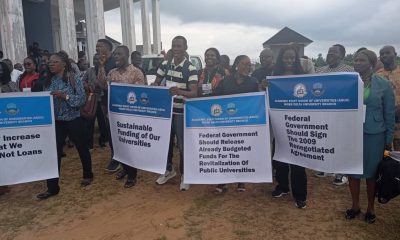
ASUU-NDU protest against FG loans, unpaid salaries,Non-Implementation of agreements …..says loans is generational slavery
-

 Business & Economy1 year ago
PC-NCG Issues Disclaimer on Purported Nigerian Coast Guard National Orientation Exercise In Anambra State
-
 Entertainment2 years ago
Jubilation galore as Parishioners of CKC Kurudu celebrate their cultural heritage ….FG should exploit our Cultural heritage to unite Nigerians-Rev Fr Dim
-

 Sports8 months ago
Bayelsa-born ex-football star’s son, Opuama donates spike shoes to Athletics Association
-

 General News2 years ago
Reps hold public hearing on FMC Ugwuaji Awkunanaw
-
 Law & Crime1 year ago
Legal practitioner raises alarm over threat to his life by CSP Muhammed Abdulkareem
-
 General News2 years ago
Celebration galore as UDA Successfully Elected New Exco ……I will digitalize processes that will raise UDA to greater height -Comr. Okejiri