
General News
Team Europe Explores Kannywood’s Potential to Create Jobs, Skills, Opportunity and Social Change Across Northern Nigeria Kano, Nigeria –


By Michael Agbaji
Diplomats from Team Europe have visited Kano Film Village to gain first-hand insight into how Kannywood is contributing to youth employment, education and economic opportunity across northern Nigeria, while also promoting positive social values through storytelling.
The delegation was led by the European Union Ambassador to Nigeria and ECOWAS, Gautier Mignot, and included ambassadors and deputy heads of mission from Denmark, Spain, Italy, France, Czechia, Finland, Belgium and Austria.
The delegation was received by the Executive Secretary of the Kano State Films and Video Censorship Board, Alhaji Abba El-Mustapha, and the Managing Director of the Nigerian Film Corporation, Ali Nuhu.
During the visit, Team Europe met with filmmakers, actors, producers and regulators, and observed the production of Hindatu, a film that tells the story of a young girl determined to continue her education and pursue a career in medicine despite pressure from her family to marry at an early age.
Speaking during the visit, Ambassador Mignot emphasised the transformative power of storytelling and the creative arts.
“Stories have the power to inspire change.
Films that promote education, opportunity and inclusion can spark important conversations and encourage positive change within communities,” he said.
He added: “Creative industries are not only about culture. They are also about jobs, skills, entrepreneurship and creating opportunities for young people.
Across Nigeria, young people are demonstrating remarkable talent and creativity, and industries such as Kannywood are helping transform that potential into livelihoods and economic opportunity.”
The Executive Secretary of the Kano State Films and Video Censorship Board, Alhaji Abba El-Mustapha, highlighted Kannywood’s role in promoting positive social values while creating opportunities for practitioners across the creative sector.
According to him, the Board has approved more than 10,000 films over the years and continues to support the industry through training programmes, workshops and stakeholder engagement.
“Our role is not only regulatory,” he said. “We also work with filmmakers to strengthen professional standards, support capacity development and ensure that films contribute positively to society.”
The delegation also toured Kano Film Village, a production facility developed by broadcaster and filmmaker Abdullaziz Dansmall.
The facility provides a dedicated environment where films can be produced efficiently and professionally.
“Our first major production was Gidang Haya. We used the revenue from that project to build little by little, expanding the facility over time,” Dansmall explained.
“Our long-term ambition is to transform the site into a fully developed film village capable of supporting larger productions.”
The Managing Director of the Nigerian Film Corporation, Ali Nuhu, underscored the economic importance of the industry, citing research which identified film production as the second-largest source of youth employment in Kano State after agriculture.
He noted that the industry’s impact extends far beyond entertainment, creating livelihoods and supporting businesses throughout the value chain.
Ali Nuhu also highlighted some of the challenges facing the sector, particularly in the areas of distribution and access to production facilities.
He observed that Kannywood has increasingly adapted to digital platforms and online distribution channels following the decline of traditional DVD markets.
The visit comes as the European Union expands its support for cultural cooperation between Africa and Europe through initiatives such as the Africa-Europe Partnerships for Culture (AEPC), a €30 million programme that supports artist mobility, cultural spaces and collaboration between African and European creative professionals.
The initiative reflects the EU’s growing recognition of culture and creative industries as powerful drivers of economic opportunity, innovation and social development.
By Our Correspondent
In a bid to improve the welfare of Nigerian workers, the federal government declared on Friday that it has commenced consultations ahead of fresh negotiations on the national minimum wage..
Permanent secretary, federal ministry of Labour and Employment, Dr Kamil Shoretire, who disclosed this during a capacity-building workshop for labour correspondents in Abuja, said that although the government had not announced a timetable for the formal commencement of negotiations, background consultations were already underway.
He said: “We are yet to announce the timetable for that, but background discussions are already ongoing. When it’s time to get the press involved in what has been proposed and what is being negotiated, it will be revealed to you,”.
The permanent secretary stressed that the consultations were part of wider efforts to address wage and allowance issues across different sectors, noting that collective bargaining discussions were also ongoing with workers in sectors such as health and education.
According to him: “Various discussions with health, education and other sectors that have lots of issues in terms of wages and allowances are ongoing and they are being fast-tracked so that the ones that are agreed will reflect in next year’s budget,”.
The permanent secretary also disclosed that the Federal Government had responded to a complaint filed against it by the Nigeria Labour Congress (NLC) at the International Labour Organisation (ILO).
He said, Nigeria met the September 1 deadline set by the ILO to respond to outstanding issues raised in the complaint.
“Let me start with the ILO. We have met the deadline. We have responded to the request from ILO. I was there when a complaint was filed by the NLC against the Nigerian government at the ILO on some of the labour issues that are yet to be resolved in the country.
“We responded at the ILO, but we also got that certain areas were not addressed or were pending. So those ones were the ones that we got a deadline on September 1, and we have responded accordingly”, he said.
The NLC had petitioned the ILO at the International Labour Conference in Geneva, alleging violations of workers’ rights under the Right to Organise and Collective Bargaining Convention, 1949, otherwise known as Convention No. 98.

By David Owei, Yenagoa
As part of efforts to enhance the capacity of its staff to effectively lead and regulate the oil and gas industry, the Nigerian Content Development and Monitoring Board (NCDMB), on Thursday inaugurated its LearnFest Lecture Series, a platform for continuous learning among staff and oil and gas industry stakeholders.
LearnFest, an initiative under the Nigerian Content Academy (NCA), a specialised knowledge-sharing and training arm of the agency, will provide trainings on the mandate and inner workings of the Board.
Attended by all staff at the corporate headquarters in Yenagoa, the three-hour event was focused on raising awareness of the different directorates of the organisation, their constituent divisions and departments, as well as their specific responsibilities and how they function individually and collectively to advance corporate goals and objectives.
In a promo video, the Academy explained that NCDMB’s knowledge is spread across seven directorates and each has its own mandate, processes, expertise, responsibilities, and way of creating value.
It added that knowledge becomes more powerful when it does not exist in silos but moves from one department to the other with handshakes of different units.
According to the Academy, LearnFest is intended to help staff understand “how everything fits together,” the big picture, with respect to the mandate of the Board as well as institutional processes, practices, culture, and relationships. “When we understand what others do, we collaborate better, support one another better, and work as one integrated ecosystem,” it added.
In opening remarks at the event, the Director, Capacity Building Directorate, Engr. Abayomi Bamidele, stated that the LearnFest Lecture Series was informed by the need to create an understanding of Nigerian Content tools and processes among staff and other oil and gas industry stakeholders.
Industry players, he explained, need to understand and interpret the Nigerian Oil and Gas Industry Content Development (NOGICD) Act, 2010, operational principles as enshrined in the NCDMB Guideline for Nigerian Content Human Capital Development Implementation Strategy, the Nigerian Content Compliance Certificate (NCCC), Nigerian Content Plan (NCP), statutory reporting and matters relating to expatriate quota.LearnFest, he pointed out, “will make our work easier.”
He disclosed that industry operators and service companies, industry associations such as the Oil and Gas Trainers Association of Nigeria (OGTAN), academic institutions, and ministries, departments and agencies (MDAs), have been writing to the Academy to express interest in sending their staff for the specialised training provided there.
Engr. Bamidele further stated that the NCA is building a faculty, and that the Lecture Series is a way of preparing the grounds for its take-off. According to him, “The people presenting [the lectures] could form part of our faculty,” and those attending the event are expected to give feedback on the suitability of such resource persons for the said roles.
He also said that the Management of the Board has approved the use of the Board’s purpose-built facility in Opolo, along the Opolo-Elebele Road in Yenagoa as a centre for the NCA training programmes.
In the first presentation under the Lecture Series, the Manager, Planning and Policy Development Department, Engr. MofeMegbele, spoke on the theme “Understanding the Activities and Processes of the Planning, Research and Statistics Directorate,” with subheadings such as “Operating Framework for Planning Research and Statistics (PRS),” “Overview of Planning and Policy Development Department (PPD),” “Expatriate Quota,” and “Inter-Directorate/Division Relations,” “Research and Development Programme,” “Technology Commercialisation and Innovation,” “Overview of R&D Infrastructure,” “NOGIC JQS/NOGIC JQS User Communication,” “NCCF Objectives,”and “E-Marketplace and Stakeholders Engagement.”
He said the Directorate comprised two major Divisions, namely, PPD and Research and Statistics Development Division,” both of which are headed by General Managers. PPD, he explained, was established in September 2018 under Section 70 of the NOGICD Act, and has been responsible for “policies and guidelines for internal and external stakeholders,” whose implementation it also monitors.
The LearnFest Lecture Series will hold monthly for the next nine months, with a specific Directorate featured in each edition. Attendance, online and in-person, is mandatory for all staff of the NCDMB, while other oil and gas industry stakeholders could participate in subsequent editions.
General News
22nd ANEC Confrence: Media, Govt Must Meet at Point of Truth-Mbah …..bags plaque for good governance
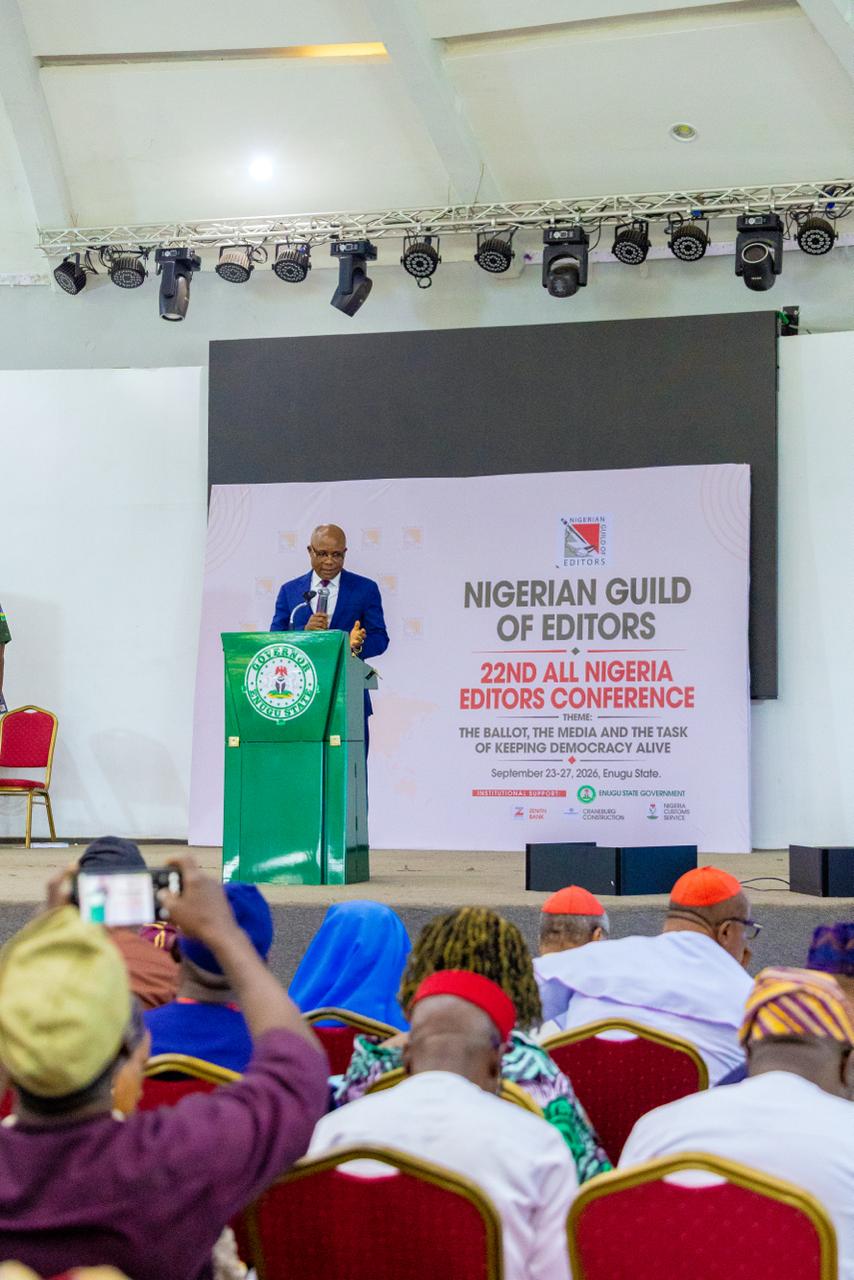
By our correspondent
Enugu State Governor, Peter Mbah, has challenged the government and the media to meet at the point of truth, urging journalists to go beyond headlines and political narratives by independently establishing facts through evidence, investigation and context.
Mbah said government had a responsibility to be transparent about its actions and accountable for its results, while the press must independently scrutinise those actions and report the truth, whether the findings exposed shortcomings or revealed progress.
The governor stated this on Thursday while welcoming over 300 editors to the 22nd All Nigeria Editors Conference (ANEC) organised by the Nigerian Guild of Editors (NGE) in Enugu.
The conference has as its theme, “The Ballot, the Media and the Task of Keeping Democracy Alive,” while its sub-theme is “When Lies Look Real: Detecting and Debunking AI Misinformation Before, During and After Elections.”
Mbah said the relationship between government and the media should not always be defined by confrontation, stressing that both institutions had different responsibilities, but a common obligation to serve the Nigerian people.
“Government must be transparent about what it is doing and be accountable for the results. The press must establish the facts and report the truth.
“Sometimes that truth will expose failure. Sometimes it will reveal progress. The obligation for us both is the same in either case – serving the people of Nigeria,” he said.
The governor urged journalists to deepen investigative reporting, particularly at a time when artificial intelligence and other technologies were making it increasingly difficult to distinguish between genuine and fabricated information.
He said AI could be used to fabricate photographs, clone voices and manipulate videos to make people appear to say things they never said, warning that the development had increased the responsibility of professional journalists.
“My challenge to you, therefore, is simple – go deeper, beyond the surface,”Mbah told the editors.
According to him, rigorous journalism should not involve searching for evidence to support a position that had already been taken.
“Its value lies precisely in its independence: examine the evidence, test competing claims, establish what happened, and report what you find,” he said.
Mbah added that the same standard should apply to government and its critics, stressing that government achievements should not be ignored simply because they did not fit a particular political narrative.
“We have tried to build an Enugu government that is open about what it is doing and clear about what it is trying to achieve. Where we fall short, that should call for scrutiny and be reported. But the same principle applies when the evidence reveals progress,” he said.
The governor also used the occasion to highlight some of his administration’s projects, including more than 1,500 kilometres of roads constructed or reconstructed, over 7,000 classrooms, Smart Green Schools and Type-2 Primary Healthcare Centres across the state’s 260 wards.
He listed other interventions as water infrastructure, new transport terminals and CNG buses, Enugu Air, the revival of dormant industries and the development of a new city.
Mbah said the administration was working to position Enugu as an economic gateway to the South-East, with the ambition of making the state one of Nigeria’s leading economies and a national leader in human development and quality of life.
He also acknowledged the support of President Bola Tinubu and the Federal Government, particularly in areas of roads, aviation, energy and regional development.
The governor urged the editors to use their presence in Enugu to independently assess the developments in the state.
“Take some time to explore the city, speak to the people who live and work here, and get a sense of the direction in which Enugu is moving,” he said.
One of the highpoints of the opening ceremony was the presentation of a plaque for good governance to Governor Mbah by the Guild.

Tinubu-Shettima Movement Calls for 3 Days of National Prayers
By Our Correspondent The National Movement for Tinubu-Shettima 2027 – Forward Nigeria has called for three days of national prayers...

THE UNBORN CHILD HAS HUMAN RIGHTS
By Emmanuel Nnadozie Onwubiko This piece was first written and circulated for publication in 2012. I have revisited and substantially...

NCDMB Honours Retirees, Reflects on Local Content Growth
By David Owei The Nigerian Oil and Gas Industry Content Development (NOGICD) Act, 2010 and the exponential growth of local...

2027 : PDP Candidate re-connects Zanchita community with National grid after two years of darkness
By Uthman Baba-Naseer,Minna It was a celebration galore in Zanchita community in gbako local government area of Niger State,as former...

Insecurity ,displacement alters distribution of Christian communities in Niger state to 3,417,636
By Uthman Baba -Naseer,Minna Niger state Christian leaders have disclosed that out of the Seven million, four hundred and seventy...


Death of 37 suspected illegal Miners:11 member of Judicial commission of inquiry set for inauguration on Tuesday by govrrnor Bago
BY UTHMAN BABA-NASEER,MINNA Sequel to the constitution of the Judicial commission of inquiry by the governor Mohammed Umar Bago, to...

Thanksgiving Service Heralds Bayelsa 30th Anniversary Celebration
By Dabid Owei Bayelsa State Government on Sunday held an inter-denominational thanksgiving service to kick-start activities marking the 30th anniversary...


Former Speaker challenges substition of his name with Suleiman as winner of APC primary election at Minna Fed.High Court
By Uthman Baba-Naseer,Minna The Former Speaker of the Niger State House of Assembly,Rt Hon. Adamu Usman,has filed a lawsuit before...


SWAN President to Storm Bayelsa for 30th Anniversary Celebration, Igali Confirms*
By David Owei The President of the Sports Writers Association of Nigeria (SWAN), Benjamin Isaiah, has been confirmed among dignitaries...

Panic Grips Delta Residents as Deputy Director Dies After Alleged Assault
By Our Correspondent There is palpable tension among Delta residents following an alleged death of a deputy Director in Asaba,...
-

 Politics1 year ago
Gov Okpebholo moves to end Cultism *Threatens action against leading cult groups *Vows to demolish more cult houses in Edo State
-
 Politics1 year ago
ASUU-NDU protest against FG loans, unpaid salaries,Non-Implementation of agreements …..says loans is generational slavery
-
 Business & Economy1 year ago
PC-NCG Issues Disclaimer on Purported Nigerian Coast Guard National Orientation Exercise In Anambra State
-
 Entertainment2 years ago
Jubilation galore as Parishioners of CKC Kurudu celebrate their cultural heritage ….FG should exploit our Cultural heritage to unite Nigerians-Rev Fr Dim
-

 Sports7 months ago
Bayelsa-born ex-football star’s son, Opuama donates spike shoes to Athletics Association
-

 General News2 years ago
Reps hold public hearing on FMC Ugwuaji Awkunanaw
-
 Law & Crime1 year ago
Legal practitioner raises alarm over threat to his life by CSP Muhammed Abdulkareem
-
 General News2 years ago
Celebration galore as UDA Successfully Elected New Exco ……I will digitalize processes that will raise UDA to greater height -Comr. Okejiri