
Uncategorized
2027: Igbo Agenda Dialogue Endorses Peter Obi for President ….Urges Ndigbo to rally round him …Wants other Presidential Candidates to engage in issue based campaign

By Our Correspondent
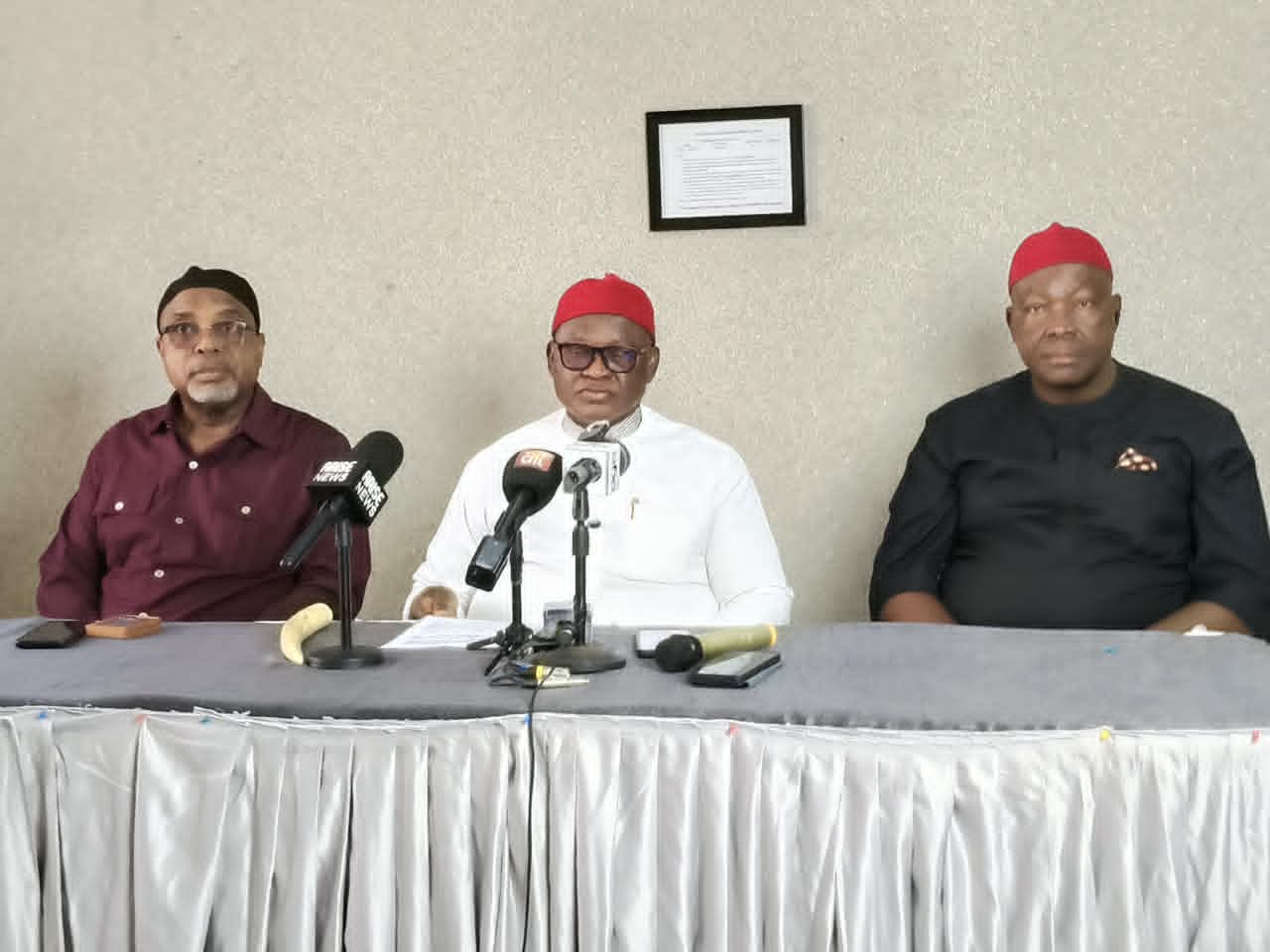
As the race for 2027 election draws closer, a socio-political and pro-democracy organization on the platform of Igbo Agenda Dialogue has declared its support to the presidential candidate of Nigeria Democratic Congress (NDC), Mr Peter Obi and urged all Igbos to give him bloc votes.
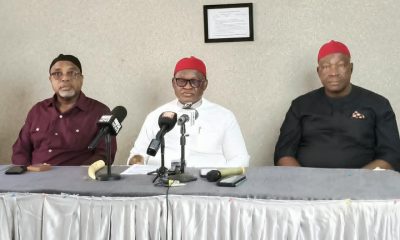
Making this declaration at a Press Conference in Abuja on Wednesday, National Chairman of Igbo Dialogue. Chief Chekwas Okorie said the organization’s choice of Mr Peter Obi was born out of deep reflection of Obi’s visionary leadership and track record.
According to Chief Okorie”The Igbo Agenda Dialogue, IAD, is a socio-political and pro-democracy organization of Igbo people in Nigeria and the diaspora. We are connected to all extant Igbo based unions, market associations, women associations, youth groups, and civil society organizations in Nigeria and abroad.
“We promote, protect, and defend Igbo political interests within the context of one Nigeria. We are the Igbo political grid.
“We have traced Igbo political antecedents in Nigeria before and after Nigeria’s independence in 1960. In this long history, Igbo people have, at various times and periods, collaborated with other ethnic nationalities to champion and promote national unity especially in the area of the formation of previous governments during and after democratic elections in Nigeria. ”
Having examined the political history of Nigeria as it affects power shift, Chief Okorie noted,” In the present build up to the 2027 presidential election, we painstakingly appraised all the frontline presidential candidates presented by the various political parties for the election.
” We considered their track records in the previous political leadership positions they held, their empathy and passion for the people of Nigeria, their physical fitness to rise to the onerous challenges of presiding over the country as large and heterogeneous as Nigeria.
“We also considered their probity and prudence in the management of public resources and with the outcome of this appraisal exercise, we consulted widely and extensively with all the extant groups earlier mentioned above, we came to the unanimous resolution that it will be in the best interest of Nigeria to elect Mr Peter Obi of the Nigeria Democratic Party (NDC) as the President of Nigeria come January 16, 2027.
” We are encouraged by the fact that Mr Peter Obi has earned the popular support of the majority of Nigerians across all ethnic and religious divide in the country. He is also easily the most visible Nigerian presidential candidate for the 2027 election known globally. We are further motivated to endorse Mr Peter Obi for the office of President of Nigeria because right from the inception of Nigeria presidential system of government, Nigerians have been compelled by certain circumstances to be limited to mostly gerontocrats in their choice of President till now.
“For the first time in a long time Nigerians have a singular opportunity to massively participate in the recruitment of the president of their choice in spite of various acts of intimidation and threats being bandied around by those who are in self-inflicted panic about the obvious defeat that awaits them in free, fair, credible, transparent and inclusive elections.
“We seize this opportunity to urge eligible Igbo persons in Nigeria to come out in their millions to compliment other Nigerians who have already demonstrated their willingness to give Mr Peter Obi the opportunity to provide the much needed leadership which Nigerians very much desire at this present time.”
Continuing he said,” In spite of the reluctance of previous Nigerian governments to conduct a credible national census, we can state without equivocation that Igbo people constitute a minimum of 25% of the voting population in each of the 31 states in Nigeria and the Federal Capital Territory (FCT) or the second largest population to the indigenous population of these states while constituting over 99% of the voting population in the five states in the South East geo-political zone of Nigeria.
“We have a responsibility to join hands with all well-meaning Nigerians to usher in a compassionate, prudent, incorruptible leader in the person of Mr Peter Obi as the next President of Nigeria in 2027, with the able support of his compatriot who is similarly compassionate and people oriented Senator Rabiu Musa Kwankwaso, the former Governor of Kano State who is his running mate in the presidential race.
“On a final note, we advise other Igbo politicians who are in other political parties who also have the right to campaign for the presidential candidates of their choice to limit their campaigns to issues while canvassing for votes for their preferred candidates. Igbo people are peace loving citizens of Nigeria, we have shown earlier in this address the support and collaboration our people and their leaders gave to candidates from other parts of the country and ethnic groups to win elections and form governments in the past.”
Chief Okorie further observed, ” It will be recalled that it was Dr. Nnamdi Azikiwe, that led the struggle to attain Nigeria’s independence in 1960 without bloodshed. In the general election of 1960 in Nigeria, it was the Igbo dominated National Council of Nigerian Citizens, NCNC, led by Dr. Nnamdi Azikiwe, against all odds, that went into a political coalition with the Northern Peoples Congress, NPC which enabled the NPC to form a stable government led by Alhaji Tafawa Balewa, a Northerner, as the Prime Minister of Nigeria. In the second republic, it was also the Igbo dominated Nigerian Peoples Party, NPP, again led by Dr. Nnamdi Azikiwe, as presidential candidate that reached an accord with the National Party of Nigeria, NPN, to form a stable and broad based government.
“In the democratic election that the military government of General Abdulsalami Abubakar presided over as Head of State and Commander-in-Chief of the Armed Forces of Nigeria, the Igbo political leaders at the time met at the Modotel Hotel in Enugu and resolved to invest their political capital in the Peoples Democratic Party (PDP), because our son, Dr Alex Ekwueme, the former Vice President of Nigeria under Alhaji Shehu Shagari informed the leaders that his Northern associates in the defunct National Party of Nigeria (NPN) had made a firm commitment to him that they would support him to become the democratically elected President of Nigeria in that year. He told the Igbo leaders that he was assured that his well established capacity and competence and his loyalty to Alhaji Shehu Shagari when they were in the NPN had earned him their support.”
He appealed to the leaders to complement the support of the Northern political leaders by voting massively for the PDP. Igbo people complied. Practically all the offices for election in the South East geo-political zone namely, State House of Assembly, Governorship, House of Representatives and Senate were elected on the platform of the PDP in the zone. Unfortunately, Dr Alex Ekwueme was shortchanged at the Presidential Primary of the party held in Jos, Plateau State after conducting all the elections we have mentioned here.
“In the present build up to the 2027 presidential election, we painstakingly appraised all the frontline presidential candidates presented by the various political parties for the election. We considered their track records in the previous political leadership positions they held, their empathy and passion for the people of Nigeria, their physical fitness to rise to the onerous challenges of presiding over the country as large and heterogeneous as Nigeria. We also considered their probity and prudence in the management of public resources and with the outcome of this appraisal exercise, we consulted widely and extensively with all the extant groups earlier mentioned above, we came to the unanimous resolution that it will be in the best interest of Nigeria to elect Mr Peter Obi of the Nigeria Democratic Party (NDC) as the President of Nigeria come January 16, 2027.
“For the first time in a long time Nigerians have a singular opportunity to massively participate in the recruitment of the president of their choice in spite of various acts of intimidation and threats being bandied around by those who are in self-inflicted panic about the obvious defeat that awaits them in free, fair, credible, transparent and inclusive elections.
He further assured,” the Igbo Agenda Dialogue (IAD) will escalate its campaign effort through the various networks we have linked with to ensure a resounding victory for Mr Peter Obi in 2027 presidential election.”
By our correspondent
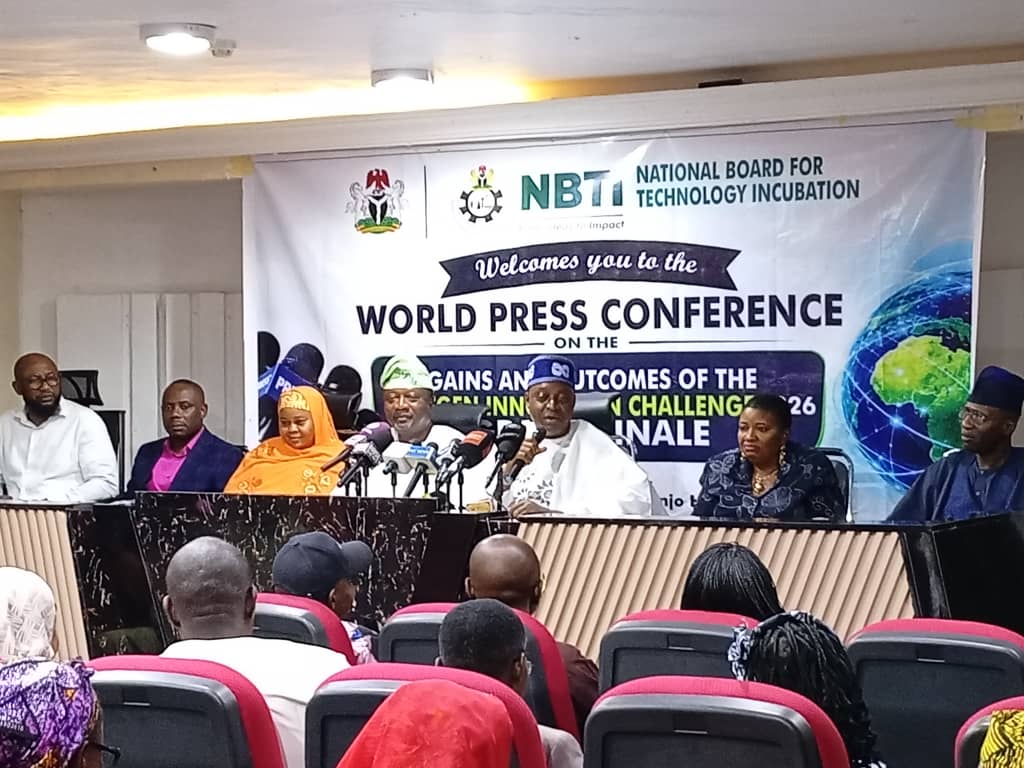
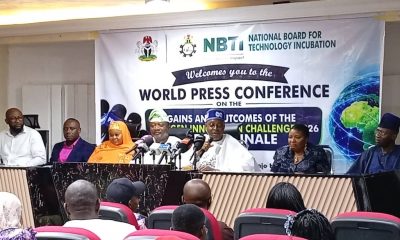
The National Board for Technology Incubation (NBTI) on Wednesday said it is pursuing over $600 million in proposed investments to boost Nigeria’s innovation and clean-energy sectors.
Director-General, Dr Kazeem Kolawole Raji, disclosed this at a press conference in Abuja, while presenting outcomes of the NextGen Innovation Challenge 2026 held in London.
The challenge, organised with UKALD, held its grand finale on October 9 at ExCeL London, bringing together Nigerian innovators, investors, diplomats and development partners.
Raji said 298 innovators from the 36 states and FCT participated, up from 105 in 2025, to showcase homegrown technologies to global markets.
Innovations covered AI, robotics, agriculture, healthcare, education, renewable energy, telecoms, enterprise software, 3D printing and advanced manufacturing.
He said NBTI’s next focus is turning ideas into viable businesses that create jobs and address national challenges.
The proposed $600million portfolio comprises a $500million solar programme with Gigawatt Global to build solar farms in universities and polytechnics under Power Purchase Agreements.
It also includes $100million financing for the Tinubu Light Initiative under an MoU between NBTI and Financial Innovation for Impact, UK.
Raji clarified the figures are proposed investments, not funds received, as realization depends on due diligence, approvals and financing agreements.
He said the investments could boost renewable infrastructure and electricity access in tertiary institutions while advancing clean-energy goals.
Raji also unveiled the Tinubu Light Initiative, targeting one million micro and small businesses with solar solutions to cut energy costs.
The programme projects 10,000 field marketers, 50,000 direct youth jobs, N30billion blended financing in phase one and N12billion annual economic benefits.
He said beneficiaries include tailors, barbers, pharmacies, restaurants, retailers, POS operators and women and youth-led businesses.
In a boost for women-led innovation, Dubai investor Erin Grover pledged $100,000 for three women innovators to improve access to finance and mentorship.
Raji added that 16 innovators got international accelerator slots worth $10,000 each and Pre-MBA scholarships worth over £5,000 each, plus UK Global Talent Visa support, urging investors to back Nigeria’s innovation ecosystem with transparent, verifiable implementation.
Uncategorized
Health Challenges Cannot be Solved Without A coordinated Approach-Speaker Abbas *As Reps Move to Establish Trust Fund for HiV, Malaria and Tuberculosis Control in Nigeria

By Our Correspondent
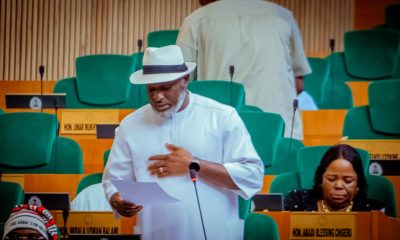
Speaker of the House of Representatives Rt.Hon.Tajudeen Abbas has said that the nation’s health challenges cannot be solved without a coordinated approach by all relevant stakeholders.
This happened as the House Committee on Infectious Diseases has held a public hearing to amend the National Agency for the Control of HIV AIDS Act Laws of the Federation of Nigeria 2004 with a view to establish a trust fund for the control of these ailments
Speaking when he declared the hearing open, he said that our nation cannot realize it’s full potentials when preventable and treatable diseases continue to deprive it’s citizens of life, productivity and opportunity.
Represented by Hon Mansur Manusoro, he said that the protection of public health must therefore be understood not simply as a government responsibility, but as an investment in the lives, capabilities and future of our people.
The proposed amendment he informed is to examine whether our existing legislative and institutional framework is sufficiently responsive to the scale and interconnected nature of these challenges.
He added that the proposal is seeking to expand the mandate of the National Agency for the Control of HIV and AIDS the Bill raises important questions about coordination, administrative efficiency, resource mobilisation and accountability.
He harped on the need to examine how better coordination can reduce duplication, strengthen collaboration and ensure more effective use of scarce public resourexes noting that HIV/AIDS, tuberculosis and malaria have distinct patterns of transmission, prevention strategies and treatment requirements.
The Speaker insisted that every proposed institutional change must ultimately be judged by its impact on the health and well-being of Nigerians.
Earlier in an opening speech Chairman of the House Committee Hon.Amobi Godwin Ogah said that said that the health of the citizenry is an important issue that is not supposed to be left to chance.
He noted that Nigeria remains the country with the highest burden of infected persons with HIV/AIDS Malaria and Tuberculosis diseases
He harped on the need for to establish a trust find to tackle the issue of delay in funding of relevant agencies on charge of control of these diseases annually.
He added that no legislation,
however well conceived, cannot succeed without effective implementation.
He added that sustained investment, public awareness,scientific innovation, institutional cooperation and community participation remain indispensable to the fight against infectious diseases.
The Abia born Labour Party lawmaker added that the proposed amendment must form part of a broader national commitment to strengthening our health system and ensuring that public health interventions produce lasting results.
By Emmanuel Nnadozie Onwubiko
When Senator Osita Bonaventure Izunaso returned to the National Assembly in 2023, more than three years ago, he came back to a Senate very different from the one he had previously known.
Nigeria was confronting a worsening cost-of-living crisis. The naira was under pressure, and the foreign-exchange market was unsettled. Infrastructure deficits remained widespread, while the South-East was still struggling with insecurity, the sit-at-home order and the economic consequences of prolonged political tension.
For Izunaso, the challenge was particularly complicated.
He was not simply another senator in Abuja. He represented Imo West, a constituency spread across 12 local government areas and embedded in one of the country’s most politically restive regions.
Two years into the 10th National Assembly, his record has consequently developed along three parallel tracks: legislation and oversight in Abuja, constituency interventions in Imo West, and advocacy on issues that have come to define the political conversation in the South-East.
That combination provides a more revealing picture of his time in the Senate than a simple catalogue of projects.
Capital-market reform and legislative responsibility
One of the first tests of Izunaso’s second Senate career came not from his constituency but from Nigeria’s financial markets.
In August 2023, he became chairman of the Senate Committee on Capital Market and Institutions.
It was a consequential assignment.
The capital market is where government policy, private investment, pension funds, companies and individual investors meet. At a time when Nigeria was trying to attract investment while battling currency instability and declining purchasing power, the committee’s responsibilities extended beyond technical regulation.
Izunaso’s committee became involved in the legislative process that produced the Investments and Securities Bill 2024.
The bill sought to replace the 2007 legislation and update the legal framework governing Nigeria’s capital market. It addressed issues including investor protection, market regulation, market abuse and the powers of the Securities and Exchange Commission.
Izunaso was identified as the main sponsor of the legislation and played a prominent role in its consideration by the Senate.
The bill eventually passed the Senate in December 2024.
That episode says something important about the senator’s present role. His influence in the National Assembly is not confined to bills bearing his name. Committee chairmanship gives a lawmaker considerable influence over what comes before the chamber, how legislation is scrutinised and how regulatory institutions are subjected to oversight.
It is an influence that is less visible than the commissioning of a road or the distribution of empowerment equipment, but potentially broader in its consequences.
When the naira became a Senate issue
Izunaso also turned his attention to the foreign-exchange crisis.
He sponsored a motion calling for an investigation into the accumulation of foreign-exchange backlogs, activities in the forex market and the Central Bank of Nigeria’s development-finance programmes dating back to 2015.
The motion came at a time when businesses and households were feeling the effects of exchange-rate volatility.
For a senator representing a district where trading, manufacturing and small businesses are important components of local economic life, the issue had both national and constituency dimensions.
His intervention reflected an emerging feature of his Senate work: taking issues that appear to belong to Abuja and connecting them to the economic realities of people back home.
Besides, Senator Izunaso was the sole representative of Nigeria at the Money/202/20 Middle East which took place from September 14-16, 2026 at the Riyadh Exhibition and Convention centre in Malham, Saudi Arabia. The event was hosted by the Financial Sector Development Programme (FSDP), Saudi Central Bank (SANA), Capital Market Authority (IA); co-organized by Tahaluf and Fintech Saudi. Money20/20 Middle East brings together banks, Fintech companies, investors regulators, technology providers and policy makers to explore the future of payments, banking, financial infrastructure and digital finance.
But Abuja is only half the story
For most constituents, however, parliamentary committee work can seem remote.
The test of representation is often much more immediate: the road that connects one community to another, the electricity project, the student who receives a scholarship, the young person who receives equipment to start a business, or the patient who receives treatment during a medical outreach.
This is where Izunaso’s constituency programme has attracted the greatest attention from his supporters.
His office lists road rehabilitation, electricity, water, healthcare, education, agriculture and youth empowerment among the interventions undertaken in Imo West.
It also reports skills-acquisition programmes in communities including Akokwa and Urualla.
The senator’s empowerment programmes have distributed equipment such as sewing machines, grinding machines, welding tools, barbing kits and other items intended to help beneficiaries establish businesses.
Motorcycles and vehicles have also been included among the items distributed.
The political photographs from such events are easy to find. The harder question is what happens after the cameras leave.
Does the sewing machine become a viable tailoring business? Does the welding equipment create employment? Does the motorcycle become a source of sustainable income?
Those are the questions that ultimately determine whether an empowerment programme becomes a development intervention or simply another political ceremony.
Izunaso’s published record presents the programmes as part of an effort to promote self-reliance.
Education and human-capital development
Education has provided another important strand of the senator’s constituency work.
At his July 2024 town-hall meeting, Izunaso presented a first-year scorecard and highlighted scholarship programmes, youth training, healthcare and infrastructure interventions.
The senator reported that 200 students had benefited from scholarships.
His supporters have also pointed to interventions through the Kpakpando Education Foundation, including educational assistance and support for schools.
For families confronting the rising cost of education, such interventions can be significant.
But, again, the larger measure of success is not the announcement of a scholarship. It is whether the beneficiary completes school, acquires useful skills and eventually enters productive employment.
That is the difference between measuring activity and measuring impact.
Representation in a troubled region
Perhaps the most politically consequential aspect of Izunaso’s Senate career has nothing to do with roads or scholarships.
It is his position on the South-East’s political crisis.
Soon after his return to the Senate, Izunaso sought a political solution to the continued detention of Nnamdi Kanu, the leader of the Indigenous People of Biafra.
His intervention was controversial because Kanu’s case sits at the intersection of separatist agitation, national security, criminal justice and the long-running political grievances of the South-East.
Izunaso argued that a political approach could help create conditions for peace and address the economic damage associated with the sit-at-home order.
The Senate did not adopt his proposal for Kanu’s release.
But the senator continued to raise the issue.
His argument has essentially been that military and security responses alone cannot resolve a problem with deep political roots.
That position places him in a delicate political space. He is a member of the governing APC, yet he has advocated an approach to one of the South-East’s most contentious issues that has not always aligned with the harder security position of the Federal Government.
For constituents in Imo West, however, the issue is not theoretical.
The sit-at-home order has affected transport, commerce, schools and daily economic activity across the region. Any political or security intervention capable of restoring normal economic life therefore has direct consequences for the people Izunaso represents.
The Anim State question
Izunaso has also chosen to put his political weight behind the demand for another state in the South-East.
He has promoted the proposed Anim State, arguing that the creation of an additional state could improve political representation and development in the region.
The proposal has particular relevance to his political base because it involves areas around Imo West and neighbouring Anambra.
But state creation is one of the most difficult constitutional exercises in Nigeria.
It requires more than political enthusiasm. It requires the fulfilment of constitutional procedures and demonstrable support among affected communities.
Izunaso has nevertheless continued to push the proposal, making it part of his broader argument that the South-East requires greater political and developmental balance.
His support for the South-East Development Commission follows the same regional-development logic.
Together, the two issues show that his Senate agenda has increasingly moved beyond the boundaries of Imo West.
From intervention to impact
There is another way to look at Izunaso’s constituency interventions.
They represent an attempt to translate the abstract language of government policy into individual economic opportunities.
A road is infrastructure.
A scholarship is human capital.
A skills-acquisition programme is an employment intervention.
A medical outreach is social protection.
An empowerment tool is an attempt at livelihood creation.
That is the theory behind the model.
Whether the model works at scale is a separate question.
Izunaso’s official project platform reports interventions across all 12 local government areas of Imo West, while his supporters have cited hundreds of beneficiaries from empowerment programmes and thousands of persons living with disabilities who have received assistance.
Those figures are claims from his office and supporters and should be independently tested against project records, beneficiary accounts and evidence of completion.
That scrutiny is not a rejection of the interventions. It is precisely what political accountability requires.
Measuring legislative performance
There is a tendency in Nigerian politics to reduce legislative performance to numbers: how many bills were sponsored, how many motions were moved and how many projects were facilitated.
The numbers matter, but they do not tell the whole story.
A senator’s job involves legislation, representation, oversight and advocacy.
Izunaso’s first years in the 10th Assembly illustrate all four.
He has participated in financial-sector legislation as chairman of the Capital Market and Institutions Committee. He has raised questions about foreign-exchange management. He has sponsored legislative proposals dealing with infrastructure and fire prevention.
At home, his office has pursued education, healthcare, empowerment and infrastructure interventions.
And on the regional stage, he has continued to speak about Nnamdi Kanu, insecurity, state creation and the South-East Development Commission.
The record is therefore neither simply an Abuja story nor simply an Imo West story.
It is a story about a politician trying to operate in both worlds simultaneously.
The unfinished test
There is, however, a larger test ahead.
The 10th National Assembly still has time to determine the final shape of Izunaso’s legislative record.
Some bills associated with him and his committee have become law or advanced through the legislative process. Others remain proposals.
Some constituency interventions have been completed, while others require continuing assessment.
And some of the biggest issues he has championed—particularly state creation and the political resolution of the South-East crisis—remain far from settled.
That makes his first two years a chapter rather than a conclusion.
The senator has established the themes of his current representation: capital-market reform in Abuja, development interventions in Imo West and political advocacy for the South-East.
The more difficult part is converting those activities into durable outcomes.
For a lawmaker, that is ultimately where the difference between activity and impact lies.
A bill becomes meaningful when it changes the law and improves regulation.
A road becomes meaningful when it remains usable.
A scholarship becomes meaningful when it helps a student complete an education.
An empowerment programme becomes meaningful when the business survives.
And political advocacy becomes meaningful when it produces measurable change in the lives of the people affected.
That is the unfinished test of Osita Izunaso’s second journey through the National Assembly.
So far, his Senate career has been defined by an effort to occupy all three spaces available to a modern Nigerian lawmaker: the legislative floor in Abuja, the constituency at home and the wider political arena of the South-East.
What remains is for time and evidence to determine how deeply that effort has changed each of them.
EMMANUEL NNADOZIE ONWUBIKO is the founder of the Human Rights Writers Association of Nigeria and a former National Commissioner of the National Human Rights Commission of Nigeria.

NBTI eyes $600m investment to power innovation, clean energy
By our correspondent The National Board for Technology Incubation (NBTI) on Wednesday said it is pursuing over $600 million in...

Health Challenges Cannot be Solved Without A coordinated Approach-Speaker Abbas *As Reps Move to Establish Trust Fund for HiV, Malaria and Tuberculosis Control in Nigeria
By Our Correspondent Speaker of the House of Representatives Rt.Hon.Tajudeen Abbas has said that the nation’s health challenges cannot be...

2027: Igbo Agenda Dialogue Endorses Peter Obi for President ….Urges Ndigbo to rally round him …Wants other Presidential Candidates to engage in issue based campaign
By Our Correspondent As the race for 2027 election draws closer, a socio-political and pro-democracy organization on the platform of...

A Broad Reflection on Izunaso’s Thematic Focus
By Emmanuel Nnadozie Onwubiko When Senator Osita Bonaventure Izunaso returned to the National Assembly in 2023, more than three years...

Flood: Senate seeks FG intervention to save Bayelsa community from extinction
By George Mgbeleke The Senate on Tuesday urged the Federal Government to urgently tackle erosion in Obogoro community, Bayelsa State,...
Flood: Senate seeks FG intervention to save Bayelsa community from extinction By ignatius Okorocha,Abuja The Senate on Tuesday urged the Federal Government to urgently tackle erosion in Obogoro community, Bayelsa State, through shoreline protection. The resolution followed a motion titled “Urgent need to save Obogoro community from extinction” sponsored by Senator Benson Kombowei (APC Bayelsa Central). Presenting the motion, Kombowei said possession of land is essential for any community to preserve identity, livelihood, culture and communal life. He warned that Obogoro people “are in serious danger of losing their ancestral land and their communal life as a result of an aggressive erosion that has persisted for decades.” According to him, the erosion has caused loss of lives, property and livelihoods over the years. He listed recent losses to include about 300 people rendered homeless, public primary school buildings and field washed away, youth corps lodge and community playground destroyed, and several persons drowned. Kombowei said the community has persistently sought help from government, including petitions to the National Assembly and oil companies operating in the area, without solution. “The people of Obogoro community feel neglected and abandoned, and left to confront their life-threatening challenge,” he said. He noted that erosion worsens during annual floods when river levels rise and flow faster, eating up land and shrinking the homeland. Adopting the motion, the Senate called on the Federal Government to urgently provide shoreline protection to save Obogoro from extinction. It also urged the National Emergency Management Agency (NEMA) to provide relief materials to victims of flooding and erosion in the community while asking the leadership of the Red Chamber to ensure compliance with the resolution by the government.
By George Mgbeleke Senate on Tuesday urged the Federal Government to urgently tackle erosion in Obogoro community, Bayelsa State, through...

FG Confirms First Ebola Case in Abuja
By George Mgbeleke The Federal Government has confirmed one case of Ebola Virus Disease in the Federal Capital Territory, triggering...

Tinubu Will Announce Fuel Tax on Inauguration Day If Re-Elected-ADC Warns ….Say Pump Price May Rise Above N1,500.
By George Mgbeleke The African Democratic Congress (ADC) has warned that President Bola Tinubu’s planned implementation of fuel tax may...

DSS Arraigns Five suspects Over Kidnap of prospective Corps Members in Imo state
By our correspondent The Department of State Services (DSS) on tuesday, october, 20, 2026, arraigned five suspects who allegedly kidnapped...

37 illegal Dead Miners Panel: NSCDC Bans from Enforcing,Arresting Miners from Mining Site Across Nigeria-NMC North-Central
By George Mgbeleke The North Central Zonal Coordinator of Nigeria Mining Cadastral (NMC) Engr. Henry Temidayo Bolawale has said that...
-
 Politics1 year ago
Gov Okpebholo moves to end Cultism *Threatens action against leading cult groups *Vows to demolish more cult houses in Edo State
-
 Politics1 year ago
ASUU-NDU protest against FG loans, unpaid salaries,Non-Implementation of agreements …..says loans is generational slavery
-
 Business & Economy1 year ago
PC-NCG Issues Disclaimer on Purported Nigerian Coast Guard National Orientation Exercise In Anambra State
-
 Entertainment2 years ago
Jubilation galore as Parishioners of CKC Kurudu celebrate their cultural heritage ….FG should exploit our Cultural heritage to unite Nigerians-Rev Fr Dim
-

 Sports8 months ago
Bayelsa-born ex-football star’s son, Opuama donates spike shoes to Athletics Association
-

 General News2 years ago
Reps hold public hearing on FMC Ugwuaji Awkunanaw
-
 Law & Crime1 year ago
Legal practitioner raises alarm over threat to his life by CSP Muhammed Abdulkareem
-
 General News2 years ago
Celebration galore as UDA Successfully Elected New Exco ……I will digitalize processes that will raise UDA to greater height -Comr. Okejiri