
Business & Economy
Tinubu jerks up proposed 2025 budget from N49.7trillion to N54.2trillion …As NASS promises to pass the budget before the end of February

George Mgbeleke,Abuja
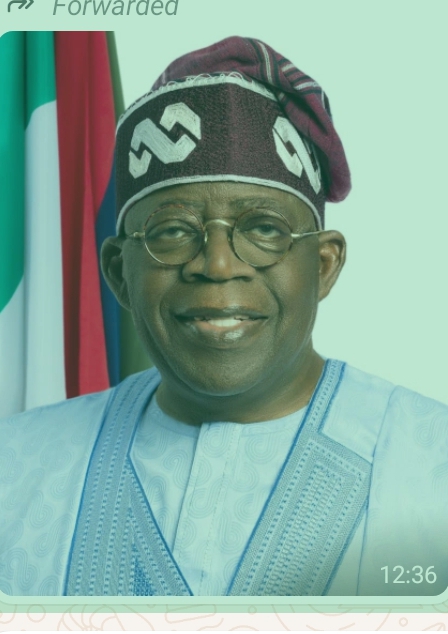
President Bola Tinubu has increased the proposed total budget size for 2025 from N49.7teillion he presented to the joint session of the National Assembly on December 18, 2024 to N54.2trillion .
President Tinubu announced an increase in the proposed budget size through separate letters forwarded to both the Senate and the House of Representatives .
The President in the letter read during plenary in the Senate by Senator Godswill Akpabio , said the increase arose from N1.4trilliion additional revenues made by the Federal Inland Revenue Service ( FIRS ) , N1.2trillion made by the Nigeria Customs Service , N1.8trilliion generated by some other Government Owned Agencies .
The President of the Senate consequently directed the request to the Senate Committee on Appropriations for expeditious consideration and declared that the budget consideration , would be concluded and passed before the end of this month.
President Tinubu’s letter to the President of the Senate on the breakdown of the additional revenue to the 2025 budget reads as follows,”I am writing to inform you of the availability of additional revenue amounting to N4,530,479,970,637 and to propose its allocation within the 2025 Appropriation Bill to enhance the budget’s responsiveness to the nation’s most pressing priorities and aspirations.
(1)Additional Revenue Breakdown:
This additional revenue, sourced from key agencies, represents a pivotal opportunity to address Nigeria’s critical challenges and advance its development agenda:
Government-Owned Enterprises (GOES): N1,823,879,970,637
Federal Inland Revenue Service (FIRS): N1,497,600,000,000
(2) Federal Government’s 52% share of the increase in revenue from N22.1 trillion to N25.1 trillion_
Nigerian Customs Service (NCS): N1,209,000,000,000
(Federal Government’s 52% share of the increase in revenue from N6.5 trillion to N9.0 trillion)
With this additional revenue, the 2025 Appropriation Bill’s total budget size will increase from N49.7 trillion to N54.2 trillion, demonstrating our commitment to inclusive growth and security.
(3) Proposed Allocation of Additional Revenue:
I propose that these funds be allocated to the following transformative expenditure areas:
i. Solid Minerals Sector-N1 trillion. To support economic diversification by unlocking the potential of Nigeria’s vast solid mineral resources, which remain an untapped revenue stream and a vital pillar of non-oil growth.
Re-capitalization of the Bank of Agriculture (BoA) N1.5 trillion: To transform Nigeria’s agricultural landscape, ensure food security, and empower small holder farmers and agribusinesses.
Re-capitalization of the Bank of Industry (Bol) N500 billion To provide critical support to small and medium enterprises (SMEs), drive local manufacturing, and reduce dependence on imports
iv Critical Infrastructure Projects (RHID Fund) – N1.5 trillion. Allocated as follows:
a Irrigation Development (through River Basin Development Authorities): N380 billion.
b. Transportation Infrastructure (roads and rail): N700 billion (300 billion for the construction and rehabilitation of critical roads and 400 billion for light rail network development in urban centers),
c. Border Communities Infrastructure: N50 billion,
d. Military Barracks Accommodation: N250 billion, and
e. Military Aviation: N120 billion.
(4) Justifications for Allocations:
i. Solid Minerals Sector – N1 trillion
a Economic Resilience: Reduces reliance on volatile oil sector by creating alternative revenue streams.
b. Regional Equity. Encourages development in resource-rich, underserved areas, boosting rural economies.
c. Value Addition: Supports processing and export of minerals, increasing foreign exchange earnings.
ii. Bank of Agriculture Recapitalization – N1.5 trillion
a. Food Security: Empowers smallholder farmers and agribusinesses, improving access to affordable credit.
b. Economic Growth: Enhances agricultural productivity and supports agro-industrial value chains.
c. Export Competitiveness: Promotes the export of high-value crops, reducing pressure on the Naira.
Bank of Industry Recapitalization – N500 billion
a. SME Empowerment. Provides affordable financing for innovation and entrepreneurship.
b. Job Creation: Drives industrial growth and supports local manufacturing, reducing unemployment
c. Revenue Growth: Expands the tax base through industrial expansion.
iv. Critical Infrastructure (RHID Fund) – N1.5 trillion
a. Irrigation Development: N380 billion will strengthen Nigeria’s capacity for year-round agricultural production, ensuring water security and boosting food supply.
b. Transportation Infrastructure: N700 billion will modernize Nigeria’s road and rail networks, reducing costs, enhancing connectivity, and supporting economic activity.
c. Border Communities Infrastructure: N50 billion will improve living standards and enhance the security of border regions, fostering stability and cross-border trade.
d. Military Barracks Accommodation: N250 billion will provide modern and expanded housing for personnel, boosting morale and operational readiness
e. Military Aviation: N120 billion will modernize Nigeria’s aviation capabilities, ensuring the military remains responsive to emerging security challenges.
(4). A Philosophical Case for Military Expenditure:
The foundation of a thriving nation lies in its ability to protect its citizens. No infrastructure, no innovation, and no progress can be enjoyed or sustained without security. The government has a constitutional obligation to secure lives and property, and military expenditure is not merely a fiscal decision-it is a moral imperative. By investing in our armed forces, we affirm our resolve to end terrorism, safeguard the dignity of our people, and create conditions for economic prosperity. This budget reflects not only our commitment to securing Nigeria today but to building a future where every citizen can live and thrive without fear.
)5)Broader Justification:
This allocation framework underscores the Administration’s dedication to fostering inclusive growth, addressing security challenges, and building resilience into Nigeria’s economic fabric. These investments will:
i. Promote Stability By addressing critical infrastructure deficits, especially in underserved regions, and strengthening national security
ii. Diversify Revenue: By investing in agriculture, solid minerals, and manufacturing. reducing over-reliance on oil revenues.
iii. Catalyze Economic Growth: By enhancing infrastructure, supporting SMEs, and unlocking Nigeria’s vast economic potential.
Tinubu finally requested the Senate for Integration of the additional revenue to the,2025 appropriation Bill.
“I urge the National Assembly to adopt and integrate these proposals into the 2025 Appropriation Bill, reflecting our shared commitment to national development. Kindly let me know if additional information or clarification is required,” he said.
Business & Economy
Customs Intercepts 56 Containers With Goods Worth Over N5.53bn, Inaugurates Healthcare Centre In Rivers
By Our Correspondent
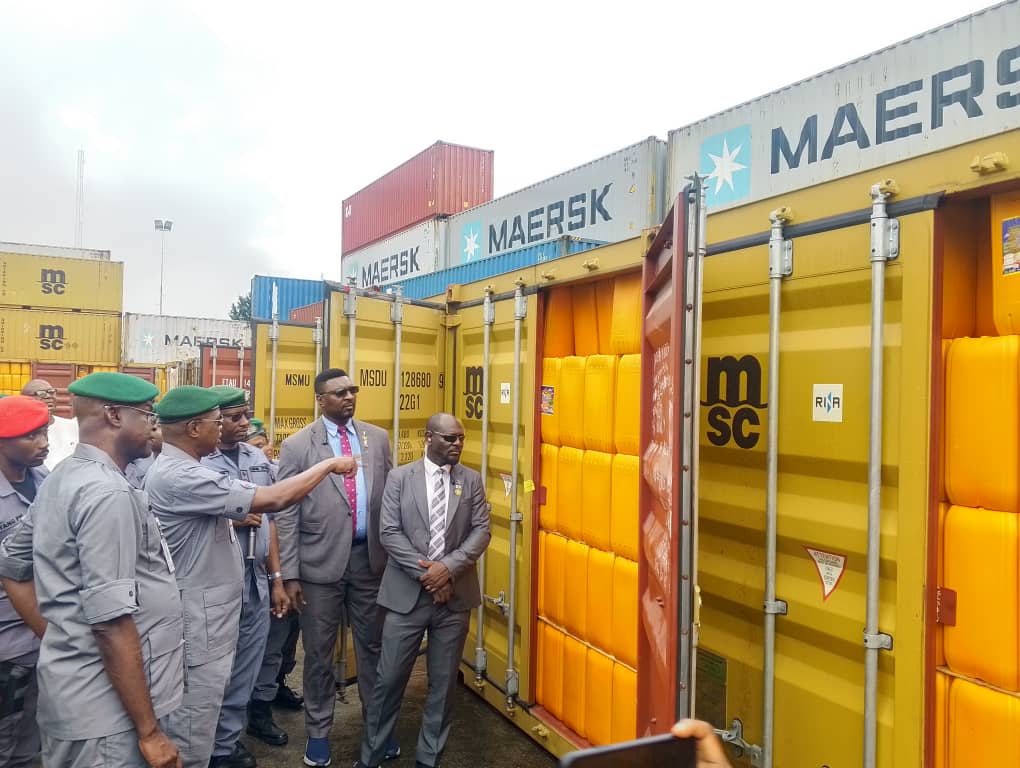
In its effort to stamp out smuggling and improve the revenue target of the country, the Nigeria Customs Service, (NCS) on Tuesday said it has intercepted 56 containers laden with banned vegetable oil, assorted used clothing and tomatoes paste with a Duty Paid Value of over N5.53 billion at the Onne Port, Rivers State.
The Service also handed over to Ebubu Community in Rivers State, a reconstructed and equiped Primary Healthcare Centre, built by the Port Harcourt Area II Customs Command, as part of its Corporate Social Responsibility drive.
The Comptroller-General of Customs, CGC Bashir Adewale Adeniyi, while briefing journalists in Port Harcourt on Tuesday said the 56 seized containers, comprising 45 containers of over 1.1 million litres of vegetable oil, nine containers of assorted used clothing and two containers of tomato paste, were falsely declared as plants, spare parts and machineries.
Adeniyi, who is also Chairman of the World Customs Organisation Council, said the interception followed an intelligence-driven review of cargoes destined for Free Trade Zones, which revealed flagrant abuse of incentives and waivers granted by the Federal Government to encourage local production.
He said each of the 45 containers of vegetable oil, branded “Deliceoux”, contained 1,050 jerry cans of 25 litres each, valued at N4.25 billion, while the nine 40-foot containers of used clothing and two 20-footer containers of tomato paste were valued at N1.04 billion and N232 million respectively, bringing the total to N5,530,080,000.
According to him, the Federal Government allows operators in free zones to import raw materials and machinery duty-free, and in some cases goods under import prohibition, but investigations showed the concessions were being diverted into the local market.
“This meeting is very important because we need to have a conversation on what we need to do to support our local industries. Our quest to facilitate trade and ensure prompt port clearance should not be exploited to damage the local economy and local production capacity. The remarkable thing about these containers is that they were declared as machinery and spare parts, but upon physical examination we discovered they were vegetable oil. The intention is clearly to introduce them into our local markets,” Adeniyi said.
He recalled that less than a month ago, the Cross River/Akwa Ibom Command seized two 40-footer containers of vegetable oil being diverted from the Calabar Free Trade Zone, while about 40 other containers had earlier been taken into the zone under questionable circumstances.
The Customs boss noted that the seized containers contravened Sections 55 and 233 of the NCS Act 2023, announcing initiation of court processes for condemnation and final forfeiture, prosecution of importers, agents and shipping companies involved, and a comprehensive audit of all containers transferred to Tinapa Free Trade Zone, with a suspension of further transfers until all previous transfers are accounted for.
He said the action was aimed at safeguarding the economy, protecting public health, supporting domestic production and ensuring compliance with import laws, noting that false declarations deprive government of revenue, expose local manufacturers and farmers to unfair competition and threaten jobs.
He commended the Customs Area Controller, Port Harcourt Area II Command, Onne, Comptroller Aliyu Alkali and his officers for the diligence that led to the seizures.
Shortly after, Adeniyi commissioned the reconstructed Ebubu Primary Healthcare Centre, built by the Onne Command, describing it as a milestone in the transformation of the NCS into a modern, professional and responsive institution.
He said the project was executed under the “Customs Care” initiative launched in Abuja on March 28, 2025, which has delivered interventions in education, healthcare, food security and environmental sustainability nationwide, earning the Service the Commonwealth Gold Award for Environmental and Corporate Social Responsibility.
“This event is significant because we are reaffirming that our responsibility extends beyond revenue collection and border security to making meaningful contributions to the communities where we serve. Customs Care provides a structured platform to respond to genuine community needs, complement government efforts and create sustainable social impact,” he said.
In his remarks, the Customs Area Controller, Port Harcourt Area II Command, Onne, Comptroller Aliyu Alkali, said the reconstruction of the health centre was part of the Command’s Corporate Social Responsibility projects and reflects the Service’s philosophy that its success is measured not only by revenue and enforcement statistics but by its positive impact on host communities.
Alkali said the facility, which had been abandoned and dilapidated, was rehabilitated to restore a critical community asset that will serve Ebubu and surrounding communities, particularly expectant mothers and children.
He attributed the successful completion of the project to the visionary leadership and personal commitment of the Comptroller-General, noting that the NCS under Adeniyi believes Customs is not only about revenue and enforcement but also about service to humanity, community engagement and national development, while appealing to authorities and the community to ensure the facility is adequately staffed, maintained and protected.
The Executive Secretary, Rivers State Primary Healthcare Management Board, Dr. Chituru Adele, represented by Dr. Tonye Lawson-Jack, Director of Medical Services, thanked the Customs Service for the intervention, describing it as crucial to the state and assured of proper maintenance of the facility.
Similarly, the Chairman of Eleme Local Government Area, Chief Obarilomate Ollor, represented by his Vice, Mrs. Virtue Eke, and the Paramount Ruler of Ebubu, Emere Godwin Chinwi, who represented the King of Eleme Kingdom, Emere Philip Obele, expressed gratitude to the NCS and pledged to take ownership of the facility and ensure its sustainability.
The event climaxed with the conferment of the chieftaincy title of “Emere Owun’se-Oboru Eta 1 of Ebubu, Eleme, meaning “The King that helped build and developed Ebubu people” on the Comptroller-General by the Ebubu clan for his intervention in reconstructing the world-class healthcare centre for their use.
Business & Economy
Renowned VOA Journalist Madina Nadabo Joins ABER as Director of Communications and Public Affairs

By David Owei
Port Harcourt, Nigeria – The Board of Trustees of the BRACED Tourism Promotion & Development Initiative (BTPDI), sponsors of the Africa Blue Economy Roundtable (ABER) has announced the appointment of veteran journalist Hajiya Madina Dauda Nadabo as Director of Communications and Public Affairs.
Hajiya Nadabo brings over four decades of distinguished experience in journalism, public communication, and international broadcasting. She currently serves as Bureau Coordinator and Programme Officer for the Voice of America (VOA) in Nigeria, a role she has held since 1998 across the English and Hausa services.
Announcing the appointment in Port Harcourt, Rivers State on Tuesday, Convener/CEO of ABER and Chairman of the BTPDI Board of Trustees, Dr. Piriye Kiyaramo, said it was in recognition of her stellar professional record, global exposure, credibility, and extensive network – assets that will significantly advance ABER’s mission to empower women in Africa’s Blue Economy.
In her new role, Hajiya Nadabo will provide strategic leadership for ABER’s communications architecture. Her mandate includes developing the Roundtable’s communication strategy and brand identity; serving as official spokesperson and managing all press releases and public statements; leading engagement with national, regional, and international media; and overseeing ABER’s digital platforms.
She will also drive high-level stakeholder engagement with the Presidency, the Federal Ministry of Marine and Blue Economy, NIMASA, the Nigerian Navy, State Governments, diplomatic missions, and development partners, while coordinating internal communications, publications, and publicity for all ABER programmes and roundtables. The appointment takes immediate effect.
About ABER
The Africa Blue Economy Roundtable is a continental blue networking platform dedicated to promoting sustainable blue economy development and women’s leadership across Africa’s maritime, fisheries, aquaculture, tourism, and marine ecosystem sectors.
Business & Economy
Gov Otti Charges1086 Graduands of Abia State Leadership Academy To Embrace Execellence , Innovation, Hardwork
By Our Correspondent
In a bid inspire jobless youths to join hands in the creation of new Abia state project, Abia State Governor, Dr. Alex Otti, has charged youths to embrace selfless service, innovation and excellence, and to become active drivers of the New Abia project.
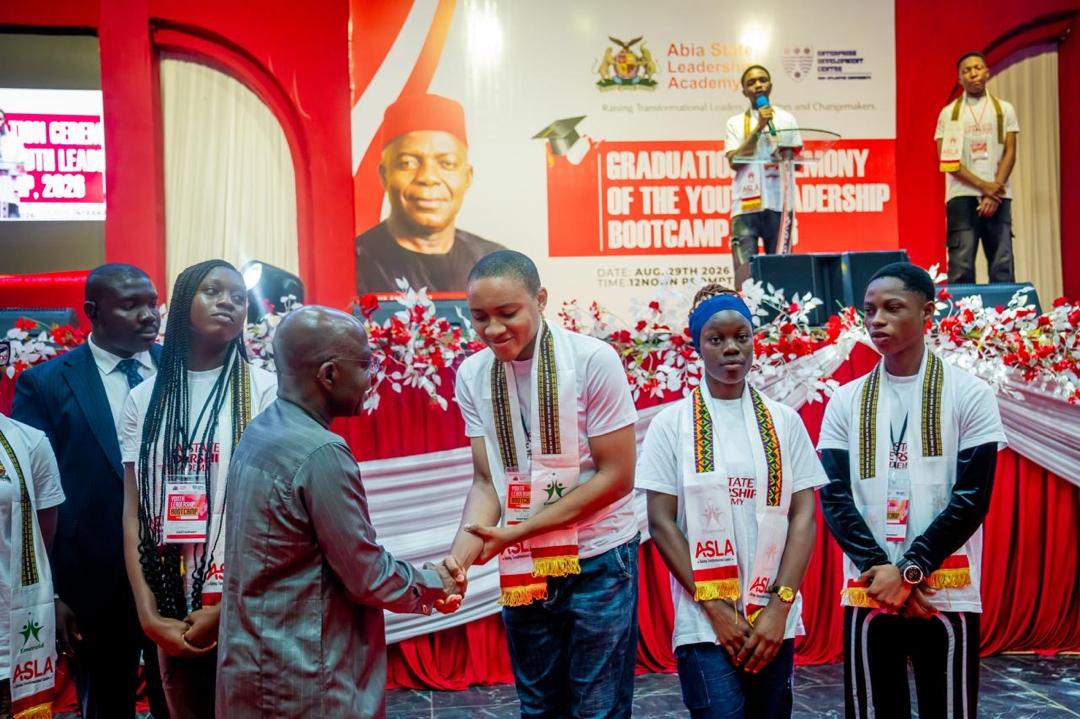
The Governor gave the charge on Saturday, August 29, 2026, while speaking at the graduation ceremony of the 2026 Abia State Leadership Academy Youth Leadership Boot Camp,held at International Conference Centre Umuahia organised by the Abia State Leadership Academy in collaboration with the Enterprise Development Centre of Pan-Atlantic University, Lagos.
Governor Otti, whose speech was titled “The Leadership Vocation,” congratulated the 1,086 graduates of the Abia State Leadership Academy Boot Camp.
Gov. Otti reminded them that they were not returning home as ordinary citizens, and invited them to become active participants in the New Abia. He commended the quality of training delivered, noting that the programme was designed to inspire participants to pursue meaningful impact.
“The process was as seamless as it was transparent, and today, we can see evidence that, in line with our philosophy of merit, only the best performers were chosen to be part of this class,” the Governor said.
Governor Otti commended the President of the Academy, Professor Kenneth Kalu, and his team for their dedication, as well as the Enterprise Development Centre of Pan-Atlantic University, led by its Director, Dr. Nneka Okekaru, for their commitment to the successful delivery of the four-week programme.
The State Chief Executive also appreciated the Nigerian Council of Registered Insurance Brokers, the management of Government College Umuahia, and the Nigerian Naval College of Accounts and Finance for their partnership and support. He thanked parents for entrusting their children to the government for the programme.
The Governor noted that about 10 percent of the participants were young people of Abia origin living in different parts of the country, describing this as evidence that the administration’s inclusive policy of identifying anyone who lives in Abia as an Abian is yielding results.
The Governor particularly acknowledged one of the outstanding participants, Ms. Rosely Farida Abdusalam, who lives in Aba with her parents, saying her success demonstrated that the policy of “if you live in Abia, you are from Abia” is working.
Addressing the graduating class, Governor Otti urged them to understand that their graduation marks the beginning of a greater responsibility, rather than the end of their leadership journey.
“You are not going home as regular people anymore. You now belong to a special community of young minds with a responsibility to act with distinction and carry the light of excellence into your communities, schools, and wherever the future takes you,” Gov. Otti said.
Gov. Otti charged them to establish mentoring clusters, share the knowledge acquired at the academy, and mobilise their peers to become active partners in building the New Abia.
The Governor described the New Abia project as a transgenerational journey requiring patience, resilience, teamwork and commitment, and urged the graduates not to remain passive citizens.
The Governor stated that they would, in the future, occupy positions of influence and must therefore begin now to bridge the gap between the aspirations of the State’s founding generation and present realities.
“After your stay at the academy, you can no longer be passive citizens. You are invited to remove the cloak of lethargy and embrace without hesitation the responsibility of selfless service,” The Governor charged.
Governor Otti assured the graduates that the State Government would continue to support and monitor their growth, and directed the Academy to maintain a directory of participants and track their progress.
Gov. Otti expressed particular interest in seeing the ideas developed during their capstone presentations translated into practical solutions. “We are far more interested in seeing them come to fruition,” the Governor said. He described the graduates as “bearers of solutions, drivers of innovation, and agents of transformation,” and encouraged them to approach the government whenever they require assistance to actualise their ventures.
The Governor urged the graduates to remain steadfast in the face of opposition and challenges, stressing that their choices would determine the kind of future they help to build. “It is either you are voting for a prosperous future through your daily choices or you are undermining it by refusing to stand for your conviction,”
The Governor expressed confidence in the young leaders and called on them to make a difference in their communities, adding that their achievements would be the best way to justify the confidence reposed in them by the State.
Governor Otti also thanked the graduates for being good ambassadors of Abia State and their families, and directed the Academy to sustain the leadership development programme.
Speaking, the Chairman of the Abia State Civil Service Commission, Pastor Dr. Eno Jerry Eze said the Abia State Leadership Academy graduated 1,086 young people from its 2026 Youth Leadership Boot Camp, with a charge to become transformational leaders, innovators and change makers who will contribute meaningfully to the development of the State and the nation.
She noted that the 1,086 graduates were selected from more than 7,000 applicants, describing their selection as a testament to their potential and commitment to leadership.
According to her, the theme of the 2026 boot camp, “Raising Transformational Leaders, Innovators and Change-Makers,” reflects the vision of the Abia State Government under Governor Alex Otti to invest not only in physical infrastructure but also in the State’s most important asset – its young people.
“Under the leadership of His Excellency, Dr. Alex Otti, OFR, we are investing not just in roads, schools, climate-friendly transportation, agriculture, small and medium-sized enterprises and hospitals. We are also investing in our greatest assets, our young people,” she stated.
She explained that the theme was a call to participants to lead with integrity in their schools and communities, think creatively, develop solutions to problems around them, and take responsibility rather than waiting for others to act.
She said faculty members went beyond conventional lectures by exposing participants to real-life scenarios and encouraging them to think critically, understand the peculiarities of different situations, appreciate diverse perspectives and develop practical solutions.
“Through these sessions, you gained new perspectives on problem-solving techniques, learned to think more deeply, understand the peculiarities of each situation, and listened to different views across the table,” she stated.
She expressed appreciation to Governor Alex Otti for his commitment to empowering young people and commended the Abia State Leadership Academy for delivering what she described as a world-class programme.
Earlier, the Abia State Leadership Academy President, Prof. Kenneth Kalu, commended Governor Alex C. Otti for establishing the institution as a deliberate investment in the future of Abia State.
Prof. Kalu said the Academy was established because Governor Otti dared to ask a fundamental question: what if government invested not only in what Abia has today, but also in who Abia will become tomorrow.
According to him, the Governor could have chosen to concentrate exclusively on visible infrastructure such as roads, buildings and hospitals, which generate immediate public appreciation, but instead decided to invest in something that cannot be photographed – the minds, character and civic consciousness of young Abians.
“Roads, buildings and other structures are important, and Your Excellency is already doing a lot in those sectors. But a generation shaped by values, a generation taught to live with integrity, serve with compassion and build with purpose, that generation will outlast every structure one can ever erect,” he said.
The Academy President, on behalf of the faculty, staff and students, thanked the Governor for his support and vision, describing the establishment of the Academy as an investment whose impact would extend across generations.
“Thank you for planting a forest of leadership whose shade will shelter Abia for generations. History will remember this day that you came, you saw and you changed humanity for good,” he said.
Prof. Kalu urged the graduates to return to their communities and make a difference, stressing that they should take the values acquired during the programme into their schools, families and wider communities.
“Go back to your communities and lead. Go back to your schools and solve. Go back to your families and model the values you have learned during your time at the Academy,” he charged.
He further encouraged the young leaders to remain steadfast in the face of pressure and temptation, urging them to remember the values of the Academy whenever they were confronted with situations that could compromise their integrity.
“When you are tempted to compromise, as you will be tempted, please remember this day. When the path of integrity feels lonely, please remember the Academy,” he said.

2027 : PDP Candidate re-connects Zanchita community with National grid after two years of darkness
By Uthman Baba-Naseer,Minna It was a celebration galore in Zanchita community in gbako local government area of Niger State,as former...


Insecurity ,displacement alters distribution of Christian communities in Niger state to 3,417,636
By Uthman Baba -Naseer,Minna Niger state Christian leaders have disclosed that out of the Seven million, four hundred and seventy...


Death of 37 suspected illegal Miners:11 member of Judicial commission of inquiry set for inauguration on Tuesday by govrrnor Bago
BY UTHMAN BABA-NASEER,MINNA Sequel to the constitution of the Judicial commission of inquiry by the governor Mohammed Umar Bago, to...

Thanksgiving Service Heralds Bayelsa 30th Anniversary Celebration
By Dabid Owei Bayelsa State Government on Sunday held an inter-denominational thanksgiving service to kick-start activities marking the 30th anniversary...


Former Speaker challenges substition of his name with Suleiman as winner of APC primary election at Minna Fed.High Court
By Uthman Baba-Naseer,Minna The Former Speaker of the Niger State House of Assembly,Rt Hon. Adamu Usman,has filed a lawsuit before...


SWAN President to Storm Bayelsa for 30th Anniversary Celebration, Igali Confirms*
By David Owei The President of the Sports Writers Association of Nigeria (SWAN), Benjamin Isaiah, has been confirmed among dignitaries...


Panic Grips Delta Residents as Deputy Director Dies After Alleged Assault
By Our Correspondent There is palpable tension among Delta residents following an alleged death of a deputy Director in Asaba,...

SPC 2026 Annual Wkshop: Journalists Deliberate on Legislative Oversight, Budget Integrity,Media Collaboration
By Our Correspondent The 2026 Capacity-Building Workshop of the Senate Press Corps will focus on strengthening legislative oversight and media...


The Day the Church ‘Blessed’ the Media
By Emmanuel Nnadozie Onwubiko For a media practitioner and a Catholic, Thursday, September 24, 2026, will remain a remarkable day....

As ‘Ọsọ Marwa’ Sweeps Across Nigeria’s Forests
By Emmanuel Nnadozie Onwubiko Today’s reflection is on a new and increasingly significant battlefront opened by the National Drug Law...
-

 Politics1 year ago
Gov Okpebholo moves to end Cultism *Threatens action against leading cult groups *Vows to demolish more cult houses in Edo State
-
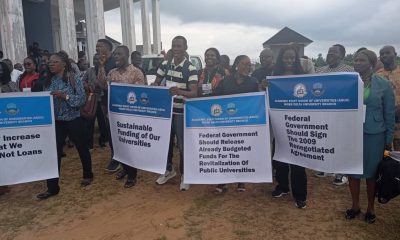
 Politics1 year ago
ASUU-NDU protest against FG loans, unpaid salaries,Non-Implementation of agreements …..says loans is generational slavery
-

 Business & Economy1 year ago
PC-NCG Issues Disclaimer on Purported Nigerian Coast Guard National Orientation Exercise In Anambra State
-
 Entertainment2 years ago
Jubilation galore as Parishioners of CKC Kurudu celebrate their cultural heritage ….FG should exploit our Cultural heritage to unite Nigerians-Rev Fr Dim
-

 Sports7 months ago
Bayelsa-born ex-football star’s son, Opuama donates spike shoes to Athletics Association
-

 General News2 years ago
Reps hold public hearing on FMC Ugwuaji Awkunanaw
-

 Law & Crime1 year ago
Legal practitioner raises alarm over threat to his life by CSP Muhammed Abdulkareem
-

 General News2 years ago
Celebration galore as UDA Successfully Elected New Exco ……I will digitalize processes that will raise UDA to greater height -Comr. Okejiri