
General News
Celebration galore as St Vincent de Paul CKC Kurudu marks 20th year Anniversary ….Embarks on Empowerment Outreach …..Gives out grinding/ sewing machines, hairdressing kits, others


By Jerry Okafor
It was a day of joy, thanksgiving, and impactful giving as the Society of St Vincent de Paul (SSVP), Christ the King Catholic Church (CKC) Kurudu Conference, celebrated its 20th anniversary on Sunday, at the St John of the Cross Hall, within the church compound in Kurudu, Abuja.

Grinding machines,sewing machines etc
The event began with a solemn Holy Mass presided over by the Parish Priest, Very Rev. Fr. Thaddeus Chike Dim OCD, at the church auditorium. In his homily, Fr. Dim commended the Society for two decades of dedicated service to the poor and less privileged, describing their works as “a true reflection of Christian charity and compassion.”
He admonished the beneficiaries of the empowerment scheme to make effective use of the items received “for their personal growth and for the good of the Society,” urging parishioners to continue supporting the SSVP’s mission of love and service.
As part of the anniversary celebration, several individuals identified as “masters” by the lay Vincentians were empowered with items such as grinding machines, sewing machines, hairdressing kits, and start-up capital for small businesses.
In addition, students from indigent families received sponsorship for their WAEC examination fees, a gesture that brought visible joy to both parents and beneficiaries.
In his goodwill message, the Acting President of the Abuja Central Council, Mr. Chika Paul Muobuike, expressed appreciation to the parish priest and the entire CKC Kurudu community for their consistent support for Vincentian activities.
He lauded the CKC Kurudu Conference for sustaining the spirit of service and prayed for continued growth and divine blessings upon its members.
The Guest Speaker, Rev. Fr. Johncross Ozor OCD, the parish’s Associate Priest, delivered an inspiring address centered on “Empowerment as a Tool for Sustainable Charity.”
He emphasized that empowering the poor is more impactful than offering temporary relief. “When we empower, we make people self-reliant and restore their dignity. Giving must go beyond bread that perishes to support that transforms lives,” he stated.
The clergyman further encouraged benefactors and benefactresses to continue giving with love, respect, and compassion, affirming that “every act of giving honours the image of Christ in the poor.”
The celebration also featured awards of recognition to benefactors, benefactresses, and outstanding members who have supported the Society’s mission over the years.
In her remarks, the Conference President, Sis. Evelyn Ataguba, expressed profound gratitude to God for the growth of the Society and appreciated the parish leadership and anniversary planning committee for their commitment.
Similarly, the Anniversary Committee Chairperson, Sis. Joy Anozie, gave the vote of thanks, appreciating all guests, donors, and members who contributed to the success of the event.
Founded in 2005, when Christ the King Catholic Church Kurudu was still an outstation under St. Patrick’s Parish, Karshi, the CKC Kurudu Centre was elevated to a Conference on July 19, 2015, following the creation of CKC Kurudu Parish in 2009. Over the years, it has become a beacon of hope, serving the needy and promoting Christian love and solidarity within and beyond the parish.
The anniversary celebration ended with light entertainment, group photographs, and a renewed commitment by members to continue “serving Christ in the poor.”








By Mohammed Mohammed, Gombe
The National Universities Commission (NUC) has approved 17 postgraduate programmes for North-Eastern University, Gombe, paving the way for the institution to commence postgraduate studies across 12 academic disciplines from the 2026/2027 academic session.
The approval, conveyed in a letter dated October 22, 2026, followed a resource verification exercise conducted by the commission to assess the university’s academic manpower, infrastructure and other facilities required for the effective delivery of the programmes.
The newly approved programmes comprise 11 Master of Science (M.Sc.) degrees, three Postgraduate Diplomas (PGD), one Master of Business Administration (MBA), one Master of Public Administration (MPA) and one Master of Laws (LL.M.).
The M.Sc. programmes cover Accounting, Business Administration, Public Administration, Public Health, Architecture, Mass Communication, Computer Science, Environmental Chemistry, Organic Chemistry, International Relations and Economics.
Others are PGD programmes in Business Administration, Public Administration and Mass Communication, alongside MBA, MPA and LL.M. in Common Law.
In a statement, the university’s Public Relations Officer, Mukhtar Sani Saulawa, said all the programmes would be offered at the institution’s main campus in Gombe.
He described the NUC approval as a major milestone in the university’s growth, noting that the introduction of postgraduate programmes would strengthen advanced learning, research and human capital development.
According to him, the development underscores the university’s commitment to academic excellence and its determination to expand access to higher education.
Saulawa also announced that admission into the newly approved programmes would commence on December 7, 2026, urging interested applicants to visit the university’s official website for details of admission requirements and application procedures.
The introduction of the programmes is expected to provide more opportunities for graduates in Gombe State and the wider North-East to pursue postgraduate qualifications without necessarily travelling outside the region.
It is also expected to enhance the university’s contribution to research, professional development and the production of skilled manpower needed for the region’s socio-economic development.

By Tony Okafor
in bid to avoid building callapse in the state Ebonyi State Government has issued a 30-day ultimatum to occupants of a structurally defective building located at No.10 Aguluezechukwu Street, Abakaliki, directing them to vacate the premises over concerns about its safety.
The directive was issued by the Ministry of Capital City and Urban Planning following an on-site inspection led by the Commissioner, Richard Ugo Idike, alongside the Head of the Town Planning Department, Esther Nwite, other town planning officials and members of the ministry’s enforcement taskforce.
During the inspection, Idike expressed concern over visible structural defects and substandard construction, describing the building as a potential threat to human lives and property.
He said the state government would not compromise on public safety, stressing that all buildings across the state must comply with approved building codes and regulatory standards.
According to him, the 30-day notice is intended to give the property owner an opportunity to undertake necessary structural remediation while allowing occupants sufficient time to secure alternative accommodation.
Idike warned that the notice was necessary to prevent a possible building collapse and urged occupants to vacate the premises before the expiration of the deadline.
He further disclosed that the ministry would intensify monitoring and enforcement activities across Abakaliki to identify unsafe structures and ensure compliance with building regulations.
The commissioner said the exercise was part of the state government’s urban renewal and public safety initiatives under Governor Francis Ogbonna Nwifuru’s administration.
The ministry’s taskforce also urged property owners, developers and builders to obtain necessary approvals, engage qualified professionals and use standard construction materials to prevent structural failures.
Occupants of the affected building are expected to comply with the directive within the stipulated 30-day period.
General News
HURIWA Condemns Multiple Toll Gates on Keffi–Lafia–Makurdi Highway, Demands Immediate Suspension

By George Mgbeleke
The Human Rights Writers Association of Nigeria (HURIWA) strongly condemns the Federal Government’s imposition of multiple toll gates on the Keffi–Lafia–Makurdi highway, describing the policy as an unjust financial burden on already impoverished citizens, commercial transport operators, traders and businesses across Nasarawa and Benue states.
HURIWA considers the tolling arrangement particularly insensitive at a time when Nigerians are struggling with rising transportation costs, high food prices, declining purchasing power and an increasingly unbearable cost of living. Rather than easing the burden on citizens who depend on this critical economic corridor, the Federal Government has introduced a system that forces motorists to pay repeatedly for using the same highway.
In a statement signed by national Coordinator,Comrade Emmanuel Nnadozie Onwubiko,the association demands the immediate suspension of toll collection along the corridor pending a comprehensive review of the policy, the condition of the road, the number of toll plazas, the payment arrangements and the transparency of the revenue management system.
FOUR TOLL GATES ON ONE CORRIDOR: AN UNNECESSARY BURDEN
The Federal Government commenced toll operations on February 4, 2025, along the 227.2-kilometre Abuja–Keffi–Akwanga–Lafia–Makurdi highway. The tolling arrangement covers four principal locations: Keffi, including Garaku, Akwanga, Lafia and Makurdi.
Under the published fee structure, saloon cars pay N500 at each toll point, SUVs and jeeps pay N800, minibuses and light buses pay N1,000, while trucks, buses and multi-axle vehicles pay N1,600. Although certain categories of vehicles enjoy exemptions or discounts, the cumulative cost remains a major concern for ordinary motorists and commercial operators.
A saloon car travelling through all four toll points could pay N2,000 for a one-way journey and N4,000 for a return trip, assuming payment is required at every plaza in both directions. For heavier vehicles, the financial burden is considerably higher.
These are not insignificant amounts in an economy where commercial drivers must contend with fuel costs, vehicle maintenance, spare parts, levies and other operational expenses. The consequences are eventually transferred to passengers and consumers through higher transport fares and increased prices of goods.
HURIWA questions the rationale for subjecting road users to four separate toll collections along a single highway, particularly when motorists have not been provided with sufficient evidence that the arrangement offers value commensurate with the charges imposed.
A ROAD THAT DEVELOPED DEFECTS BEFORE TOLL COLLECTION
Even more troubling are concerns about the quality and durability of the highway itself.
Reports and complaints from road users indicate that sections of the road began showing signs of deterioration, including peeling surfaces, before toll collection commenced. There have also been complaints about poorly constructed culverts and drainage structures at several locations, with some reportedly failing during the road’s first year of use and leaving sections impassable for weeks.
If these concerns are substantiated, they raise serious questions about construction quality, supervision, contractual compliance and the adequacy of maintenance arrangements.
HURIWA insists that Nigerians should not be compelled to pay premium charges for infrastructure whose durability and maintenance standards remain questionable. A tolling regime must not become a mechanism for collecting money from citizens while fundamental defects in the infrastructure remain unresolved.
The Federal Government and the relevant project authorities must publish verifiable information on the road’s construction standards, defect-liability arrangements, maintenance obligations and the measures taken to address reported failures.
The public deserves answers about who is responsible for repairing defective sections and whether the cost of correcting construction deficiencies is being improperly shifted to road users.
CASHLESS TOLLING WITHOUT ADEQUATE FACILITATION
HURIWA is also concerned about the implementation of the cashless tolling system, which reportedly relies on point-of-sale terminals, ATM cards and preloaded electronic cards, with a minimum preloaded value of N10,000.
A cashless payment system may have administrative advantages, but it must not be implemented in a manner that creates avoidable hardship, long queues and severe traffic congestion.
Motorists have complained about delays arising from payment difficulties, inadequate access to the required payment instruments and the burden of making multiple payments at separate toll points. Legislative concerns, including calls for a unified payment arrangement, cash alternatives or temporary suspension pending the resolution of operational problems, have also emerged.
HURIWA is disturbed that these concerns have not resulted in a satisfactory and publicly demonstrated resolution.
A government that introduces a new revenue-generating arrangement has a responsibility to ensure that the system works efficiently before imposing it on millions of road users. Citizens should not lose productive hours in traffic because the authorities failed to anticipate predictable operational challenges.
The association therefore calls for a transparent, integrated payment system that eliminates unnecessary repeated transactions, provides accessible alternatives for motorists and prevents toll plazas from becoming permanent bottlenecks.
A STRATEGIC FOOD CORRIDOR MUST NOT BECOME A TAX TRAP
The Keffi–Lafia–Makurdi highway is more than a transport route. It is a strategic economic corridor connecting communities, markets, farms and distribution centres across Nasarawa and Benue states, two important food-producing states in North-Central Nigeria.
Farmers, agricultural traders, transporters and wholesalers depend on this route to move food and other essential commodities to markets across the country.
Any policy that increases the cost of moving agricultural produce along this corridor threatens the sustainability of businesses and places additional pressure on food prices. The consequences are not limited to motorists in Nasarawa and Benue; they extend to households across Nigeria that depend on produce transported through the region.
HURIWA is particularly concerned that repeated toll payments, alongside existing taxes, levies and other operating costs, could undermine small businesses, reduce commercial transport margins and weaken the livelihoods of traders and transport workers.
The association maintains that infrastructure policy must support economic productivity rather than impose additional obstacles on the movement of food and essential goods.
The Federal Government must explain why a corridor of such national importance requires multiple toll points instead of a more efficient, transparent and affordable arrangement that recognises the economic realities of the communities and businesses that depend on it.
CITIZENS MUST NOT BE MADE TO PAY REPEATEDLY WITHOUT ACCOUNTABILITY
The Federal Government has defended the tolling arrangement as part of a public-private partnership framework intended to support road maintenance and recover financing obligations associated with the project, including a China Exim Bank loan.
HURIWA recognises that major road infrastructure requires sustainable financing and regular maintenance. However, the existence of a financing obligation does not automatically justify every tolling arrangement or excuse the government from its duty to protect citizens from disproportionate financial burdens.
Where public infrastructure is tolled, the authorities must demonstrate that the charges are reasonable, the collection system is efficient, the road meets acceptable standards and the proceeds are managed transparently.
HURIWA therefore demands full disclosure of the concession or tolling agreement, the approved revenue-sharing framework, the applicable maintenance obligations and the mechanisms for auditing collections and expenditure.
The government must also explain how the tolling arrangement accounts for the road’s reported defects and what safeguards prevent motorists from paying repeatedly without corresponding improvements in road quality and service delivery.
Citizens must not be left to shoulder the burden of public borrowing, questionable construction outcomes and inefficient toll administration without access to information or meaningful avenues for redress.
OUR DEMANDS
In the interest of public welfare, economic justice and accountability, HURIWA calls on the Federal Government and the Federal Ministry of Works to:
Immediately suspend toll collection along the Keffi–Akwanga–Lafia–Makurdi corridor pending an independent review of the policy and its implementation.
Review the number and distribution of toll plazas, with a view to eliminating unnecessary multiple payments along the same highway and adopting a fairer, more affordable collection structure.
Publish the relevant concession, financing and tolling agreements, including the obligations of the concessionaire, revenue-sharing arrangements and the responsibilities of the government and contractors.
Commission an independent technical audit of the highway, focusing on reported pavement deterioration, defective culverts, drainage failures and other construction or maintenance concerns.
Resolve traffic congestion and payment difficulties by providing an efficient, integrated payment platform and accessible alternatives for motorists who cannot use electronic payment methods.
Engage transport unions, traders, farmers, affected communities and state legislatures before taking further decisions on tolling arrangements that directly affect livelihoods and the cost of essential commodities.
Establish a transparent toll-revenue accountability mechanism that allows the public to understand how much is collected, how the money is spent and what improvements road users can expect in return.
GOVERNMENT MUST CHOOSE PUBLIC WELFARE OVER REVENUE COLLECTION
HURIWA warns that public infrastructure should never become an instrument for deepening poverty or punishing citizens for using an essential transport corridor.
The Federal Government cannot celebrate the construction or rehabilitation of a major highway while ignoring legitimate complaints about its condition, the cost of accessing it and the hardship created by the collection system.
The people of Nasarawa and Benue states deserve particular consideration because their farms, markets, businesses and transport networks contribute to the nation’s food supply and wider economic activity. Their strategic contribution should attract policies that facilitate commerce and reduce logistical costs, not arrangements that multiply financial pressure on already struggling households and enterprises.
HURIWA is not opposed to responsible infrastructure financing. It is opposed to tolling policies that lack sufficient transparency, impose disproportionate cumulative charges and fail to address credible complaints about road quality and operational efficiency.
We therefore call on President Bola Ahmed Tinubu to direct an urgent review of the tolling regime and suspend collections until the concerns of motorists, commercial operators and affected communities have been satisfactorily addressed.
The Federal Government must demonstrate that the public interest comes before revenue collection. Until it does so, the multiple toll gates on the Keffi–Lafia–Makurdi highway will remain a troubling symbol of a policy that places the financial burden of infrastructure on citizens without adequately demonstrating fairness, efficiency and accountability.

Lifu Judgement : ADC Guber Candidates Forum Seeks Int. Community’s Intervention
By Grorge Abuja As the awaits the outcome of Justice Peter Lifu’s judgment invalidating Sen. David Mark led leadership of...


UNN Confirms Death of Four Graduates at An Off-Campus Party
By John Nwafor The management of the University of Nigeria, Nsukka (UNN), has declared a three-day mourning period following the...

Niger Police Assures FUT Minna of Enhanced Security
BY UTHMAN BABA-NASEER,MINNA The Niger State Police Command has assured the management of the Federal University of Technology (FUT), Minna,...

Fubaa: Rivers Caoable of deliverying znassive Votes fir Tinubu,Chinda, Others Charges APC, Rainbow Coalition to embrace team work
By George Mgbeleke Governor of Rivers State, Sir Siminalayi Fubara, has declared that the State is capable of delivering massive...


Suspected cultists kill rival member in Bayelsa, hid his mutilated corpse in a sack
By David Owei,Bayelsa There was a sense of horror in Yenagoa, the Bayelsà following the suspected cultists killing of a...


HURIWA Condemns Detention of FIJ Journalist, Calls on Tinubu to Protect Press Freedom
By George Mgbeleke Association seeks Daniel Ojukwu’s release on bail, urges police to focus on insecurity and calls for safeguards...

2027: Where Are the Trillions? Tinubu’s Loans,FAAC Windfall and Nigeria’s Economic Reality
By Abdullateef Bamgbose As the 2027 presidential campaign gathers momentum, political discourse appears to be drifting towards personality attacks, name-calling...


HURIWA Demands Probe on Alleged N4m Medical Admission Racket in UNN,UNIZIK – Wants NUC, JAMB, Education Ministers to explain silence; -Urges ICPC to Investigate Allegation
By George Mgbeleke The Human Rights Writers Association of Nigeria (HURIWA) has raised the alarm over disturbing allegations of an...
APC Repackages 2023 Promises in New 2027 Manifestor-ADC — Says manifesto reads like that of a new party.
By Our Correspondent The African Democratic Congress (ADC) has described the newly released 2027 manifesto of President Bola Ahmed Tinubu...


ABER Congratulates Safari Gateway Ltd On Winning Best Safari Tour Operator World Tours Operator At World Tourism Awarld 2026
By David Owei,Bzylse Just as the World Tourism Forum Institute (WTFI) concluded it’s World Tourism Awards 2026 in Brussels under...
-

 Politics2 years ago
Gov Okpebholo moves to end Cultism *Threatens action against leading cult groups *Vows to demolish more cult houses in Edo State
-
 Politics1 year ago
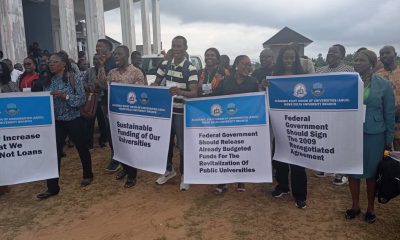
ASUU-NDU protest against FG loans, unpaid salaries,Non-Implementation of agreements …..says loans is generational slavery
-

 Business & Economy1 year ago
PC-NCG Issues Disclaimer on Purported Nigerian Coast Guard National Orientation Exercise In Anambra State
-
 Entertainment2 years ago
Jubilation galore as Parishioners of CKC Kurudu celebrate their cultural heritage ….FG should exploit our Cultural heritage to unite Nigerians-Rev Fr Dim
-

 Sports9 months ago
Bayelsa-born ex-football star’s son, Opuama donates spike shoes to Athletics Association
-

 General News2 years ago
Reps hold public hearing on FMC Ugwuaji Awkunanaw
-

 Law & Crime1 year ago
Legal practitioner raises alarm over threat to his life by CSP Muhammed Abdulkareem
-
 General News2 years ago
Celebration galore as UDA Successfully Elected New Exco ……I will digitalize processes that will raise UDA to greater height -Comr. Okejiri